The worksheet
About this worksheet
Students learn to write repeated multiplication as powers and find the value. They build squares and cubes, then use order of operations with powers. This Grade 6 Math worksheet gives students (ages 11–12) five pages of practice on whole-number exponents, part of the expressions and equations unit. It goes with our free Whole-number exponents lesson, which has the slides and a timed lesson plan.
What it covers
By the end, students should be able to:
- Students will write repeated multiplication as powers using base and exponent.
- Students will evaluate whole-number powers with small exponents by multiplying in steps.
- Students will evaluate numerical expressions with powers using order of operations.
How to use it
- Main activity (20 minutes): Give Worksheet Task B for fluency practice with powers of whole numbers and circulate.
- Practice (10 minutes): Have pairs solve Worksheet Task D using order of operations and exponents.
- Support: Provide expanded form first and use tiles so students count factors before multiplying.
- Stretch: Compare 2 to the fourth power and 4 squared to find equal values different ways.
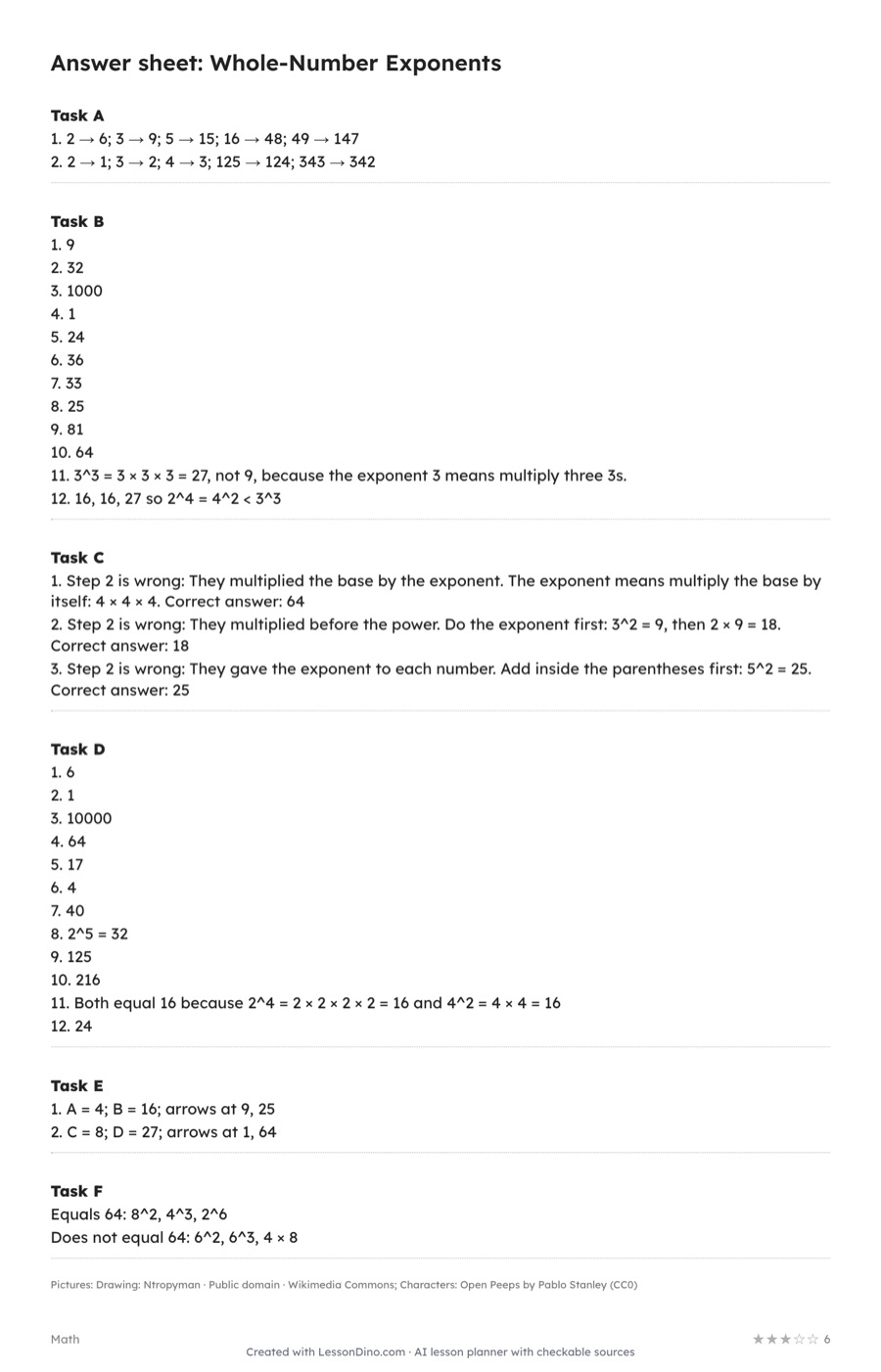
- The answer sheet is the last page, so you can print it on its own or let students check their own work.
Key vocabulary
- base: the big number that gets multiplied again and again
- exponent: the little number that shows how many copies to multiply
- power: the whole short form like 3 to the 4th
- expanded form: the long multiplication written out with x signs
- order of operations: the rules that say to do powers before x and +
Mistakes to watch for
- Writing 3 squared as 3 x 2 instead of 3 x 3. Restate that the exponent shows how many times to multiply the base by itself and rewrite as 3 x 3 = 9.
- Writing 2 cubed as 2 x 3 = 6. Count three 2s in expanded form 2 x 2 x 2, then multiply 4 x 2 = 8.
- Doing addition first, like 2 + 3 squared = 25. Remodel order of operations with whole number exponents: find 3 squared = 9 first, then 2 + 9 = 11.
What's on the worksheet
Powers Make Sense
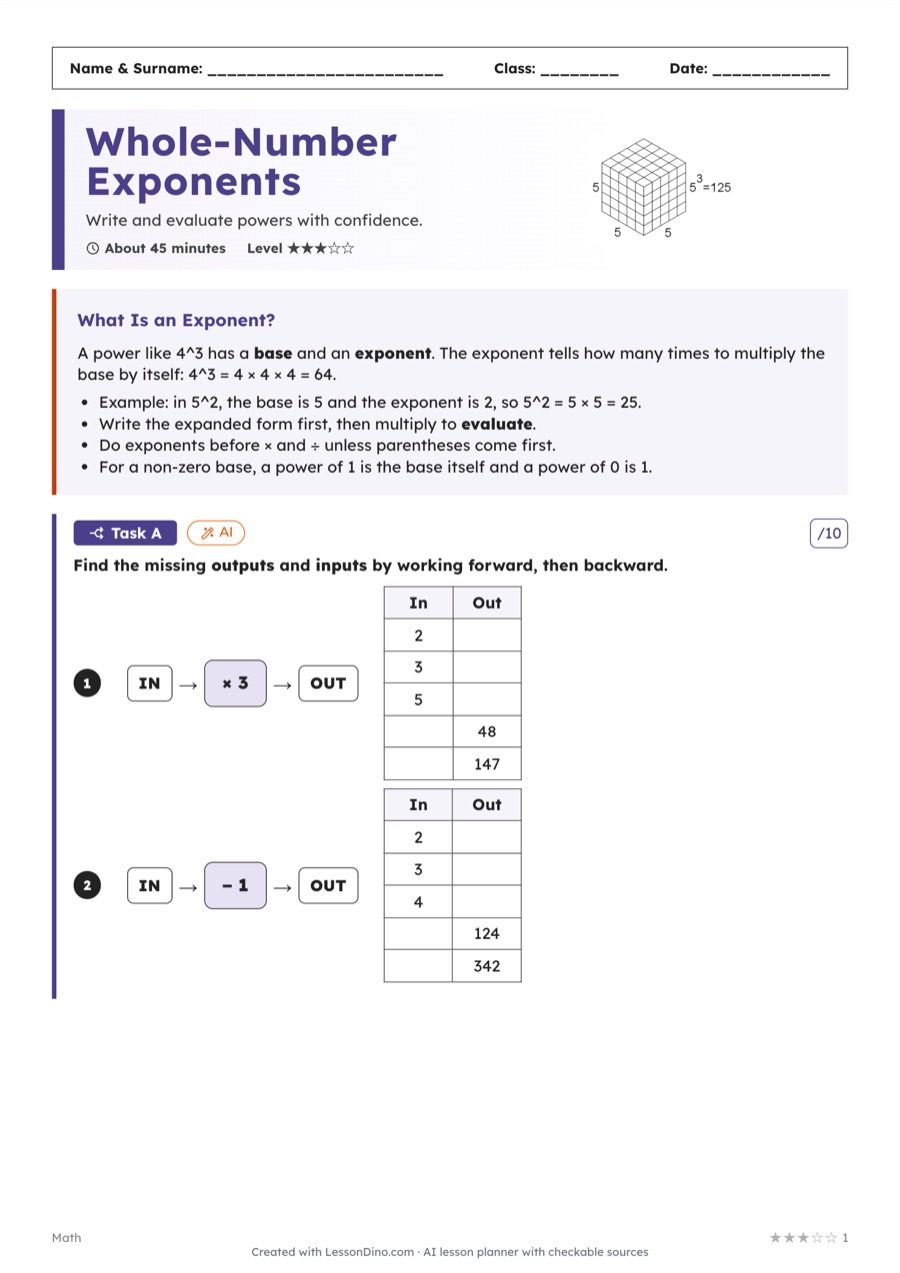
Learn what whole-number exponents mean and try two machines.
What Is an Exponent?
- A power like 4^3 has a base and an exponent. The exponent tells how many times to multiply the base by itself: 4^3 = 4 × 4 × 4 = 64.
- Example: in 5^2, the base is 5 and the exponent is 2, so 5^2 = 5 × 5 = 25.
- Write the expanded form first, then multiply to evaluate.
- Do exponents before × and ÷ unless parentheses come first.
- For a non-zero base, a power of 1 is the base itself and a power of 0 is 1.
Find the missing outputs and inputs by working forward, then backward.
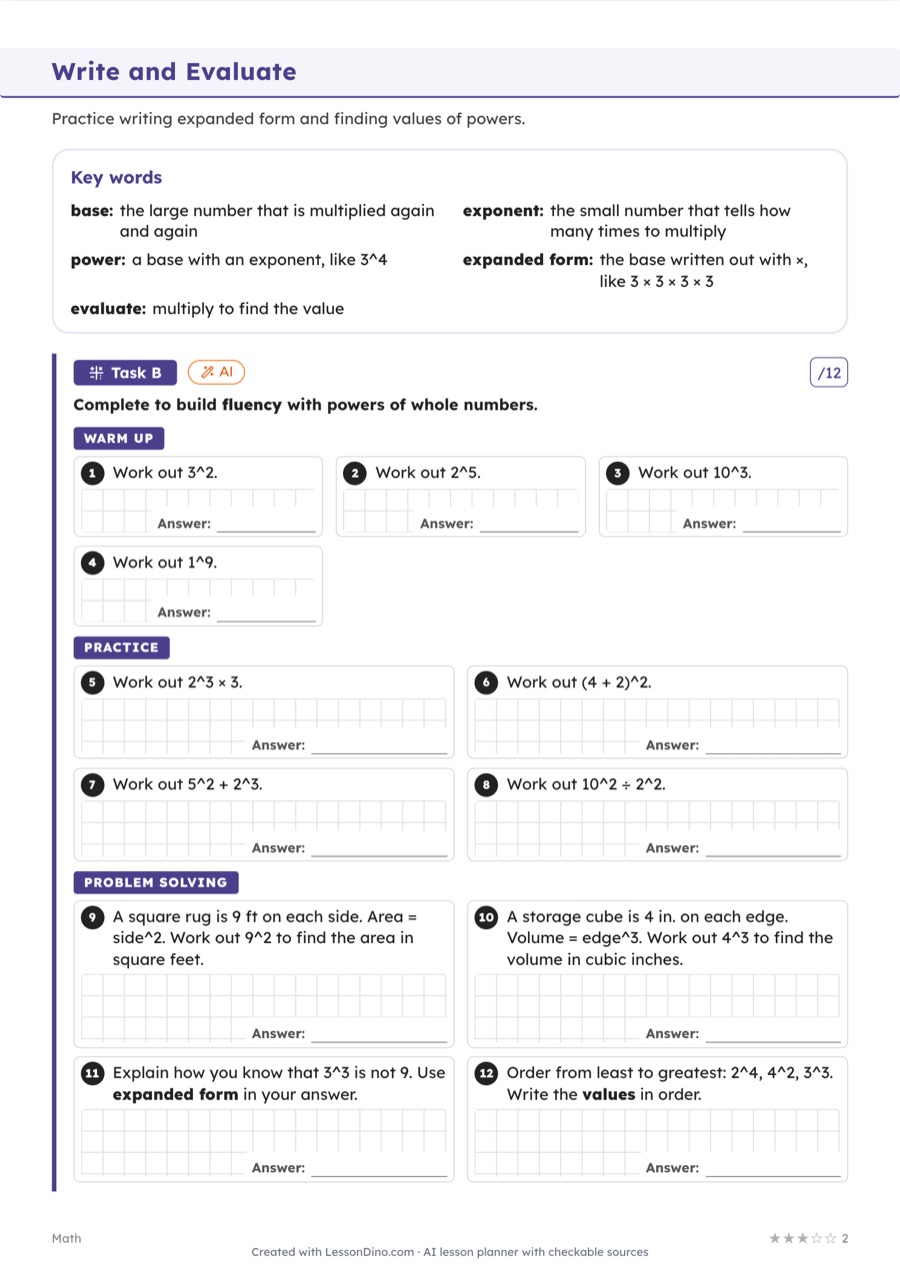
Write and Evaluate
Practice writing expanded form and finding values of powers.
| Word | Meaning |
|---|---|
| base | the large number that is multiplied again and again |
| exponent | the small number that tells how many times to multiply |
| power | a base with an exponent, like 3^4 |
| expanded form | the base written out with ×, like 3 × 3 × 3 × 3 |
| evaluate | multiply to find the value |
Complete to build fluency with powers of whole numbers.
Warm up
- Work out 3^2.
- Work out 2^5.
- Work out 10^3.
- Work out 1^9.
Practice
- Work out 2^3 × 3.
- Work out (4 + 2)^2.
- Work out 5^2 + 2^3.
- Work out 10^2 ÷ 2^2.
Problem solving
- A square rug is 9 ft on each side. Area = side^2. Work out 9^2 to find the area in square feet.
- A storage cube is 4 in. on each edge. Volume = edge^3. Work out 4^3 to find the volume in cubic inches.
- Explain how you know that 3^3 is not 9. Use expanded form in your answer.
- Order from least to greatest: 2^4, 4^2, 3^3. Write the values in order.
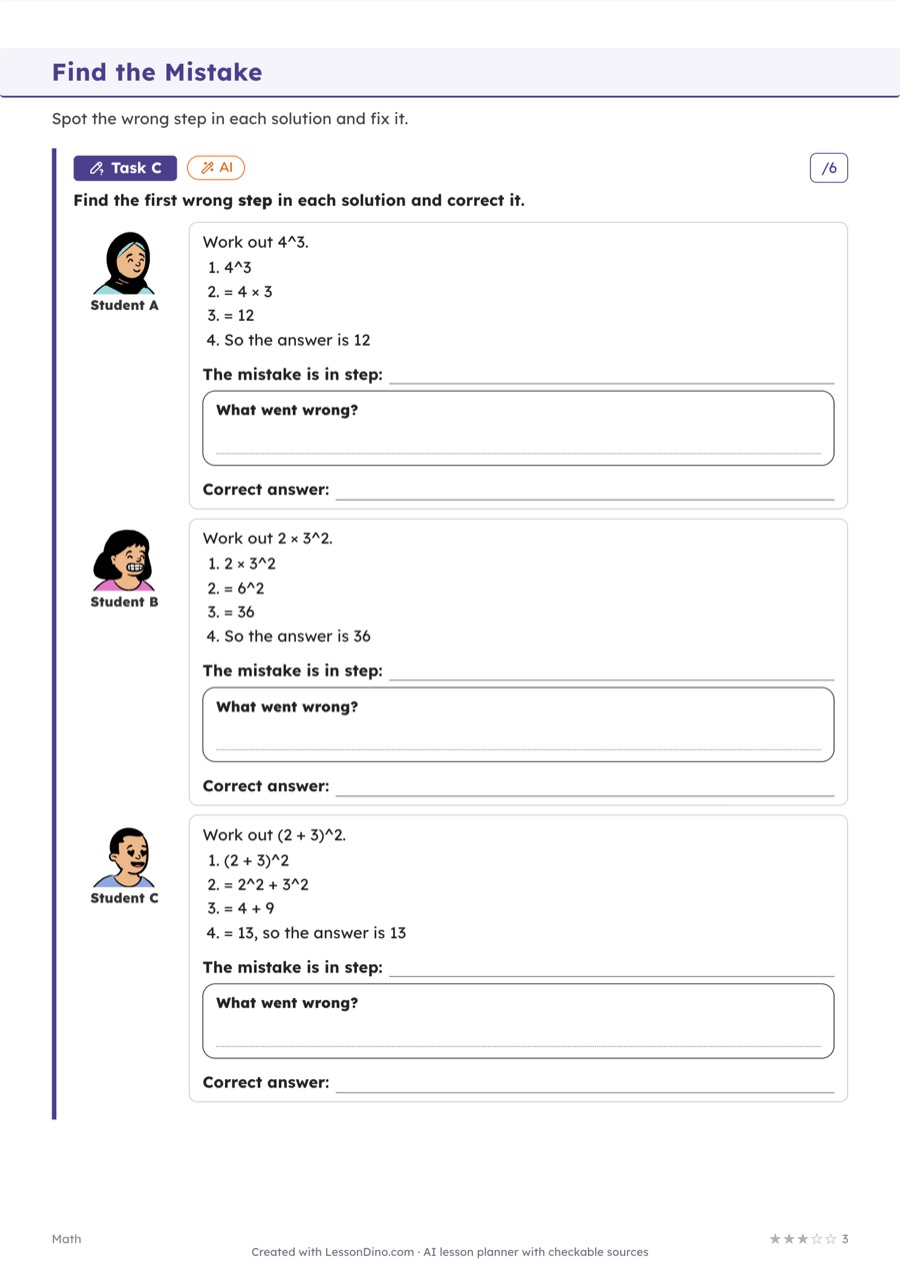
Find the Mistake
Spot the wrong step in each solution and fix it.
Find the first wrong step in each solution and correct it.
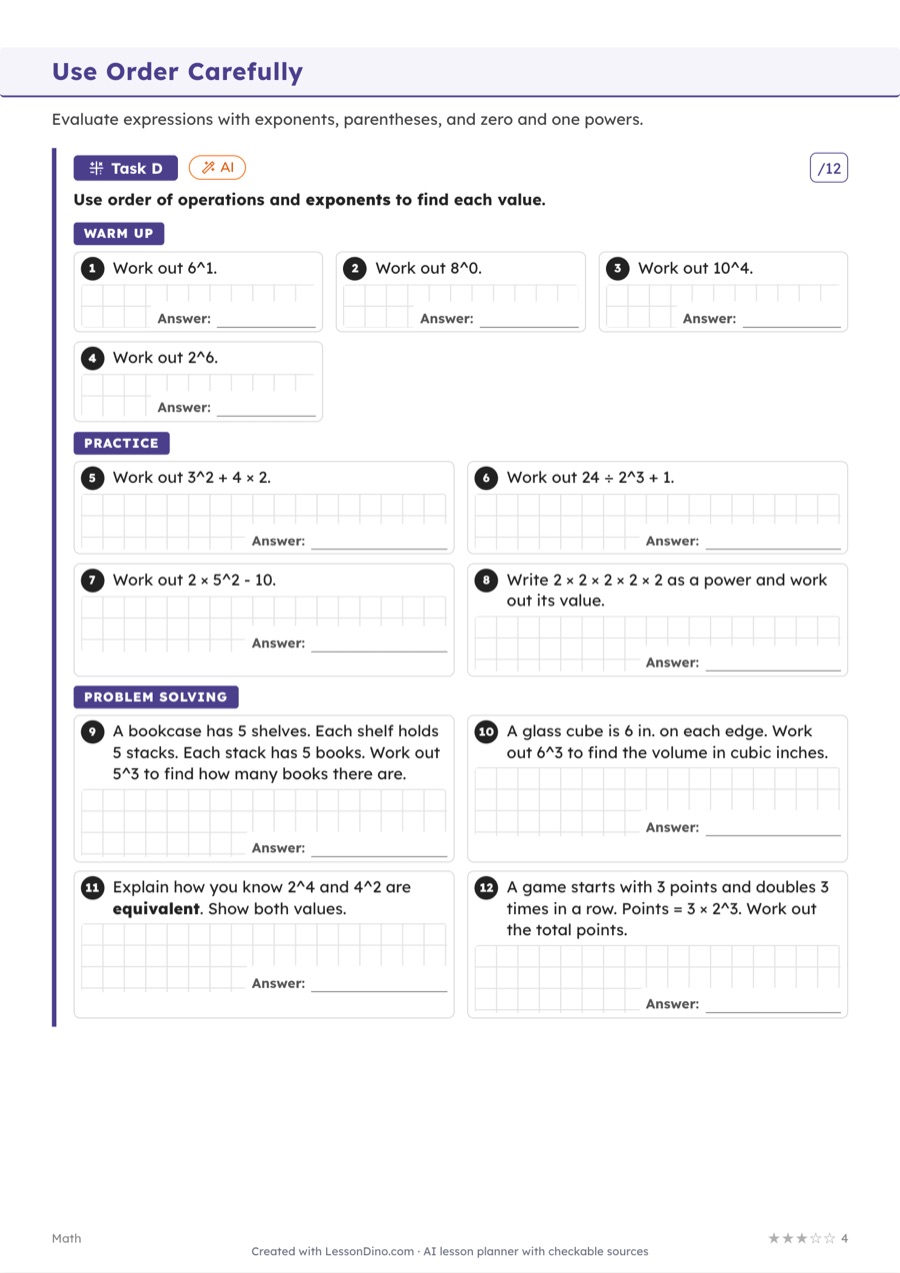
Use Order Carefully
Evaluate expressions with exponents, parentheses, and zero and one powers.
Use order of operations and exponents to find each value.
Warm up
- Work out 6^1.
- Work out 8^0.
- Work out 10^4.
- Work out 2^6.
Practice
- Work out 3^2 + 4 × 2.
- Work out 24 ÷ 2^3 + 1.
- Work out 2 × 5^2 - 10.
- Write 2 × 2 × 2 × 2 × 2 as a power and work out its value.
Problem solving
- A bookcase has 5 shelves. Each shelf holds 5 stacks. Each stack has 5 books. Work out 5^3 to find how many books there are.
- A glass cube is 6 in. on each edge. Work out 6^3 to find the volume in cubic inches.
- Explain how you know 2^4 and 4^2 are equivalent. Show both values.
- A game starts with 3 points and doubles 3 times in a row. Points = 3 × 2^3. Work out the total points.
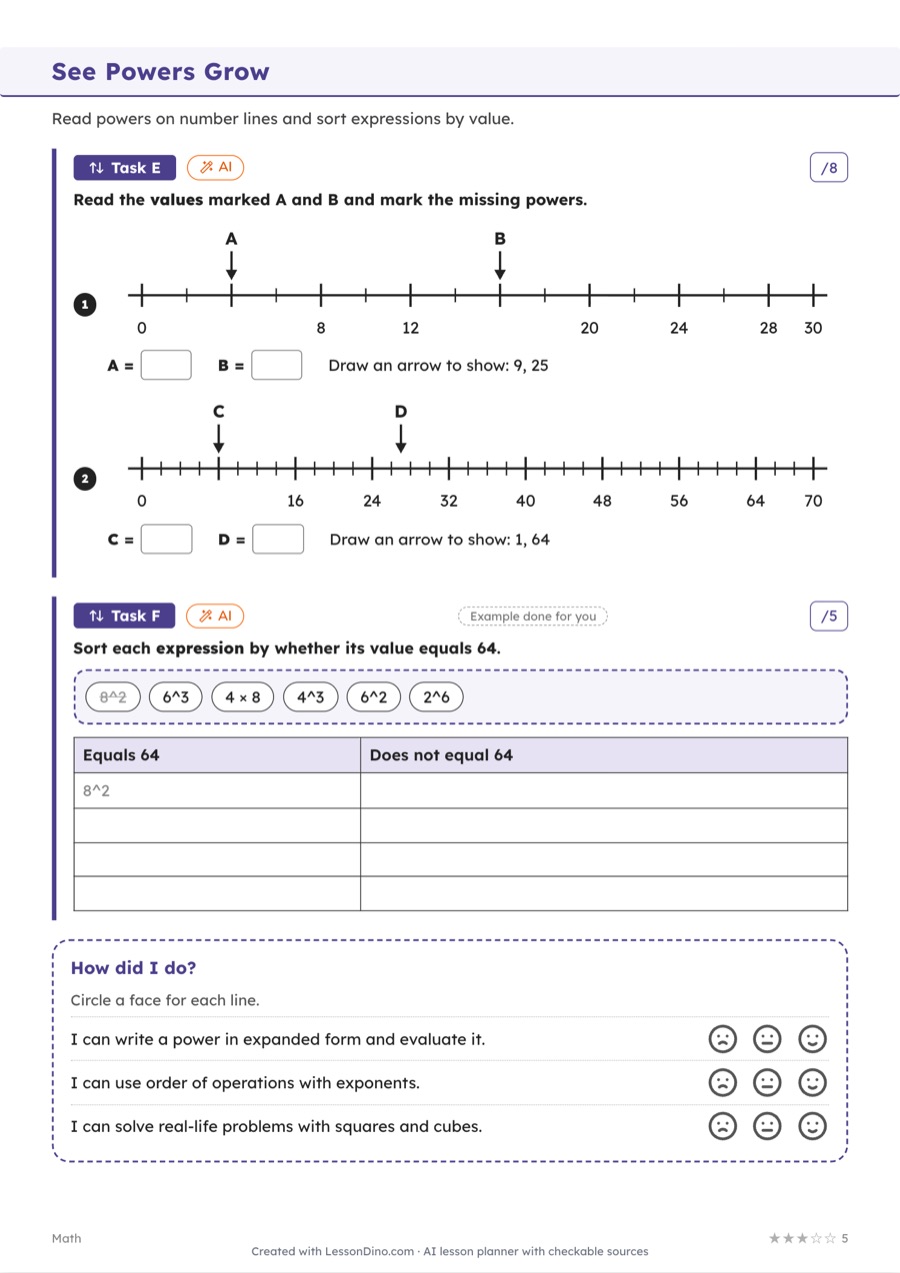
See Powers Grow
Read powers on number lines and sort expressions by value.
Read the values marked A and B and mark the missing powers.
Sort each expression by whether its value equals 64.
Answers
Show the answers
- Work out 3^2. 9
- Work out 2^5. 32
- Work out 10^3. 1000
- Work out 1^9. 1
- Work out 2^3 × 3. 24
- Work out (4 + 2)^2. 36
- Work out 5^2 + 2^3. 33
- Work out 10^2 ÷ 2^2. 25
- A square rug is 9 ft on each side. Area = side^2. Work out 9^2 to find the area in square feet. 81
- A storage cube is 4 in. on each edge. Volume = edge^3. Work out 4^3 to find the volume in cubic inches. 64
- Explain how you know that 3^3 is not 9. Use expanded form in your answer. 3^3 = 3 × 3 × 3 = 27, not 9, because the exponent 3 means multiply three 3s.
- Order from least to greatest: 2^4, 4^2, 3^3. Write the values in order. 16, 16, 27 so 2^4 = 4^2 < 3^3
- Work out 6^1. 6
- Work out 8^0. 1
- Work out 10^4. 10000
- Work out 2^6. 64
- Work out 3^2 + 4 × 2. 17
- Work out 24 ÷ 2^3 + 1. 4
- Work out 2 × 5^2 - 10. 40
- Write 2 × 2 × 2 × 2 × 2 as a power and work out its value. 2^5 = 32
- A bookcase has 5 shelves. Each shelf holds 5 stacks. Each stack has 5 books. Work out 5^3 to find how many books there are. 125
- A glass cube is 6 in. on each edge. Work out 6^3 to find the volume in cubic inches. 216
- Explain how you know 2^4 and 4^2 are equivalent. Show both values. Both equal 16 because 2^4 = 2 × 2 × 2 × 2 = 16 and 4^2 = 4 × 4 = 16
- A game starts with 3 points and doubles 3 times in a row. Points = 3 × 2^3. Work out the total points. 24
The answer sheet is the last picture above.
Curriculum
Write and evaluate numerical expressions involving whole-number exponents.
Made with Lesson Dino's AI on 19 October 2026. AI can make mistakes, so check the answers and facts against the sources before you teach.