Slides
Lesson plan
Power Up With Exponents
Students learn to write repeated multiplication as powers and find the value. They build squares and cubes, then use order of operations with powers.
Objectives
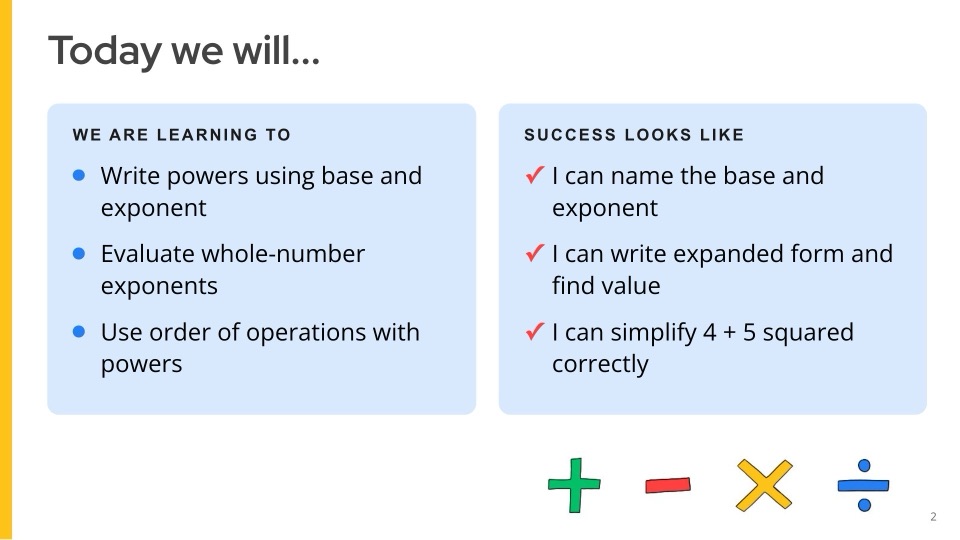
- Students will write repeated multiplication as powers using base and exponent.
- Students will evaluate whole-number powers with small exponents by multiplying in steps.
- Students will evaluate numerical expressions with powers using order of operations.
Success criteria
- I can name the base and exponent in a power.
- I can write the expanded form and find its value.
- I can do powers first in order of operations.
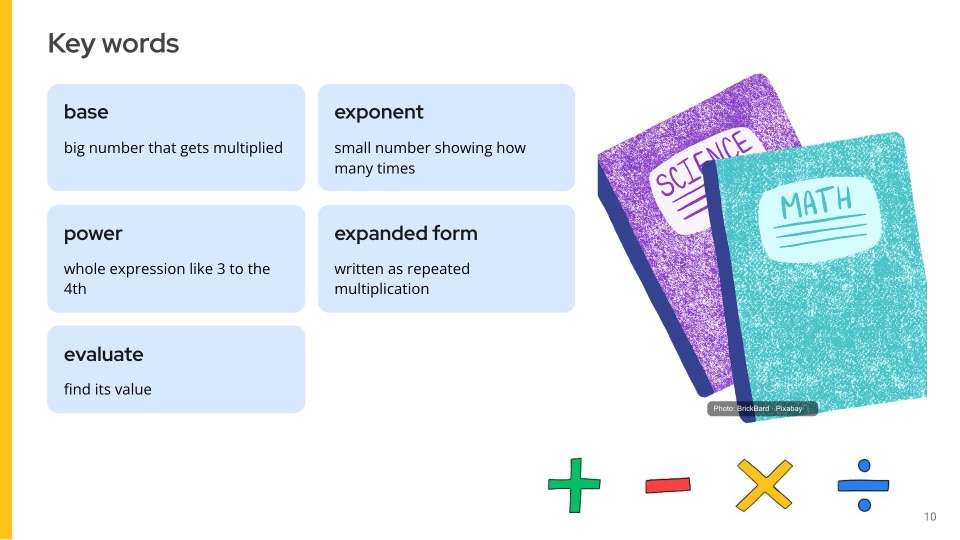
Key words
| Word | Meaning |
|---|---|
| base | the big number that gets multiplied again and again |
| exponent | the little number that shows how many copies to multiply |
| power | the whole short form like 3 to the 4th |
| expanded form | the long multiplication written out with x signs |
| order of operations | the rules that say to do powers before x and + |
Timed plan (60 minutes)
| Time | Stage | What happens |
|---|---|---|
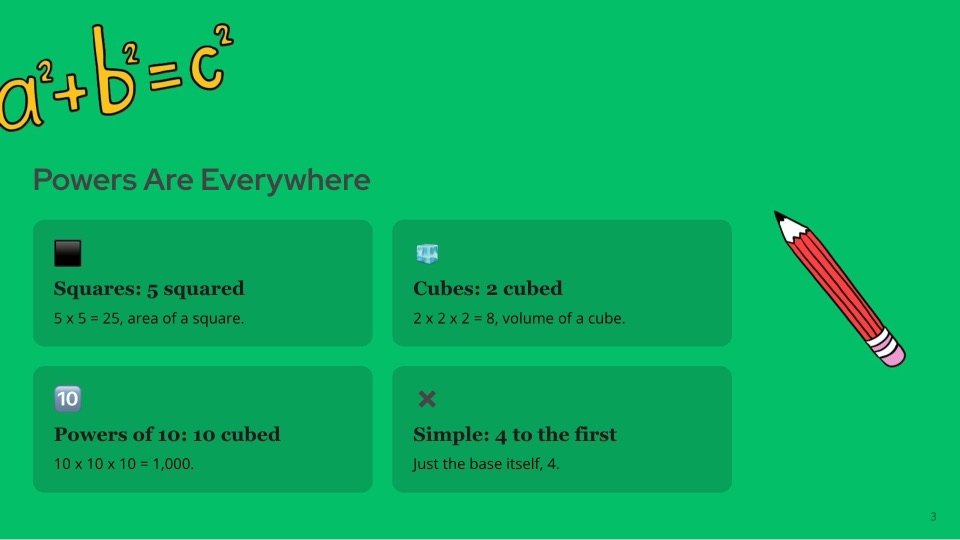
| 8 min | Starter | Connect fluent multiplication to squares, cubes, and powers of 10. Show Slide 1 title and Slide 2 objectives and read them aloud. Show Slide 3 cards for squares, cubes, and powers of 10 with area and volume pictures. Use the hook: Can you build 3 squared so I can actually see it? Ask for quick multiplication facts and link 5 x 5 to 5 squared. |
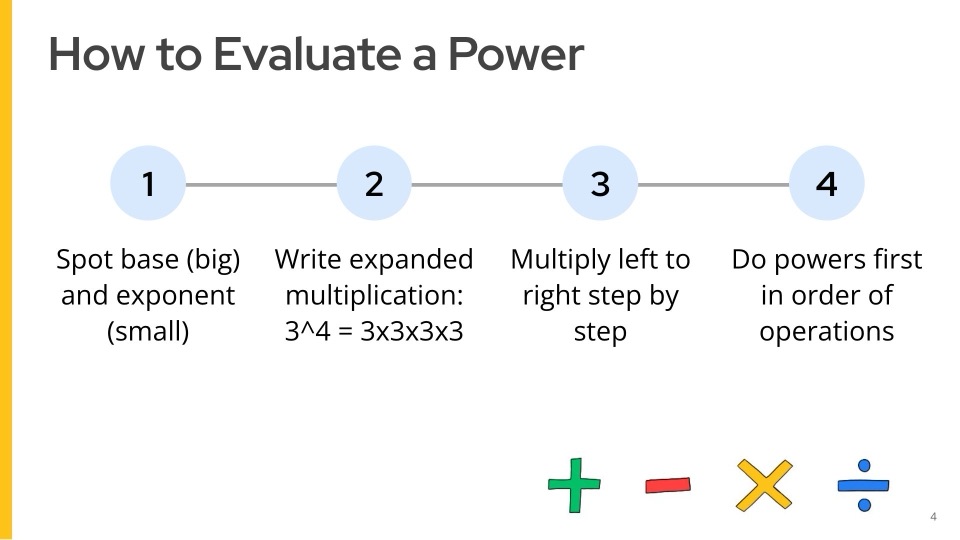
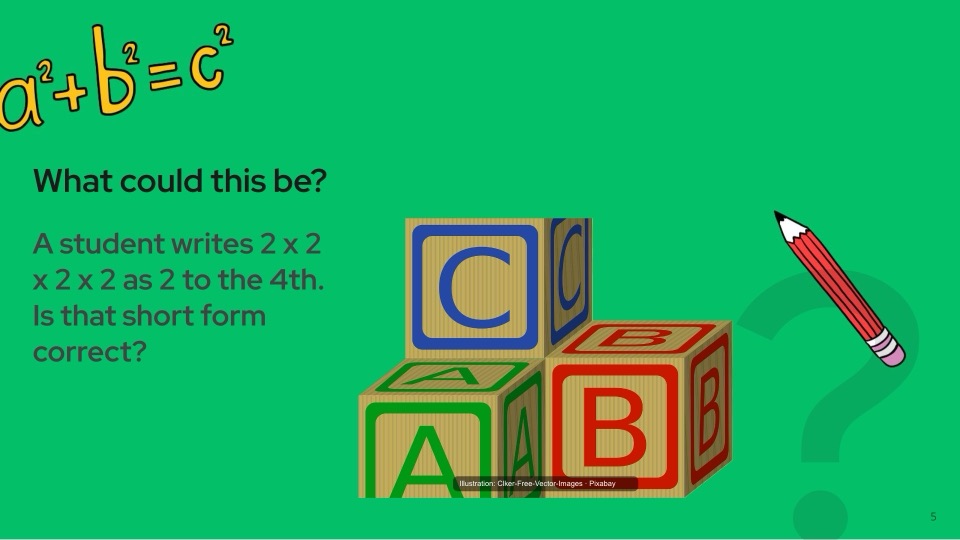
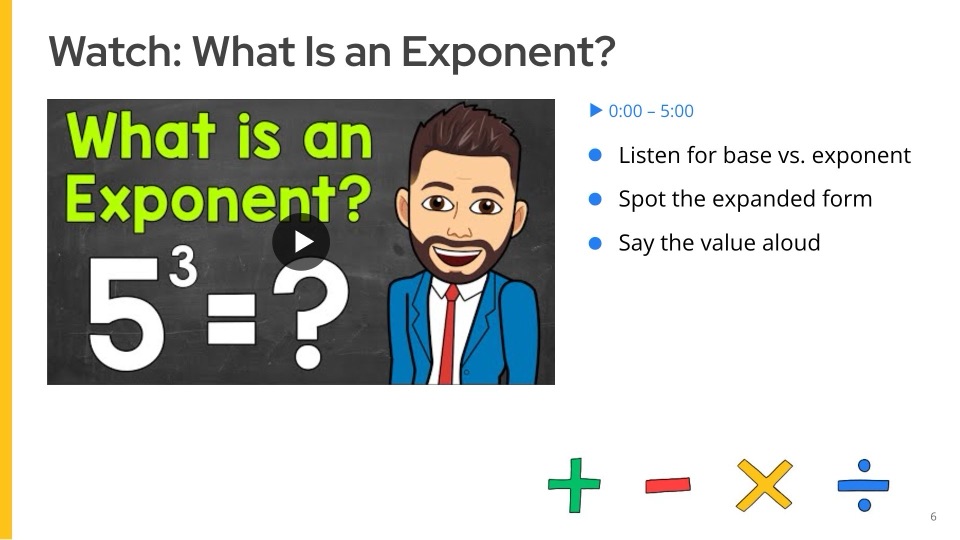
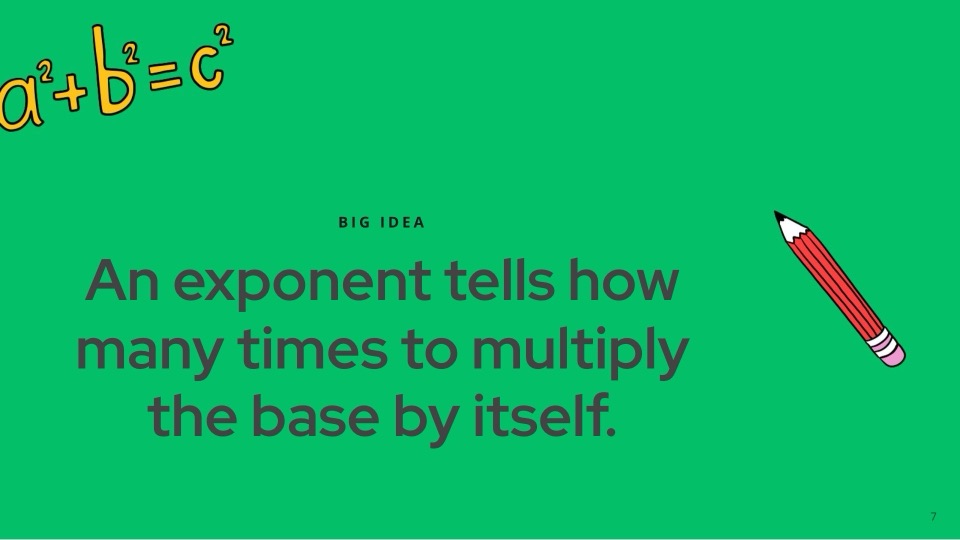
| 12 min | Teaching | Model how to name parts of a power and evaluate it step by step. Teach Slide 4 steps: spot base and exponent, write expanded multiplication, multiply left to right. Use Slide 5 mystery to confirm 2 x 2 x 2 x 2 is 2 to the 4th and equals 16. Play Video clip 1 on Slide 6 and have students listen for base, exponent, and expanded form. State the Slide 7 big idea and model 3 to the 4th fully. |
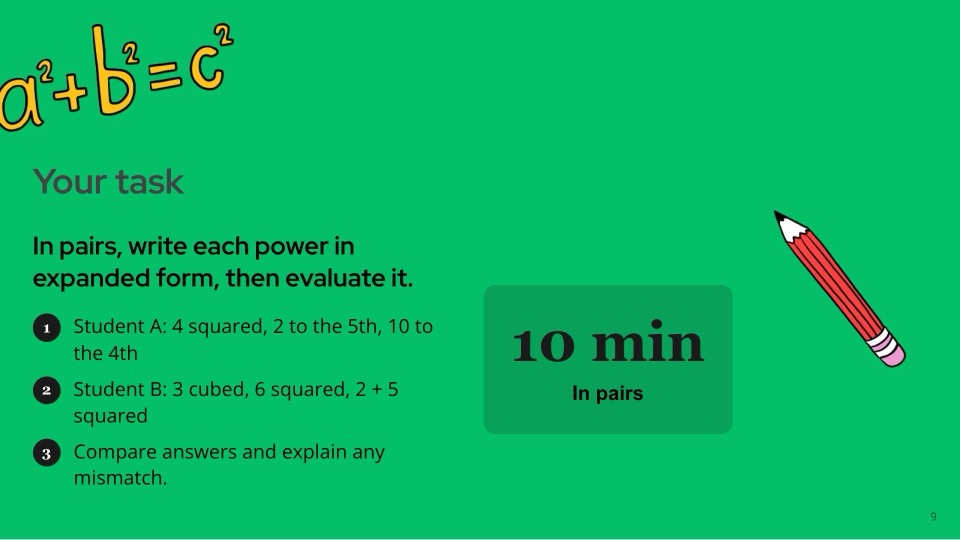
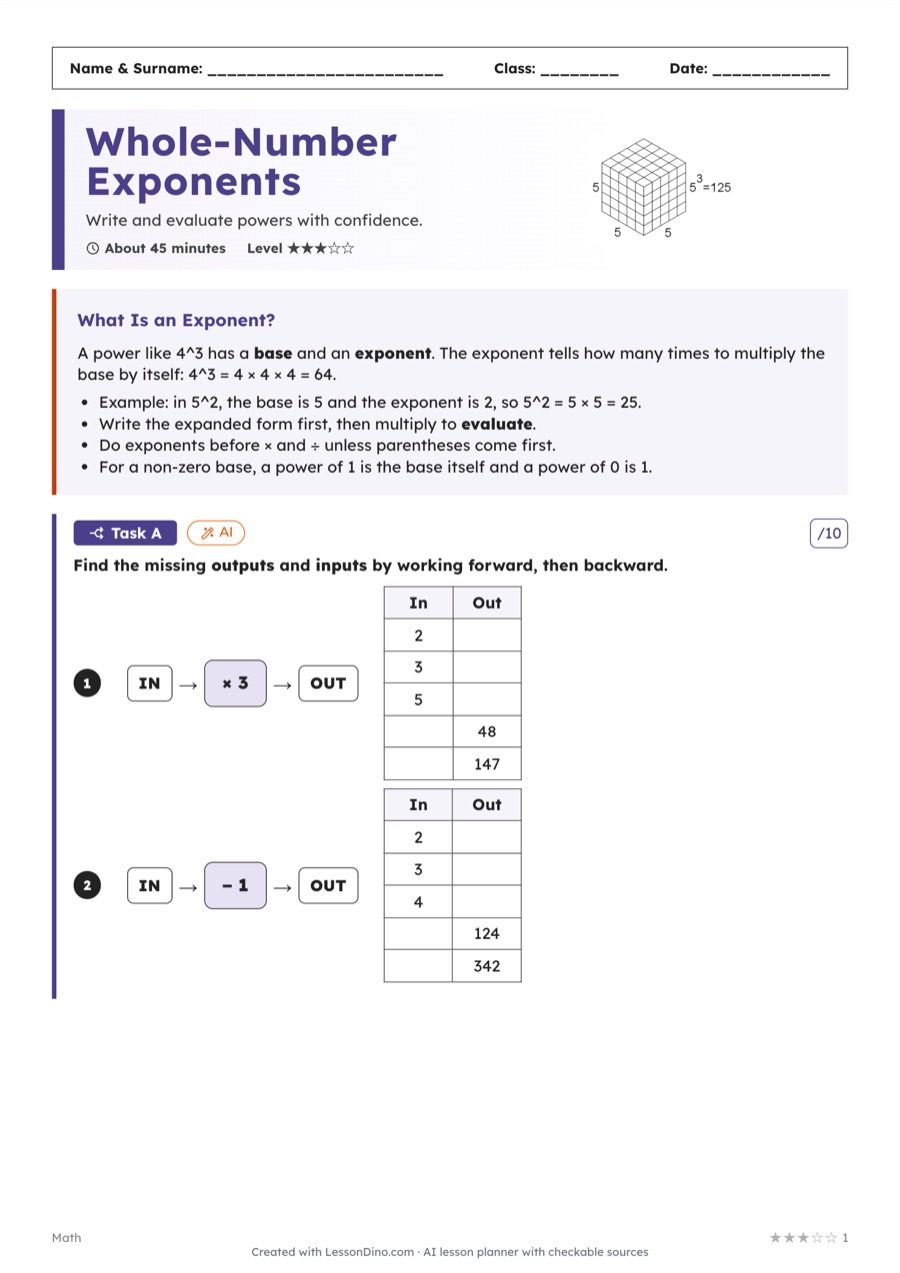
| 20 min | Main activity | Build squares and cubes to write and evaluate powers. Demo building 2 to the second power as 2 rows of 2 with tiles. Demo building 2 to the third power as a 2 by 2 by 2 cube with linking cubes. Have groups build, sketch the model, and write the full chain like 3 to the third power = 3 x 3 x 3 = 27. Give Worksheet Task B for fluency practice with powers of whole numbers and circulate. |
| 10 min | Practice | Evaluate expressions with powers using order of operations. Model 2 + 3 squared, showing the power value first, then addition. Remind students to generate equivalent numerical expressions using order of operations, including whole number exponents. Have pairs solve Worksheet Task D using order of operations and exponents. Have pairs show two lines of work for each expression. |
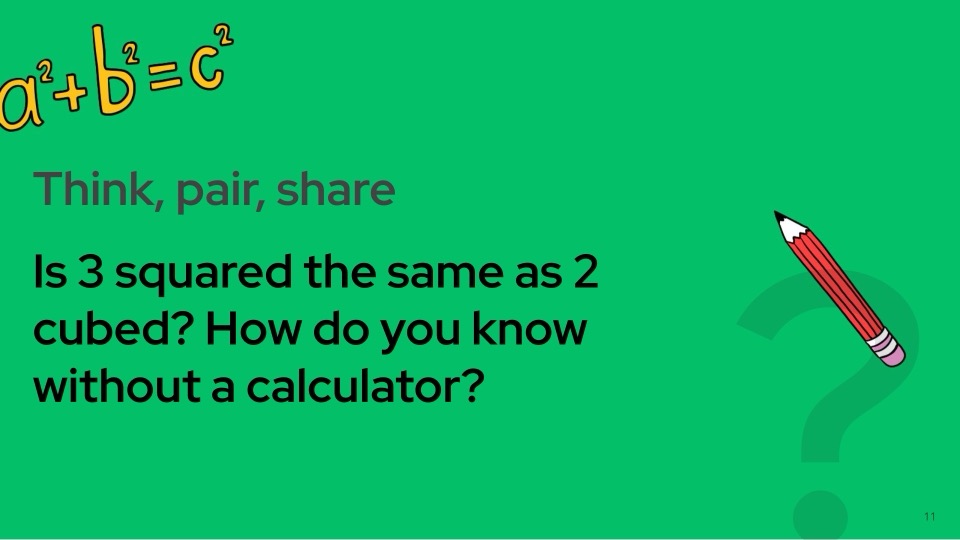
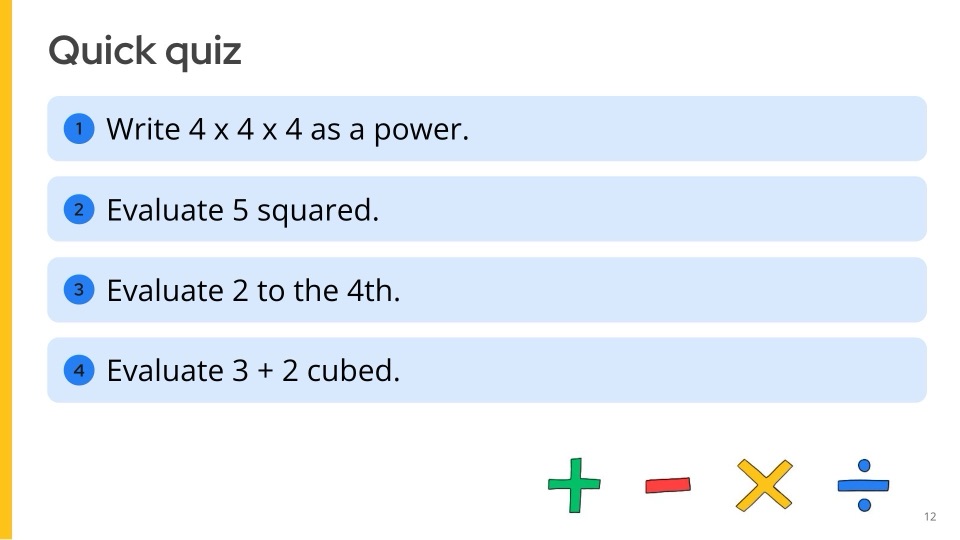
| 10 min | Plenary | Check that students can write, evaluate, and order powers. Review Slide 10 key words: base, exponent, power, and expanded form. Run Slide 11 think, pair, share: Is 3 squared the same as 2 cubed? Run Slide 12 quick quiz on whiteboards and confirm answers. Link back to success criteria and set homework. |
Common mistakes
- Writing 3 squared as 3 x 2 instead of 3 x 3
How to spot it: Expanded form has 2 as a factor instead of two 3s
Restate that the exponent shows how many times to multiply the base by itself and rewrite as 3 x 3 = 9. - Writing 2 cubed as 2 x 3 = 6
How to spot it: Student multiplies base by exponent
Count three 2s in expanded form 2 x 2 x 2, then multiply 4 x 2 = 8. - Doing addition first, like 2 + 3 squared = 25
How to spot it: Final answer is the square of the sum
Remodel order of operations with whole number exponents: find 3 squared = 9 first, then 2 + 9 = 11.
Support
- Provide expanded form first and use tiles so students count factors before multiplying.
- Allow a multiplication chart but require the expanded form line before the product.
Stretch
- Compare 2 to the fourth power and 4 squared to find equal values different ways.
- Create expressions with two powers that equal a target number.
Check questions
- Write 4 x 4 x 4 as a power.
Answer: 4 cubed - Evaluate 5 squared.
Answer: 25 - Evaluate 3 + 2 cubed. Show the power first.
Answer: 11, because 2 cubed = 8 first
Curriculum
Write and evaluate numerical expressions involving whole-number exponents.
Video clips
Clips on YouTube, from the start and end times we chose. Check each one before you show it.
-
What is an exponent intro from 0:00 to 5:00
Math with Mr. J: What is an Exponent? | An Intro to Exponents | Math with Mr. J
Teaches base, exponent, expanded form and evaluating, with clear pace perfect for ages 11-12.
-
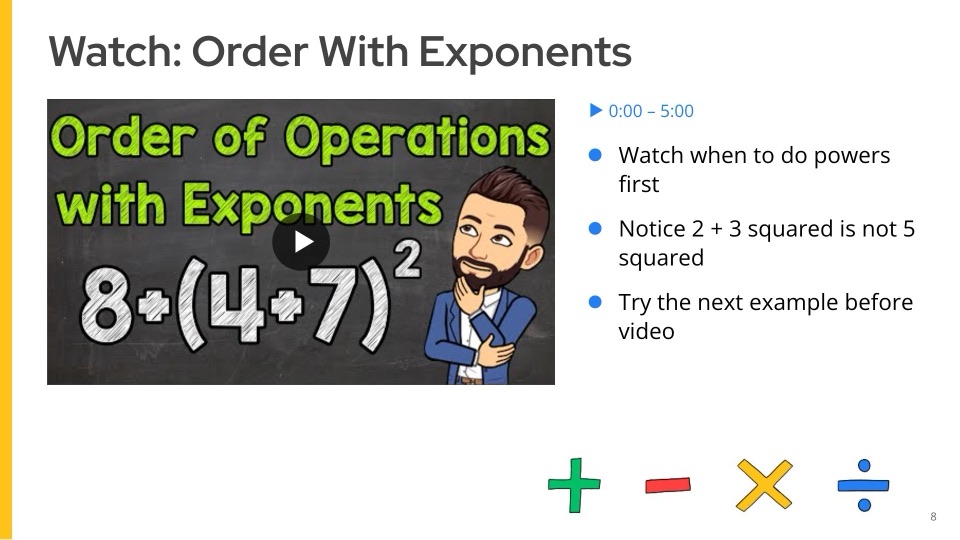
Order of operations with exponents from 0:00 to 5:00
Math with Mr. J: Order of Operations with Exponents | Math with Mr. J
Shows how to evaluate numerical expressions with exponents in order, at the right level for ages 11-12.
Worksheet
Sources
- SST Grade 6 Mathematics TEKS - Texas Education Agency tea.texas.gov
- Grade 6 Advanced Math Curriculum What is taught in grade 6 Advanced Mathematics? fcps.edu
- Powers of whole numbers (practice) | Khan Academy khanacademy.org
- Powers of whole numbers (practice) | Indices | Khan Academy en.khanacademy.org
- Whole Number Exponents ( Read ) | Arithmetic | CK-12 Foundation ck12.org
- Class 6 Exponents Worksheet: Negative & Zero Exponents Practice vedantu.com
Picture credits
Made with Lesson Dino's AI on 19 October 2026. AI can make mistakes, so check facts against the sources before you teach.