The worksheet
About this worksheet
Students learn what a ratio is and how to describe it with for-every language. They model wings and beaks and write ratios in the right order. This Grade 6 Math worksheet gives students (ages 11–12) six pages of practice on understanding ratios, part of the ratios and proportional relationships unit. It goes with our free Understanding ratios lesson, which has the slides and a timed lesson plan.
What it covers
By the end, students should be able to:
- Students will understand a ratio shows how two amounts go together.
- Students will use for-every language to describe a ratio relationship.
- Students will write the same ratio in order with words, colon and fraction.
How to use it
- Practice (14 minutes): Hand out Worksheet Task B and have pairs write each ratio in order with for-every language.
- Support: Give the frame: For every __ of the first thing, there is __ of the second thing.
- Stretch: Ask what changes if the order flips to beaks to wings, and have students say the new for-every sentence.
- The answer sheet is the last page, so you can print it on its own or let students check their own work.
Key vocabulary
- ratio: a comparison that shows how two countable amounts go together
- for every: words that link a fixed count of one thing to a fixed count of another
- order: which amount is said or written first and which is second
- colon: the : mark placed between two numbers to show a comparison
Mistakes to watch for
- Thinking 2:3 is equivalent to 4:5 by adding 2 to each number. Show with drawings that both piles must be multiplied: 2:3 scales to 4:6, because the relationship is multiplicative in nature, not additive.
- Reversing order, writing B:A for A to B. Have them point to first pile then second while saying first to second, because when taking ratios, the order of the two numbers matters.
- Mixing part-to-part with part-to-whole. Count and label part, part, total first; practice that we can compare one kind to total nuts in a jar as well as one kind to another kind.
What's on the worksheet
Ratios in Order
Learn what a ratio shows and how to say it.
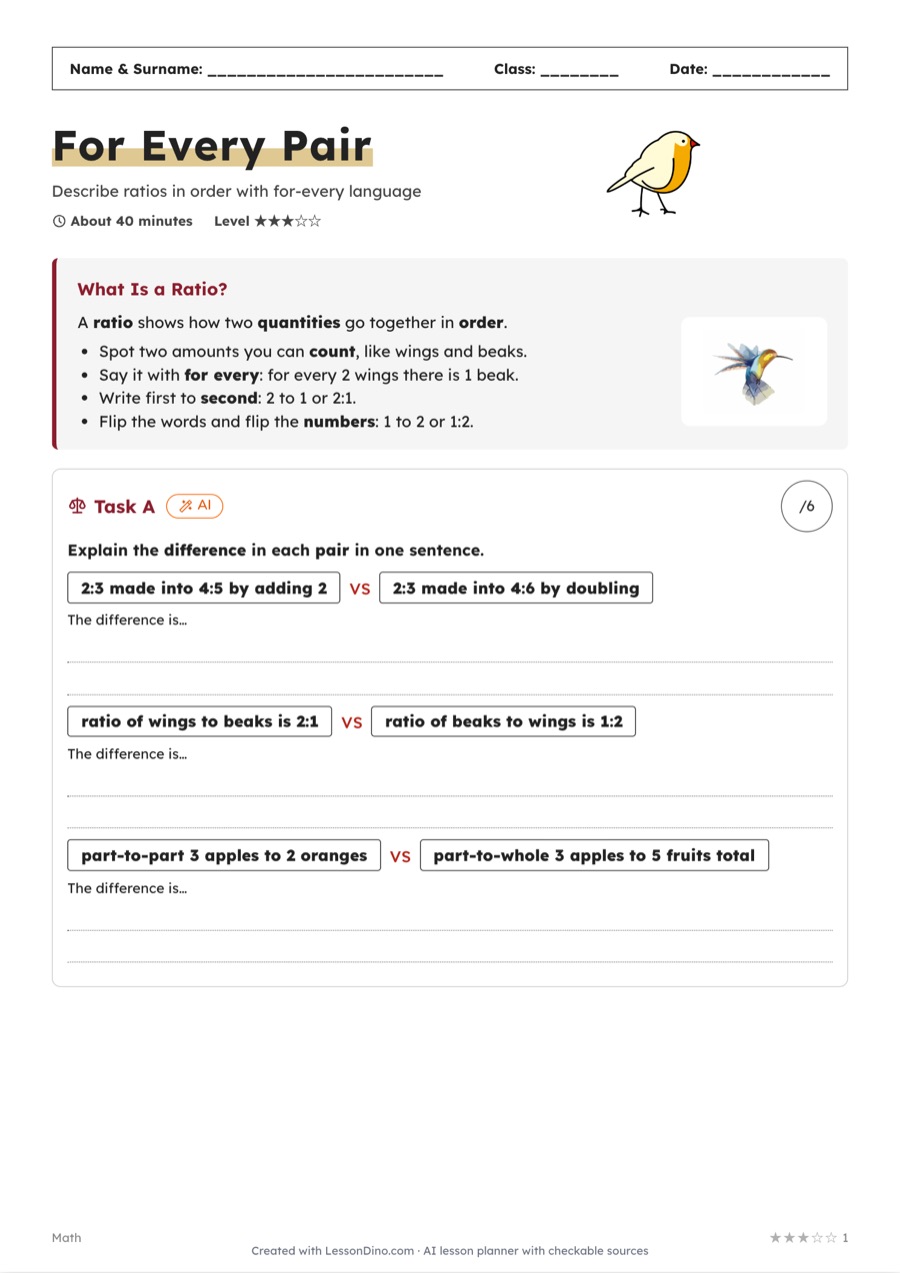
What Is a Ratio?
- A ratio shows how two quantities go together in order.
- Spot two amounts you can count, like wings and beaks.
- Say it with for every: for every 2 wings there is 1 beak.
- Write first to second: 2 to 1 or 2:1.
- Flip the words and flip the numbers: 1 to 2 or 1:2.
Explain the difference in each pair in one sentence.
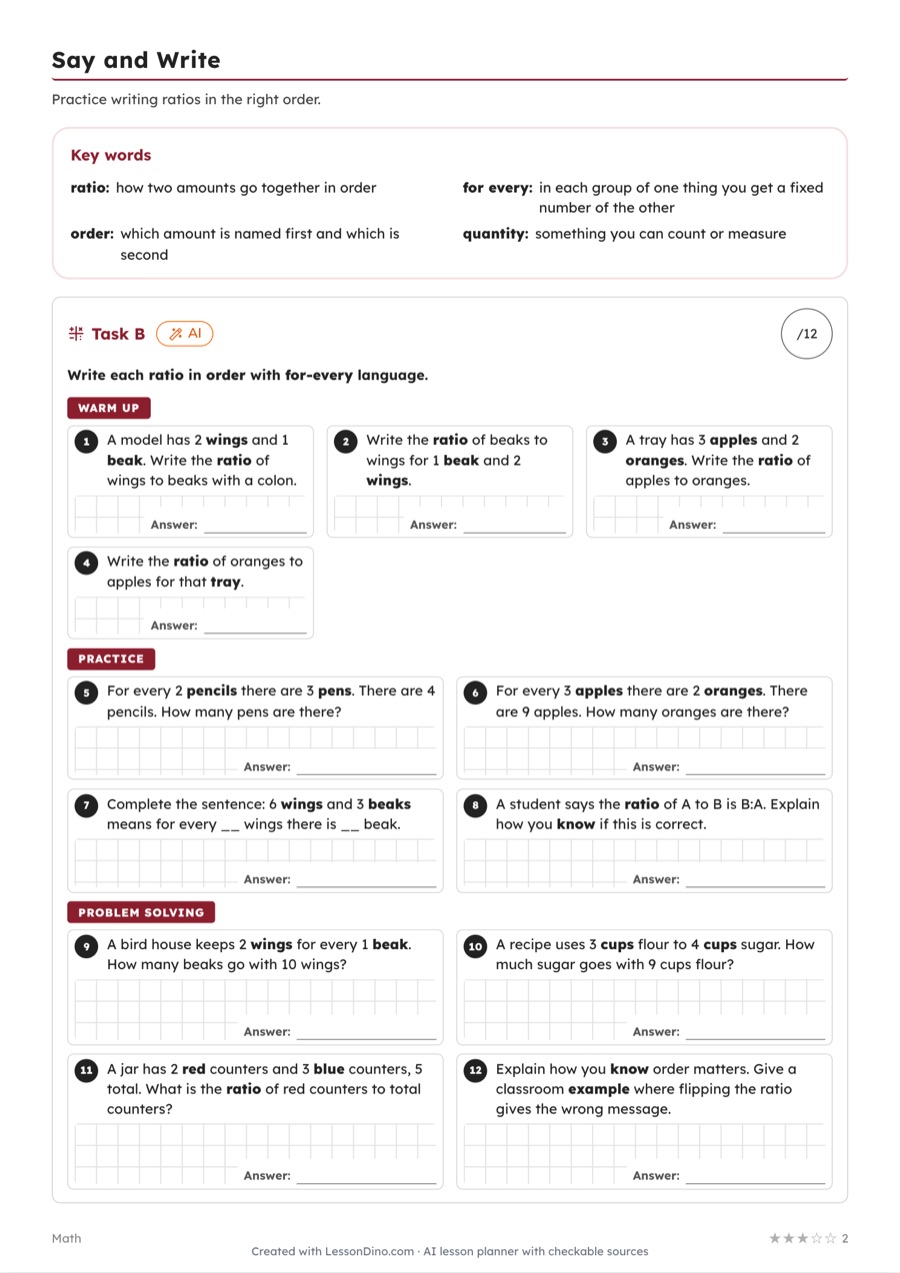
Say and Write
Practice writing ratios in the right order.
| Word | Meaning |
|---|---|
| ratio | how two amounts go together in order |
| for every | in each group of one thing you get a fixed number of the other |
| order | which amount is named first and which is second |
| quantity | something you can count or measure |
Write each ratio in order with for-every language.
Warm up
- A model has 2 wings and 1 beak. Write the ratio of wings to beaks with a colon.
- Write the ratio of beaks to wings for 1 beak and 2 wings.
- A tray has 3 apples and 2 oranges. Write the ratio of apples to oranges.
- Write the ratio of oranges to apples for that tray.
Practice
- For every 2 pencils there are 3 pens. There are 4 pencils. How many pens are there?
- For every 3 apples there are 2 oranges. There are 9 apples. How many oranges are there?
- Complete the sentence: 6 wings and 3 beaks means for every __ wings there is __ beak.
- A student says the ratio of A to B is B:A. Explain how you know if this is correct.
Problem solving
- A bird house keeps 2 wings for every 1 beak. How many beaks go with 10 wings?
- A recipe uses 3 cups flour to 4 cups sugar. How much sugar goes with 9 cups flour?
- A jar has 2 red counters and 3 blue counters, 5 total. What is the ratio of red counters to total counters?
- Explain how you know order matters. Give a classroom example where flipping the ratio gives the wrong message.
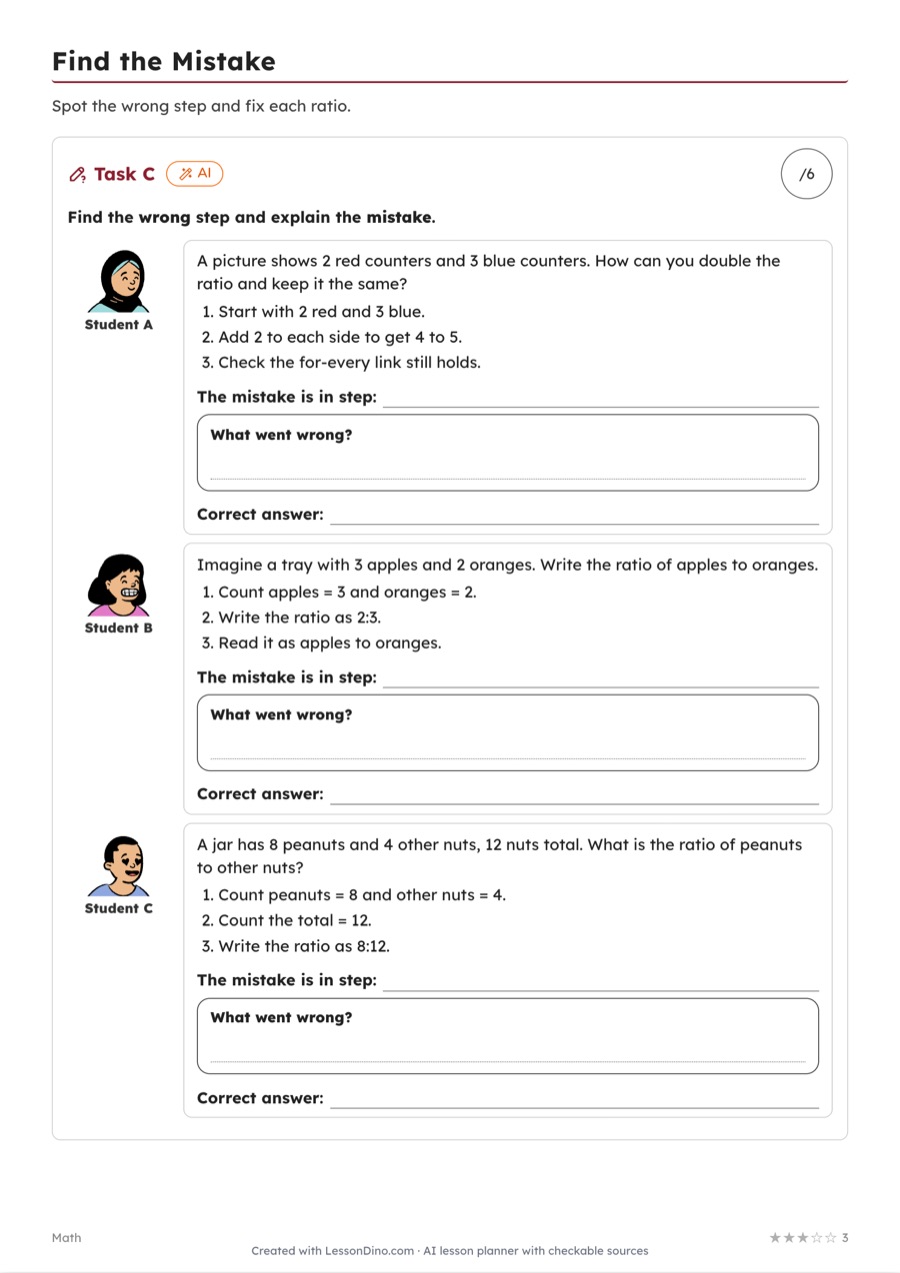
Find the Mistake
Spot the wrong step and fix each ratio.
Find the wrong step and explain the mistake.
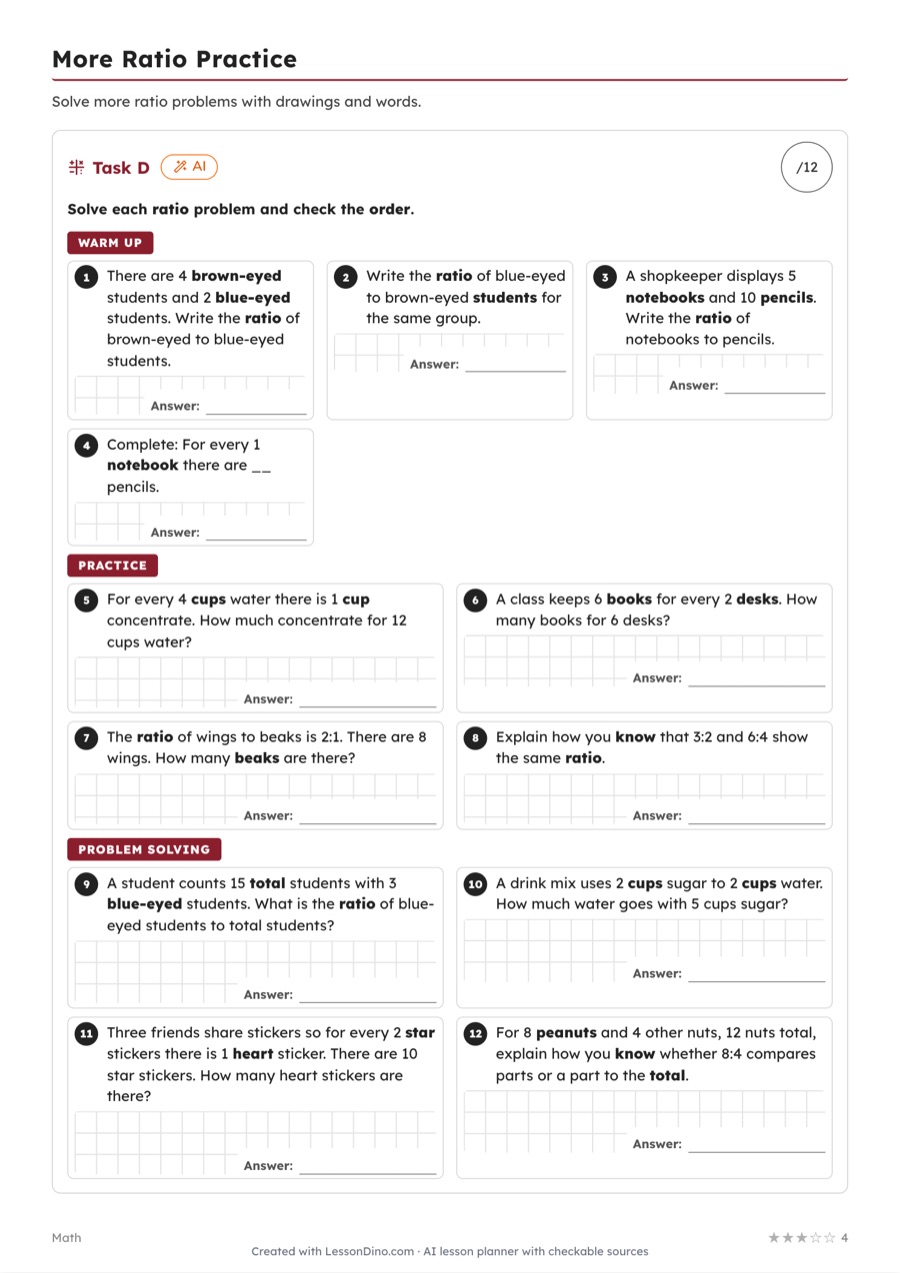
More Ratio Practice
Solve more ratio problems with drawings and words.
Solve each ratio problem and check the order.
Warm up
- There are 4 brown-eyed students and 2 blue-eyed students. Write the ratio of brown-eyed to blue-eyed students.
- Write the ratio of blue-eyed to brown-eyed students for the same group.
- A shopkeeper displays 5 notebooks and 10 pencils. Write the ratio of notebooks to pencils.
- Complete: For every 1 notebook there are __ pencils.
Practice
- For every 4 cups water there is 1 cup concentrate. How much concentrate for 12 cups water?
- A class keeps 6 books for every 2 desks. How many books for 6 desks?
- The ratio of wings to beaks is 2:1. There are 8 wings. How many beaks are there?
- Explain how you know that 3:2 and 6:4 show the same ratio.
Problem solving
- A student counts 15 total students with 3 blue-eyed students. What is the ratio of blue-eyed students to total students?
- A drink mix uses 2 cups sugar to 2 cups water. How much water goes with 5 cups sugar?
- Three friends share stickers so for every 2 star stickers there is 1 heart sticker. There are 10 star stickers. How many heart stickers are there?
- For 8 peanuts and 4 other nuts, 12 nuts total, explain how you know whether 8:4 compares parts or a part to the total.
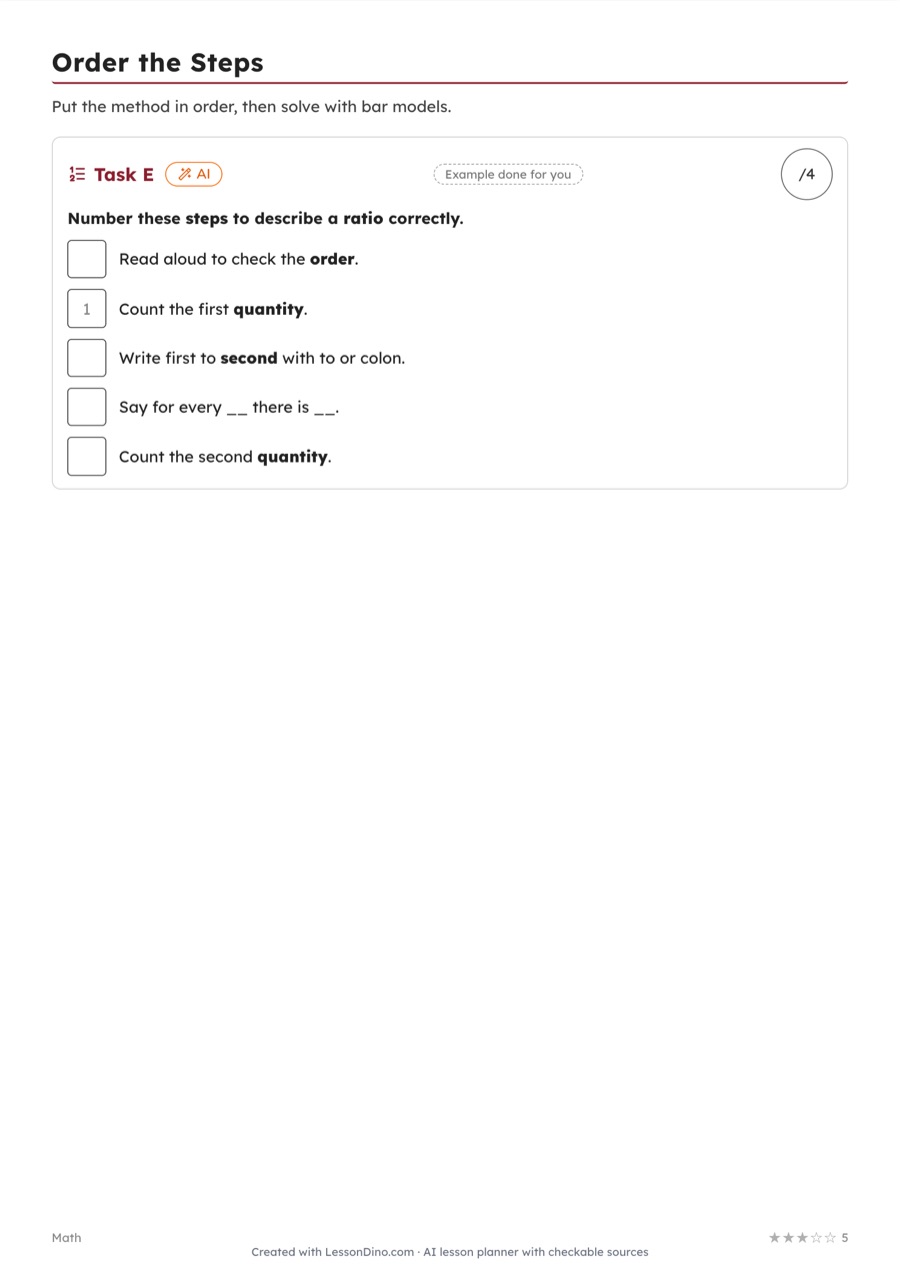
Order the Steps
Put the method in order, then solve with bar models.
Number these steps to describe a ratio correctly.
Page 6
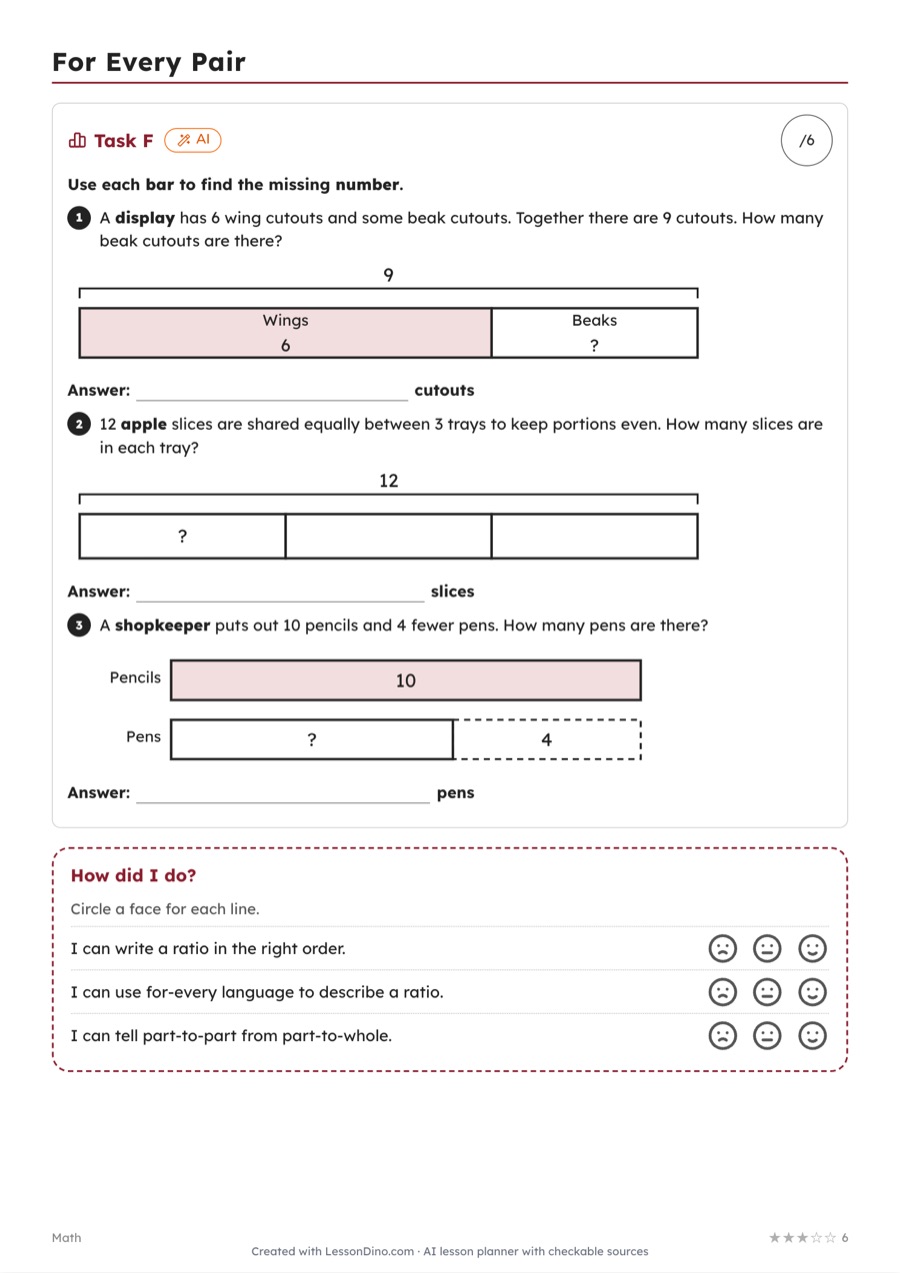
Use each bar to find the missing number.
Answers
Show the answers
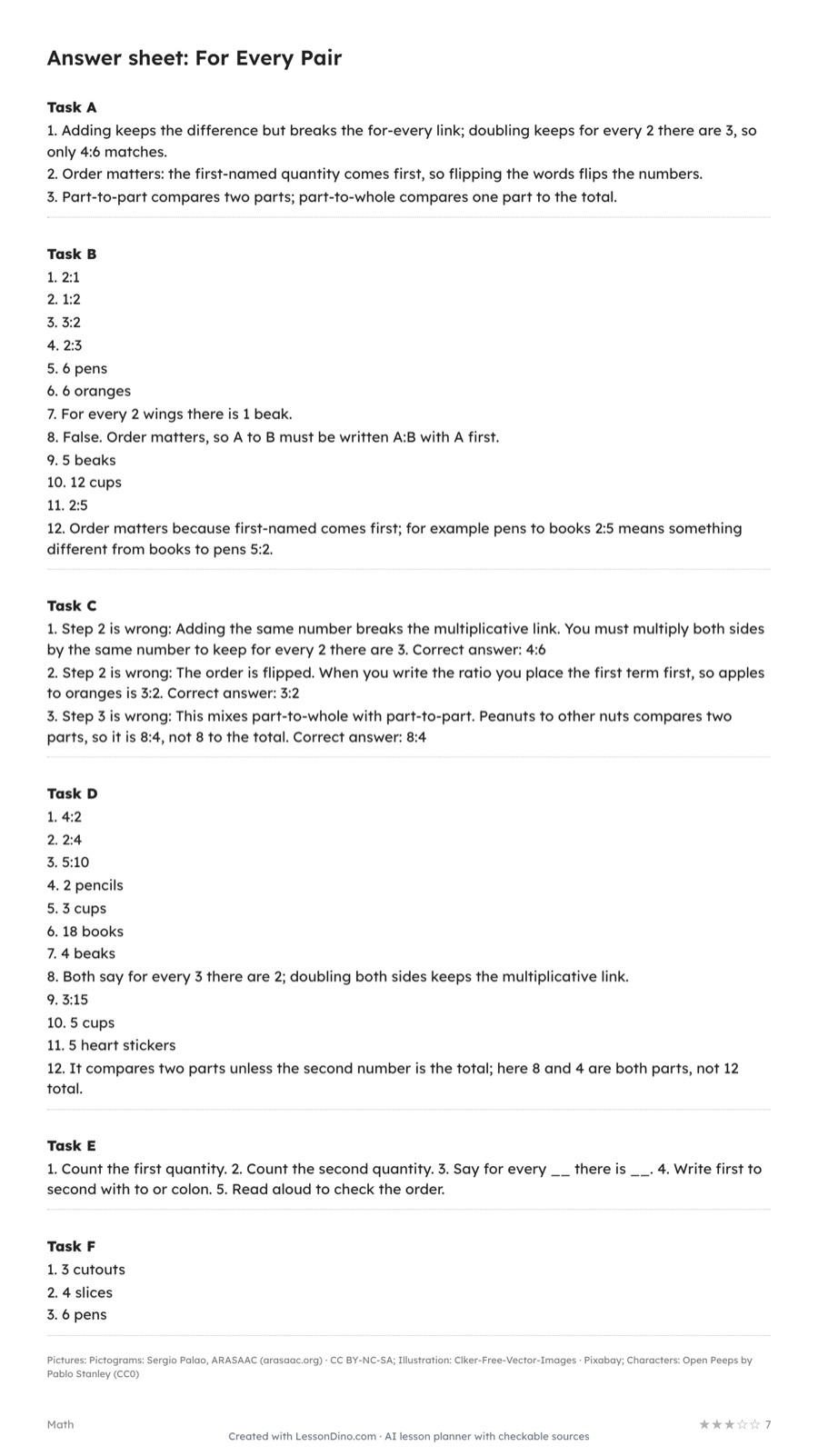
- A model has 2 wings and 1 beak. Write the ratio of wings to beaks with a colon. 2:1
- Write the ratio of beaks to wings for 1 beak and 2 wings. 1:2
- A tray has 3 apples and 2 oranges. Write the ratio of apples to oranges. 3:2
- Write the ratio of oranges to apples for that tray. 2:3
- For every 2 pencils there are 3 pens. There are 4 pencils. How many pens are there? 6 pens
- For every 3 apples there are 2 oranges. There are 9 apples. How many oranges are there? 6 oranges
- Complete the sentence: 6 wings and 3 beaks means for every __ wings there is __ beak. For every 2 wings there is 1 beak.
- A student says the ratio of A to B is B:A. Explain how you know if this is correct. False. Order matters, so A to B must be written A:B with A first.
- A bird house keeps 2 wings for every 1 beak. How many beaks go with 10 wings? 5 beaks
- A recipe uses 3 cups flour to 4 cups sugar. How much sugar goes with 9 cups flour? 12 cups
- A jar has 2 red counters and 3 blue counters, 5 total. What is the ratio of red counters to total counters? 2:5
- Explain how you know order matters. Give a classroom example where flipping the ratio gives the wrong message. Order matters because first-named comes first; for example pens to books 2:5 means something different from books to pens 5:2.
- There are 4 brown-eyed students and 2 blue-eyed students. Write the ratio of brown-eyed to blue-eyed students. 4:2
- Write the ratio of blue-eyed to brown-eyed students for the same group. 2:4
- A shopkeeper displays 5 notebooks and 10 pencils. Write the ratio of notebooks to pencils. 5:10
- Complete: For every 1 notebook there are __ pencils. 2 pencils
- For every 4 cups water there is 1 cup concentrate. How much concentrate for 12 cups water? 3 cups
- A class keeps 6 books for every 2 desks. How many books for 6 desks? 18 books
- The ratio of wings to beaks is 2:1. There are 8 wings. How many beaks are there? 4 beaks
- Explain how you know that 3:2 and 6:4 show the same ratio. Both say for every 3 there are 2; doubling both sides keeps the multiplicative link.
- A student counts 15 total students with 3 blue-eyed students. What is the ratio of blue-eyed students to total students? 3:15
- A drink mix uses 2 cups sugar to 2 cups water. How much water goes with 5 cups sugar? 5 cups
- Three friends share stickers so for every 2 star stickers there is 1 heart sticker. There are 10 star stickers. How many heart stickers are there? 5 heart stickers
- For 8 peanuts and 4 other nuts, 12 nuts total, explain how you know whether 8:4 compares parts or a part to the total. It compares two parts unless the second number is the total; here 8 and 4 are both parts, not 12 total.
The answer sheet is the last picture above.
Curriculum
Understand the concept of a ratio and use ratio language to describe a ratio relationship between two quantities.
Made with Lesson Dino's AI on 17 October 2026. AI can make mistakes, so check the answers and facts against the sources before you teach.