Slides
Lesson plan
For Every 2 Wings: What Is a Ratio?
Students learn what a ratio is and how to describe it with for-every language. They model wings and beaks and write ratios in the right order.
Objectives
- Students will understand a ratio shows how two amounts go together.
- Students will use for-every language to describe a ratio relationship.
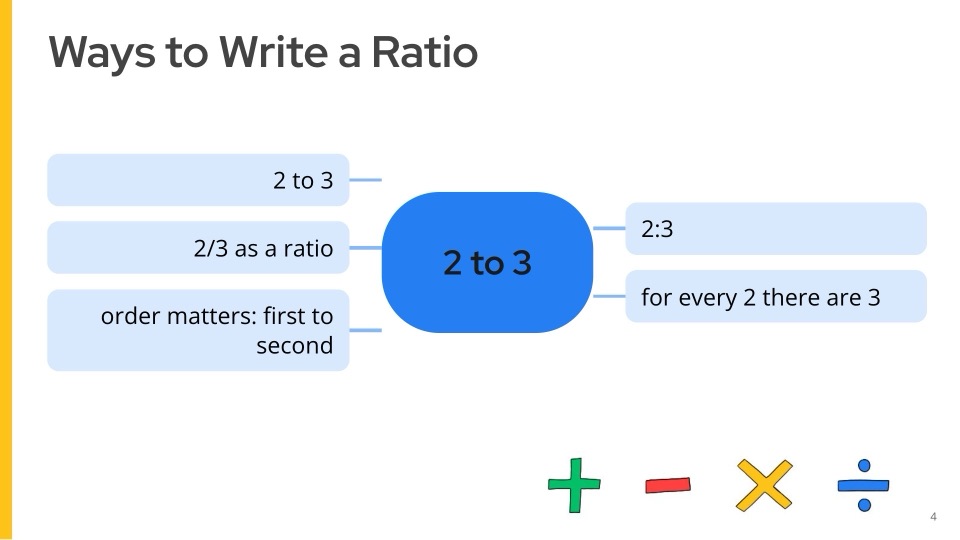
- Students will write the same ratio in order with words, colon and fraction.
Success criteria
- I can explain what a ratio shows about two amounts.
- I can say a ratio with for-every language in order.
- I can write the same ratio with words, colon and fraction.
Key words
| Word | Meaning |
|---|---|
| ratio | a comparison that shows how two countable amounts go together |
| for every | words that link a fixed count of one thing to a fixed count of another |
| order | which amount is said or written first and which is second |
| colon | the : mark placed between two numbers to show a comparison |
Timed plan (60 minutes)
| Time | Stage | What happens |
|---|---|---|
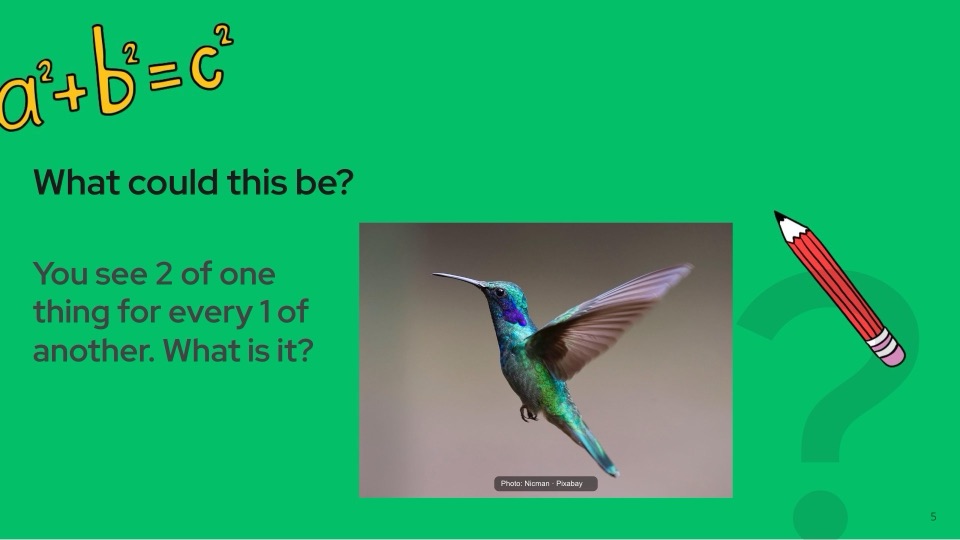
| 8 min | Starter | To hook interest and surface the idea that two amounts can go together in pairs. Greet the class and show the mystery bird situation. Ask the hook question and take 2-3 quick estimates without confirming. Show 2 wings with 1 beak, then build to 10 wings, counting beaks as you go. Link answers to today's learning: describing how two amounts go together. |
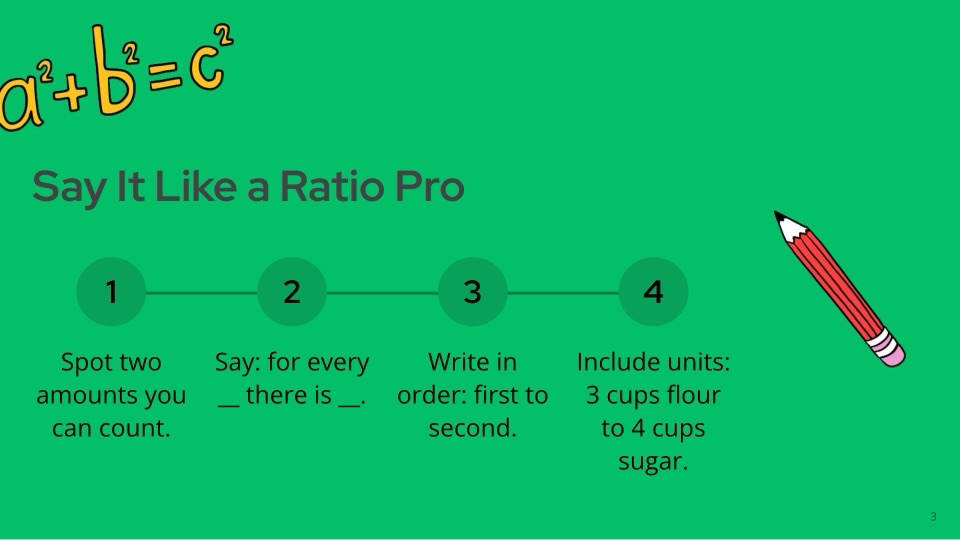
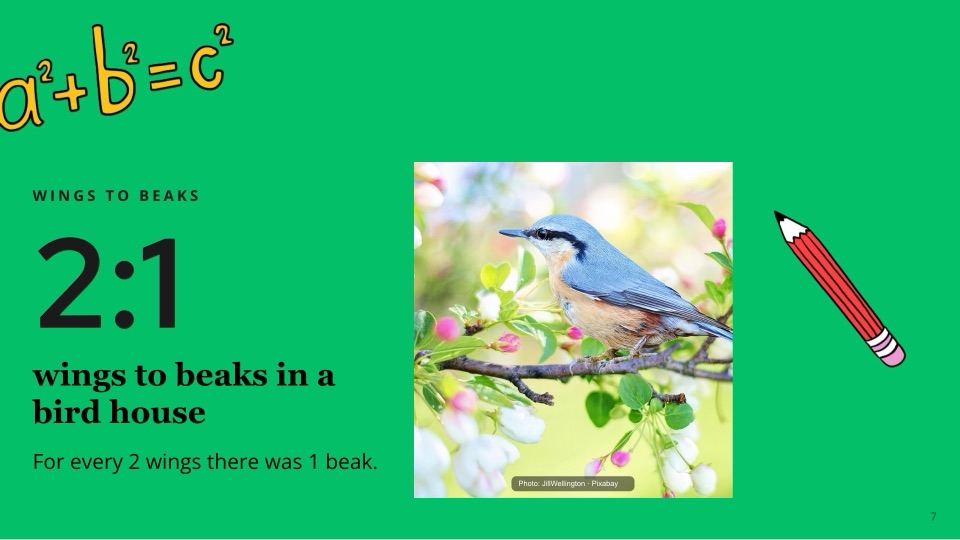
| 12 min | Teaching | To explain what a ratio is and model for-every language in order. Show the big idea and steps, then play the video for for-every language. Model with 6 wings and 3 beaks that the ratio of wings to beaks is 2:1, because for every 2 wings there was 1 beak. Explain students are learning ratio language to describe the association between two quantities. Model writing the same comparison three ways and stress placing the first term first. |
| 18 min | Main activity | To use for-every language to describe the wings-to-beaks ratio relationship. Hand out wing and beak cutouts and remind pairs that a ratio has two numbers connected by a multiplicative relationship. Have pairs build the 6-wing, 3-beak display and practice saying the comparison both ways. Circulate, correct order, and prompt full for-every sentences. Select 3 pairs to read one sentence aloud and have the class check first to second. |
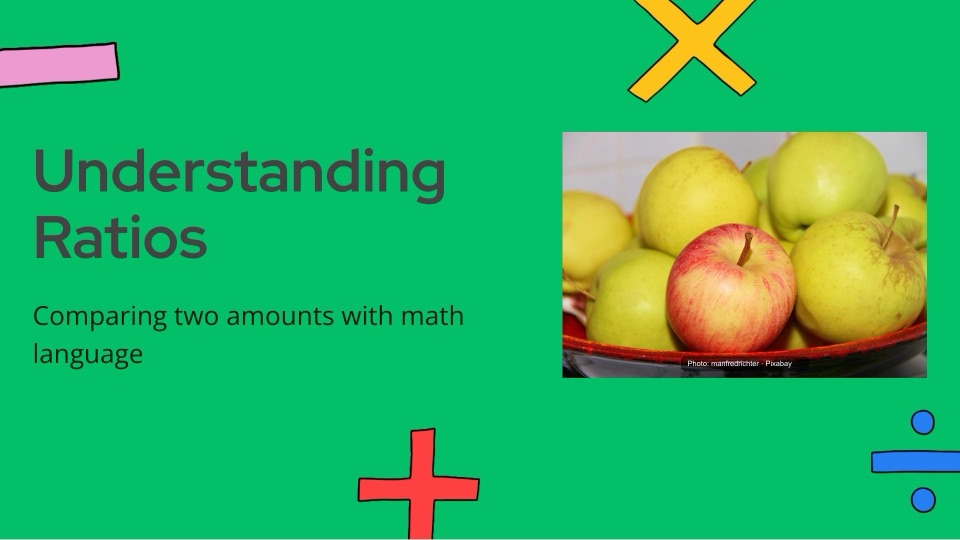
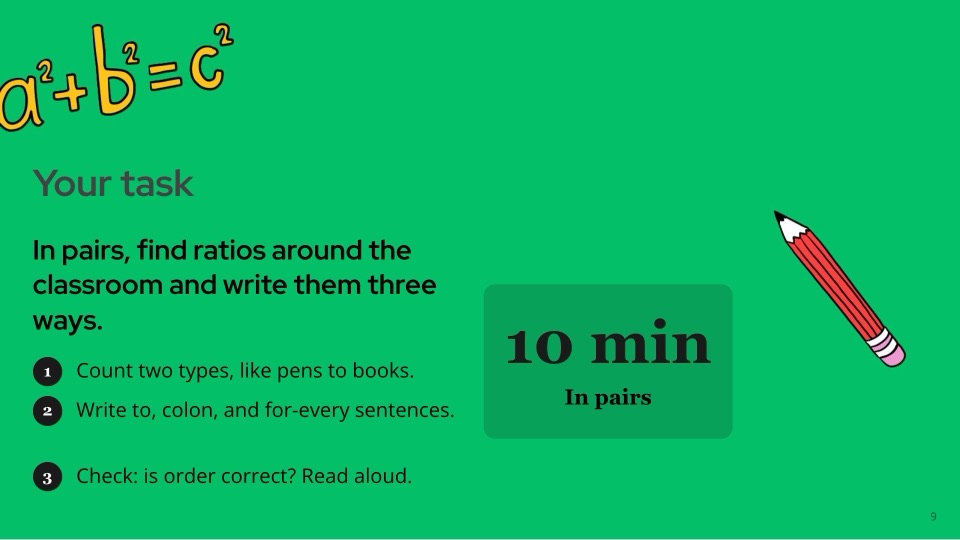
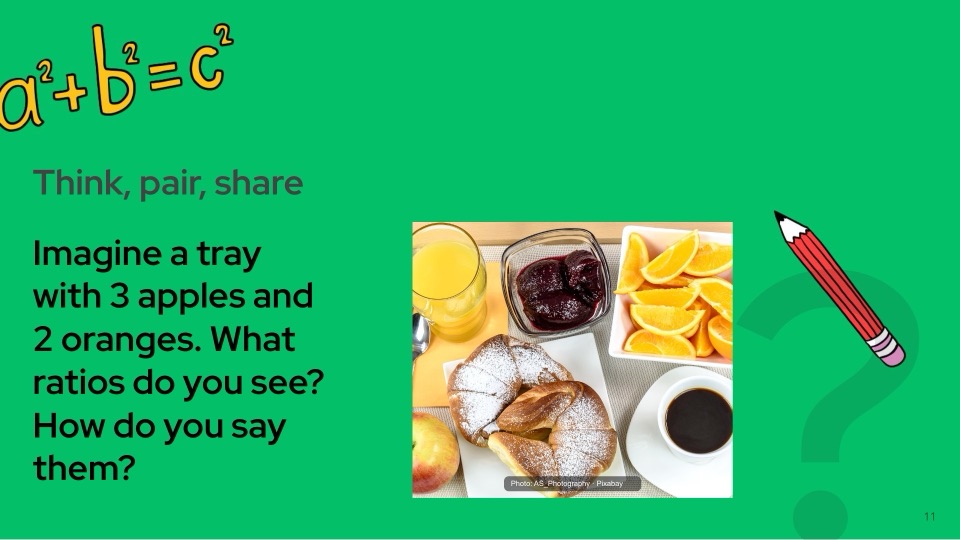
| 14 min | Practice | To write the same ratio three ways in the correct order. Explain that ratios can be expressed using the colon, as a fraction, or with the word to, such as 3:2, 3/2, or 3 to 2. Model with a tray of 3 apples and 2 oranges: apples to oranges is 3 to 2, 3:2, 3/2 as a ratio. Stress when taking ratios, the order of the two numbers matters. Hand out Worksheet Task B and have pairs write each ratio in order with for-every language. |
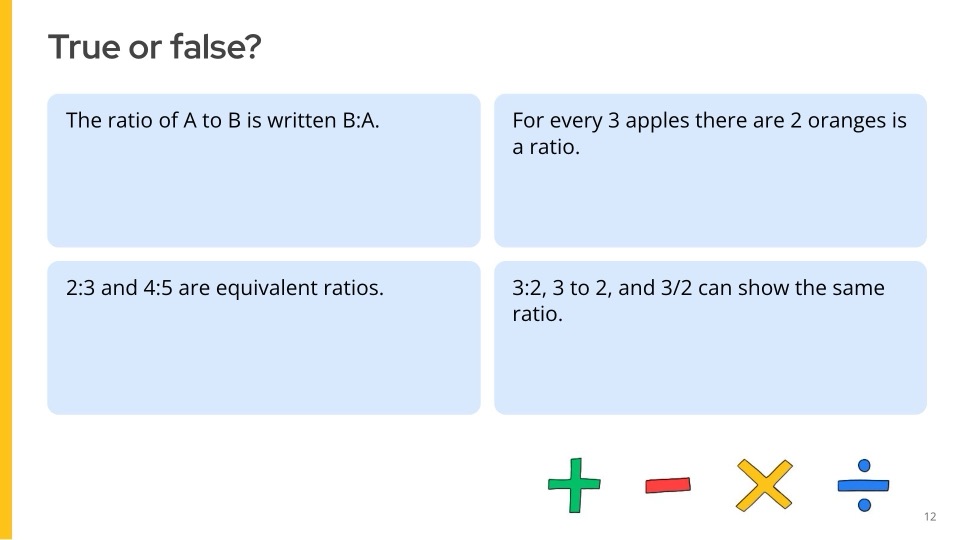
| 8 min | Plenary | To check that order matters and that ratios scale multiplicatively. Show the 2:3 to 4:5 error and explain the relationship is multiplicative in nature, not additive. Lead true-or-false voting on order and for-every language. Return to the starter: confirm 10 wings need 5 beaks. Hand out exit tickets. |
Common mistakes
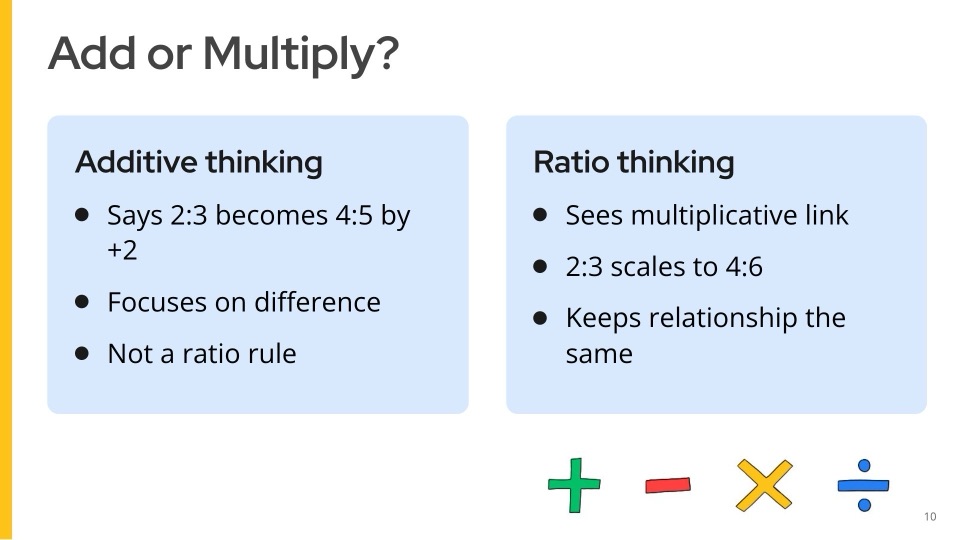
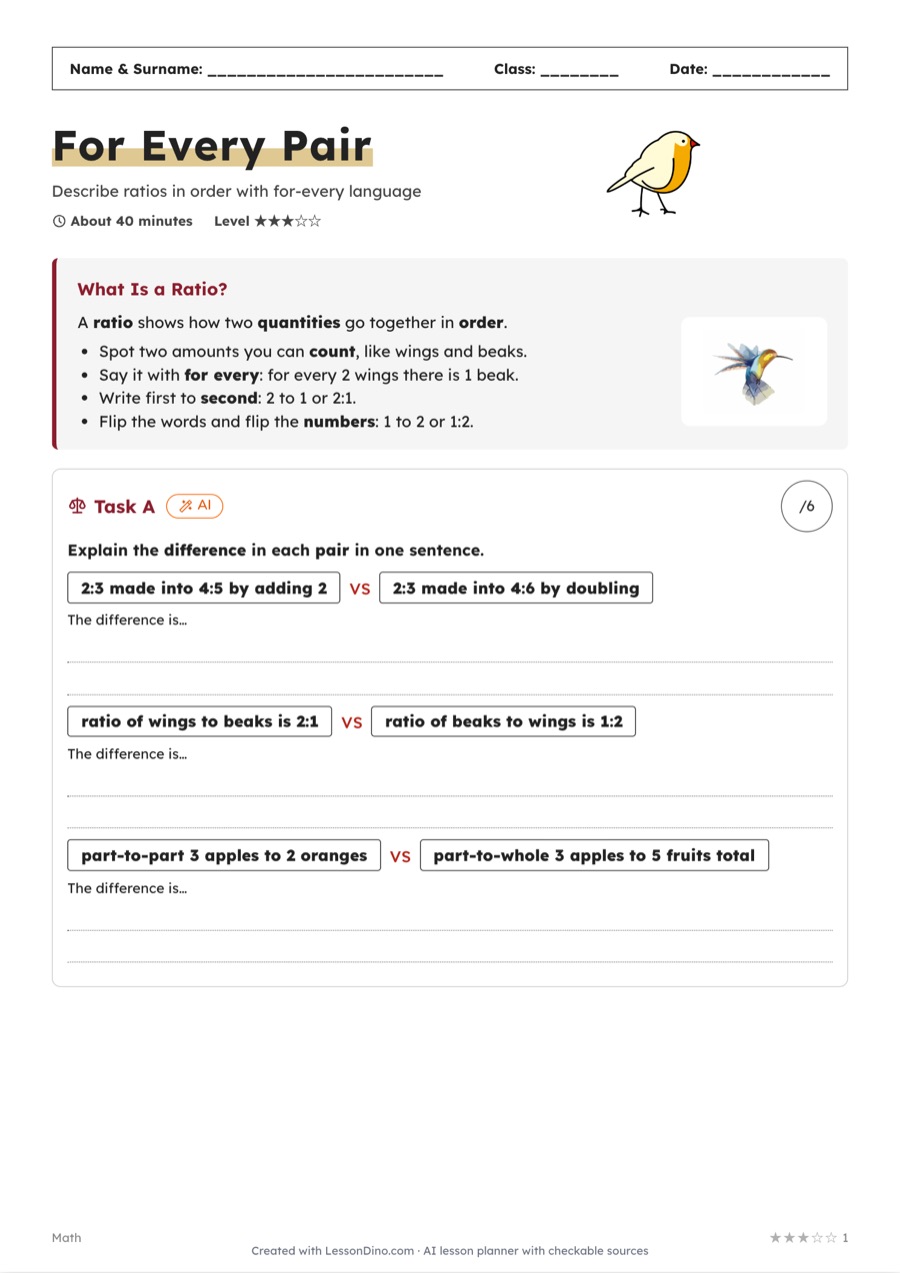
- Thinking 2:3 is equivalent to 4:5 by adding 2 to each number
How to spot it: Student writes 2:3 = 4:5 and talks about difference of 2
Show with drawings that both piles must be multiplied: 2:3 scales to 4:6, because the relationship is multiplicative in nature, not additive - Reversing order, writing B:A for A to B
How to spot it: Student says wings to beaks but writes 1:2
Have them point to first pile then second while saying first to second, because when taking ratios, the order of the two numbers matters - Mixing part-to-part with part-to-whole
How to spot it: Student says 3 apples to 5 fruit as 3:2
Count and label part, part, total first; practice that we can compare one kind to total nuts in a jar as well as one kind to another kind
Support
- Give the frame: For every __ of the first thing, there is __ of the second thing.
- Start with totals under 10 and keep pictures next to words.
- Have students write each ratio as a fraction first, then read colon and to forms.
Stretch
- Ask what changes if the order flips to beaks to wings, and have students say the new for-every sentence.
- Ask students to describe the same groups as a part-to-whole comparison.
- Call a larger ratio like 3 to 2 and ask groups to predict how many of each 12 and 8 would need.
Check questions
- Imagine a tray with 3 apples and 2 oranges. What is the ratio of apples to oranges? Say it with for every.
Answer: 3:2; For every 3 apples there are 2 oranges. - Write the ratio of beaks to wings if wings to beaks is 2:1.
Answer: 1:2; For every 1 beak there are 2 wings. - True or false with reason: 2:3 and 4:5 show the same ratio relationship.
Answer: False; you must multiply both numbers by the same number, so 2:3 matches 4:6, not 4:5.
Curriculum
Understand the concept of a ratio and use ratio language to describe a ratio relationship between two quantities.
Video clips
Clips on YouTube, from the start and end times we chose. Check each one before you show it.
-
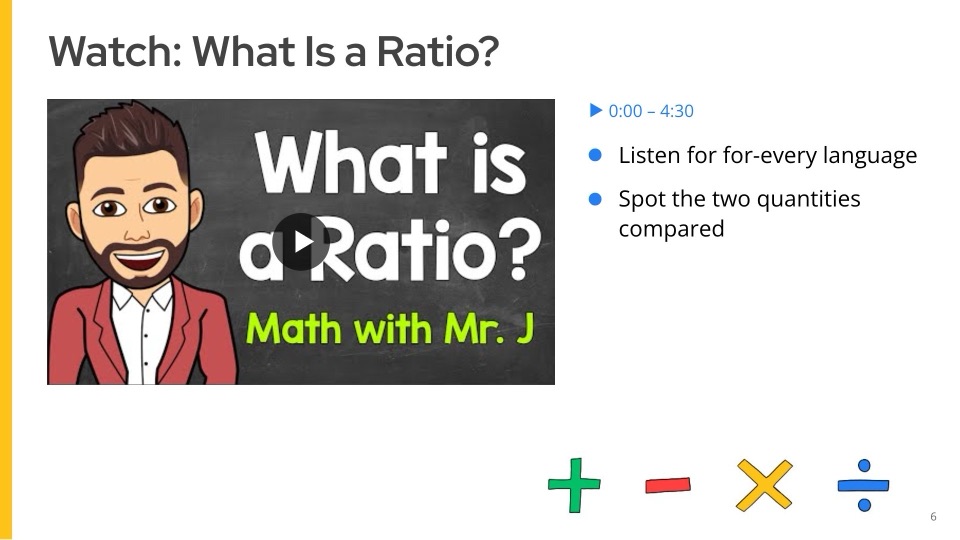
intro to ratios from 0:00 to 4:30
Math with Mr. J: An Intro to Ratios | What is a Ratio? | Understanding Ratios | Math with Mr. J
Directly introduces what a ratio is with simple examples at a perfect pace and vocabulary for 11-12-year-olds.
-
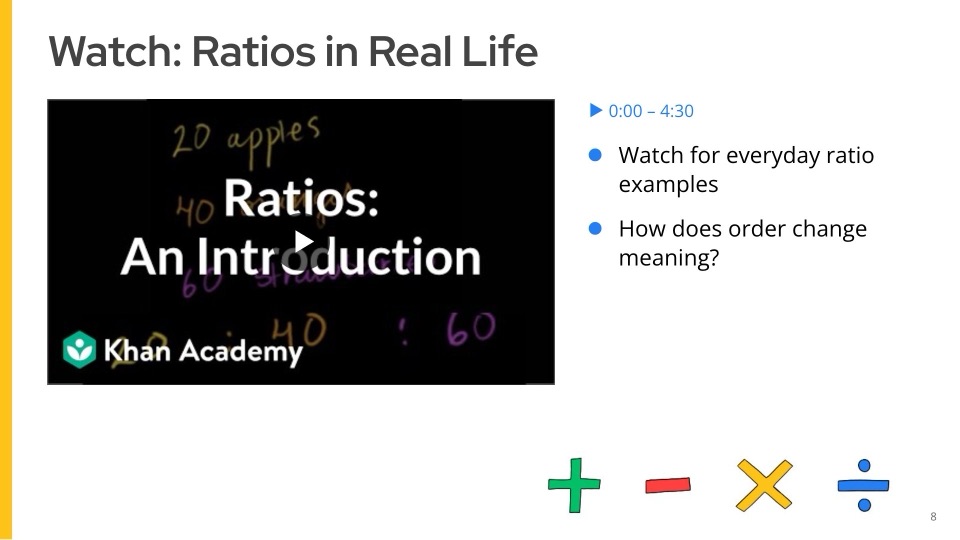
Khan intro to ratios from 0:00 to 4:30
Khan Academy: Introduction to ratios | Ratios, proportions, units, and rates | Pre-Algebra | Khan Academy
Trusted education channel introducing ratio language with everyday examples at the right level for 11-12-year-olds in Grade 6.
Worksheet
Sources
- Grade 6 Math Curriculum - Fairfax County Public Schools fcps.edu
- Grade 6 Math | SFUSD sfusd.edu
- Helping Students With Mathematics Difficulties Understand ... files.eric.ed.gov
- Ratios - mital.uaa.alaska.edu mital.uaa.alaska.edu
- Ratios, Rates, Percents and Proportion static.ias.edu
- Home - Financial Ratios - Library Guides at Nova Southeastern ... libguides.nova.edu
- Ratio language and notation KS3 | Y7 Maths | Lesson Resources thenational.academy
- 6th Grade Math | Understanding and Representing Ratios fishtanklearning.org
- Understanding Ratios - A Comprehensive Guide | Math Ratios mathratios.com
- Kids Math: Ratios - Ducksters ducksters.com
- All about Ratios (article) | Ratios | Khan Academy khanacademy.org
- Grade 6 » Ratios & Proportional Relationships | Common Core ... thecorestandards.org
- Ratio - KS2 Maths - BBC Bitesize bbc.co.uk
Picture credits
- Photo: manfredrichter · Pixabay
- Illustration: Sunriseforever · Pixabay
- Photo: Nicman · Pixabay
- Photo: JillWellington · Pixabay
- Photo: AS_Photography · Pixabay
- Illustration: Clker-Free-Vector-Images · Pixabay
- Pictograms: Sergio Palao, ARASAAC (arasaac.org) · CC BY-NC-SA
Made with Lesson Dino's AI on 17 October 2026. AI can make mistakes, so check facts against the sources before you teach.