The worksheet
About this worksheet
Students learn to show solids as nets and add face areas. They design a gift-box net and find wrapping paper needed. This Grade 6 Math worksheet gives students (ages 11–12) five pages of practice on nets and surface area, part of the geometry unit. It goes with our free Nets and surface area lesson, which has the slides and a timed lesson plan.
What it covers
By the end, students should be able to:
- Students will represent prisms and pyramids using nets of rectangles and triangles.
- Students will find surface area by adding areas of all faces in a net.
- Students will solve real-world wrapping problems using nets and surface area.
How to use it
- Guided Practice (12 minutes): Have class complete Worksheet Task A for area recall, then check answers together.
- Main Activity (22 minutes): Show Slide 9 task and hand out grid paper, rulers, colored pencils, price cards, and Worksheet Task B.
- Support: Provide starter net outline with length and width marked beside each rectangle.
- Stretch: Add flaps to the gift-box net and estimate extra square inches needed.
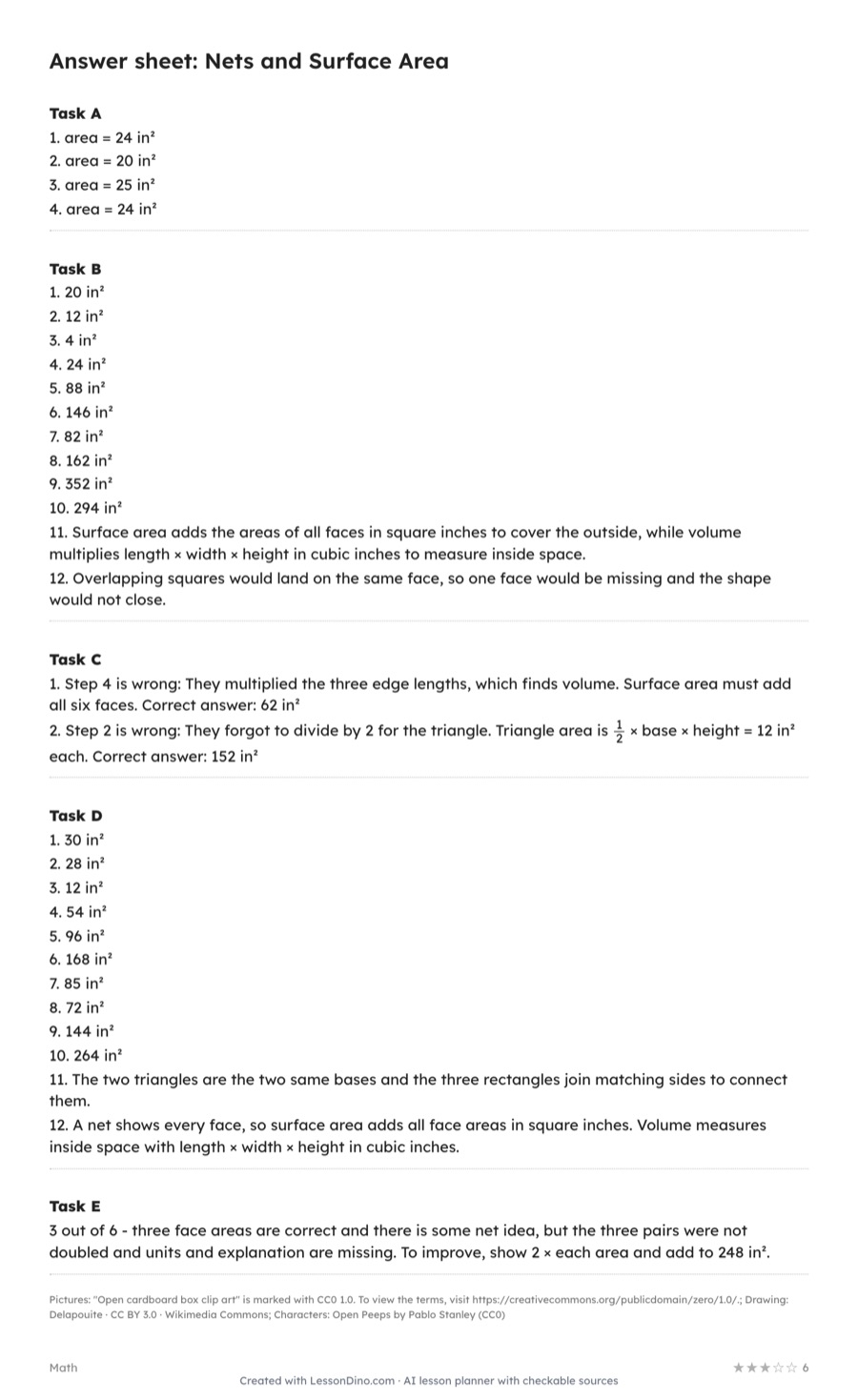
- The answer sheet is the last page, so you can print it on its own or let students check their own work.
Key vocabulary
- net: a flat pattern that can be folded to make a solid shape
- surface area: total amount covering the outside of a solid, counted in square units
- face: one flat side of a solid shape
- rectangular prism: a box shape with six rectangle sides in three matching pairs
- triangular prism: a solid with two triangle ends and three rectangle sides
Mistakes to watch for
- Multiplying length x width x height and reporting volume as surface area. Stress surface area covers the outside only: list every face area, then add in square units.
- Counting only faces seen in a drawing and forgetting back and bottom. Use the net which shows every face, and check opposite faces of a prism came out equal.
- Accepting any six connected squares as a cube net. Trace the fold with a finger or cut from paper; some arrangements overlap when folded.
What's on the worksheet
Unfold and Add
Remember area, then add faces to get surface area.
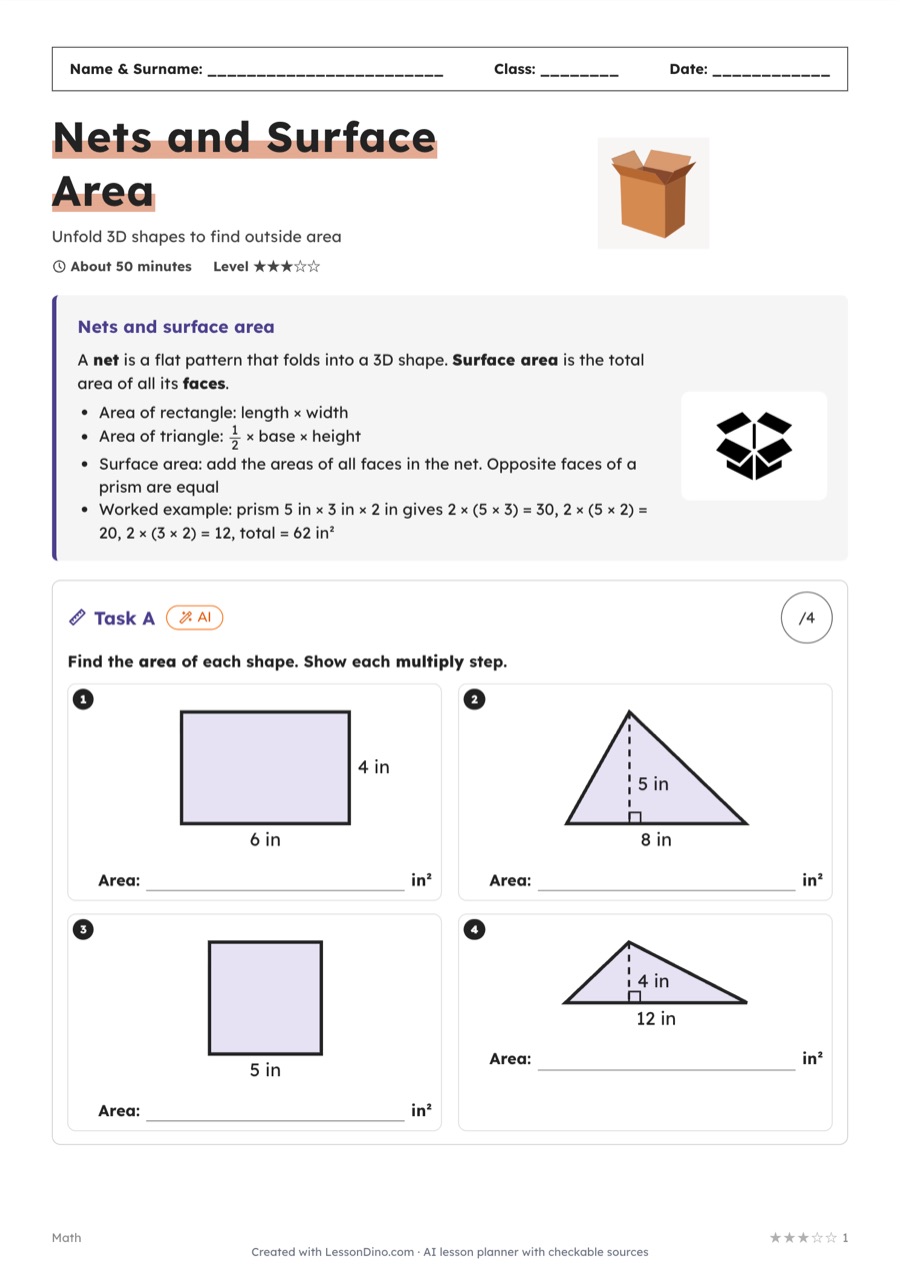
Nets and surface area
- A net is a flat pattern that folds into a 3D shape. Surface area is the total area of all its faces.
- Area of rectangle: length × width
- Area of triangle: 1/2 × base × height
- Surface area: add the areas of all faces in the net. Opposite faces of a prism are equal
- Worked example: prism 5 in × 3 in × 2 in gives 2 × (5 × 3) = 30, 2 × (5 × 2) = 20, 2 × (3 × 2) = 12, total = 62 in²
Find the area of each shape. Show each multiply step.
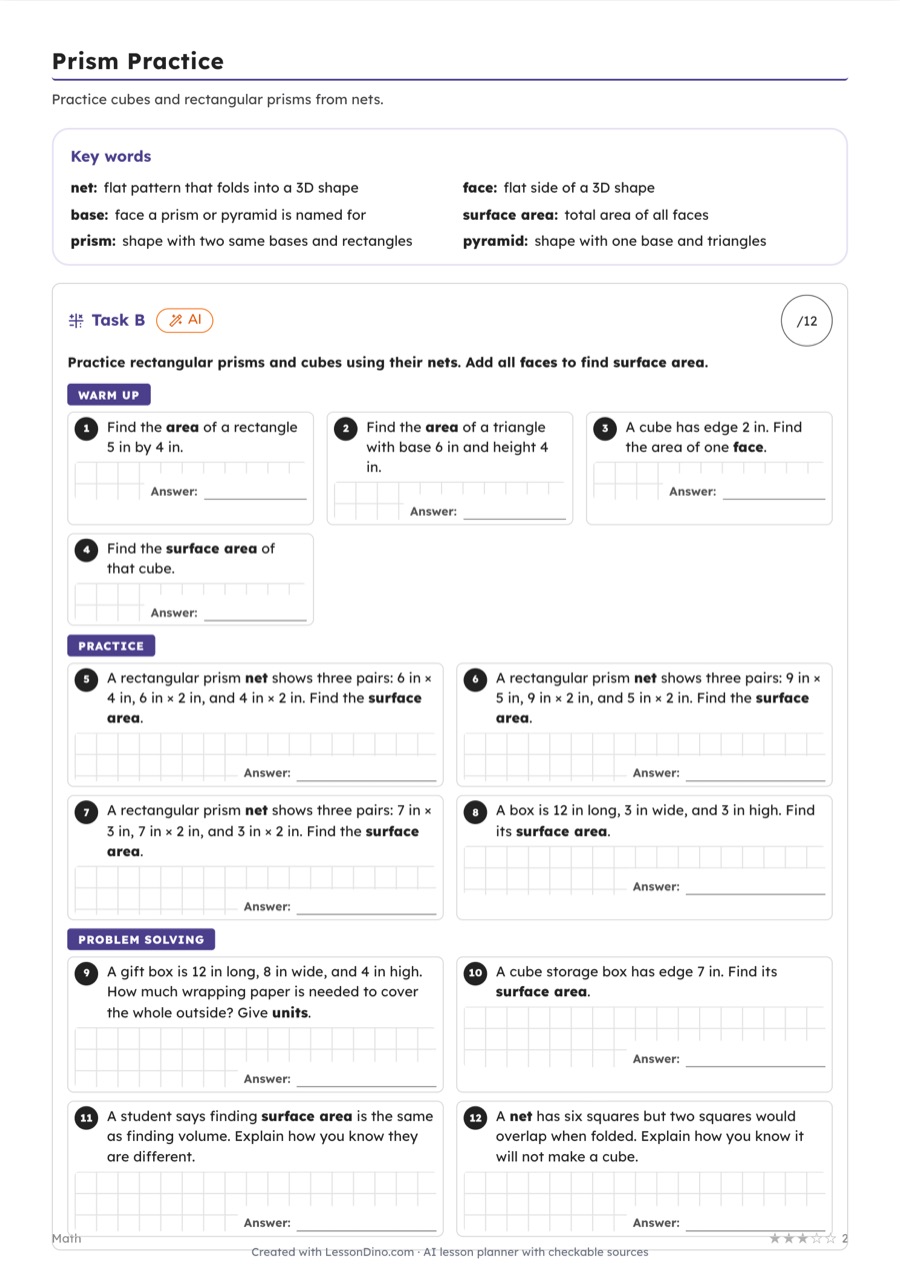
Prism Practice
Practice cubes and rectangular prisms from nets.
| Word | Meaning |
|---|---|
| net | flat pattern that folds into a 3D shape |
| face | flat side of a 3D shape |
| base | face a prism or pyramid is named for |
| surface area | total area of all faces |
| prism | shape with two same bases and rectangles |
| pyramid | shape with one base and triangles |
Practice rectangular prisms and cubes using their nets. Add all faces to find surface area.
Warm up
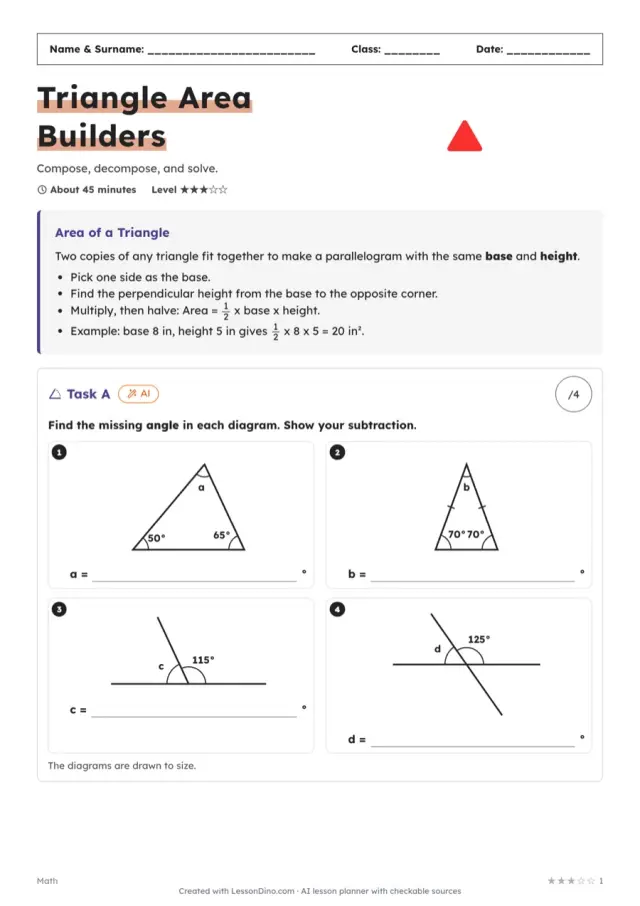
- Find the area of a rectangle 5 in by 4 in.
- Find the area of a triangle with base 6 in and height 4 in.
- A cube has edge 2 in. Find the area of one face.
- Find the surface area of that cube.
Practice
- A rectangular prism net shows three pairs: 6 in × 4 in, 6 in × 2 in, and 4 in × 2 in. Find the surface area.
- A rectangular prism net shows three pairs: 9 in × 5 in, 9 in × 2 in, and 5 in × 2 in. Find the surface area.
- A rectangular prism net shows three pairs: 7 in × 3 in, 7 in × 2 in, and 3 in × 2 in. Find the surface area.
- A box is 12 in long, 3 in wide, and 3 in high. Find its surface area.
Problem solving
- A gift box is 12 in long, 8 in wide, and 4 in high. How much wrapping paper is needed to cover the whole outside? Give units.
- A cube storage box has edge 7 in. Find its surface area.
- A student says finding surface area is the same as finding volume. Explain how you know they are different.
- A net has six squares but two squares would overlap when folded. Explain how you know it will not make a cube.
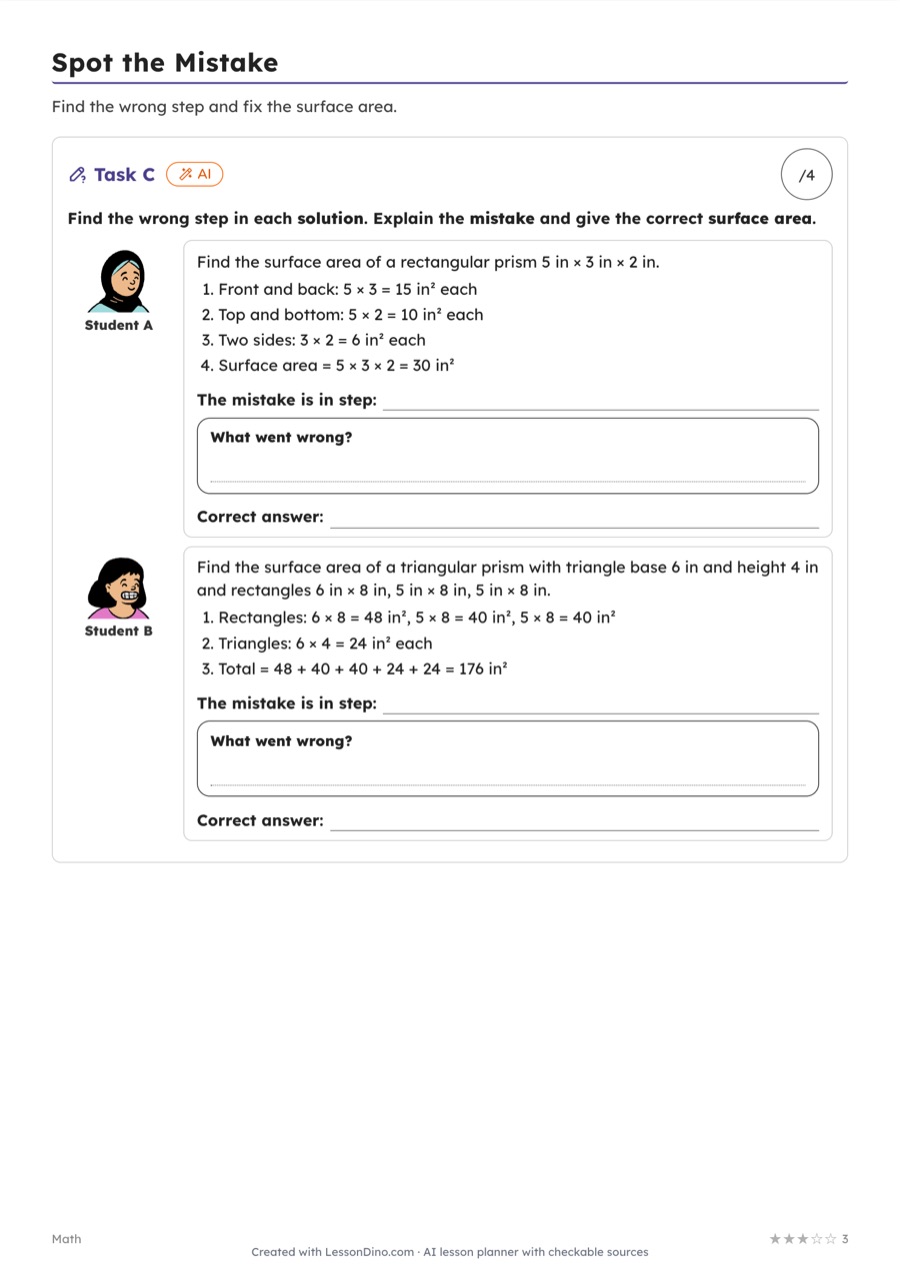
Spot the Mistake
Find the wrong step and fix the surface area.
Find the wrong step in each solution. Explain the mistake and give the correct surface area.
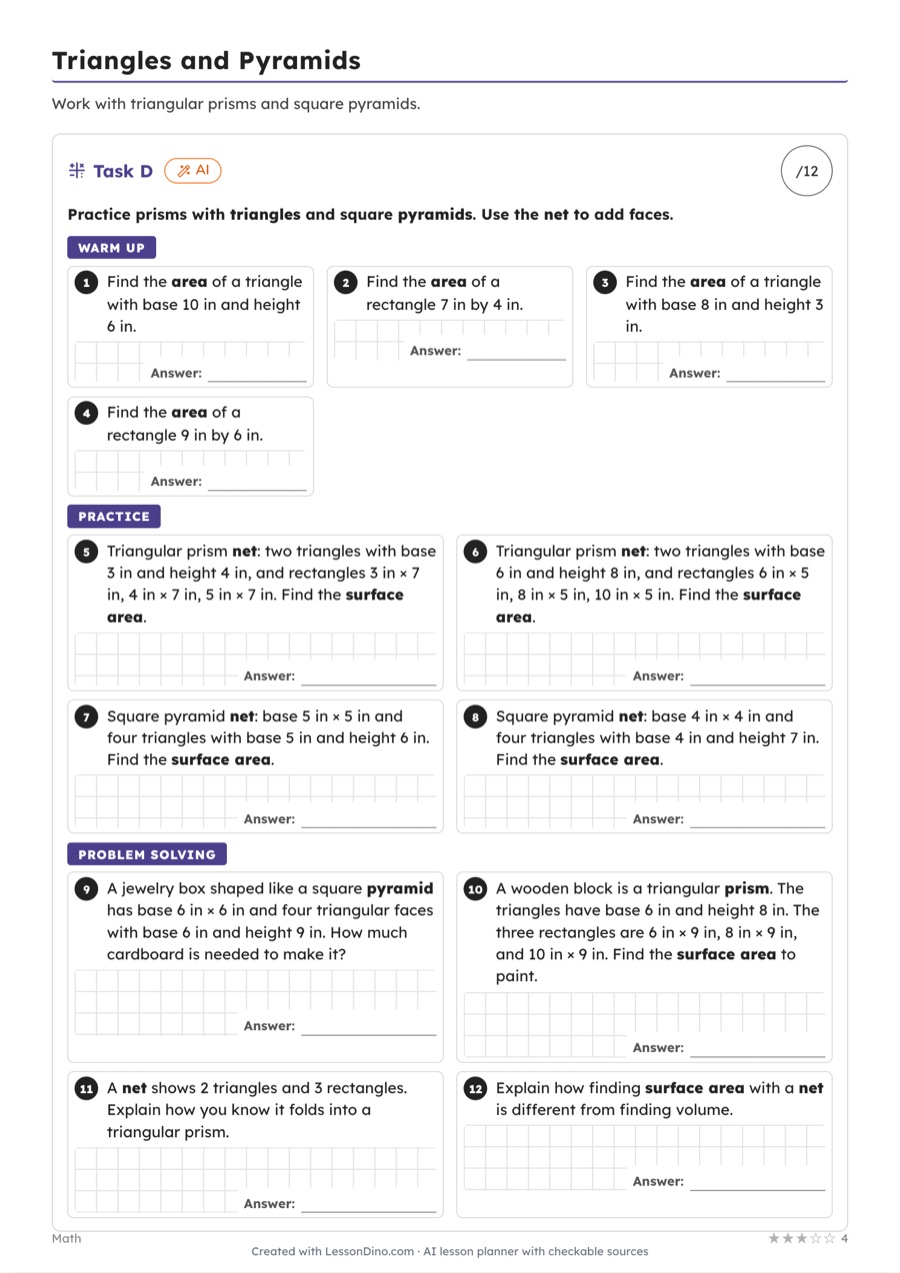
Triangles and Pyramids
Work with triangular prisms and square pyramids.
Practice prisms with triangles and square pyramids. Use the net to add faces.
Warm up
- Find the area of a triangle with base 10 in and height 6 in.
- Find the area of a rectangle 7 in by 4 in.
- Find the area of a triangle with base 8 in and height 3 in.
- Find the area of a rectangle 9 in by 6 in.
Practice
- Triangular prism net: two triangles with base 3 in and height 4 in, and rectangles 3 in × 7 in, 4 in × 7 in, 5 in × 7 in. Find the surface area.
- Triangular prism net: two triangles with base 6 in and height 8 in, and rectangles 6 in × 5 in, 8 in × 5 in, 10 in × 5 in. Find the surface area.
- Square pyramid net: base 5 in × 5 in and four triangles with base 5 in and height 6 in. Find the surface area.
- Square pyramid net: base 4 in × 4 in and four triangles with base 4 in and height 7 in. Find the surface area.
Problem solving
- A jewelry box shaped like a square pyramid has base 6 in × 6 in and four triangular faces with base 6 in and height 9 in. How much cardboard is needed to make it?
- A wooden block is a triangular prism. The triangles have base 6 in and height 8 in. The three rectangles are 6 in × 9 in, 8 in × 9 in, and 10 in × 9 in. Find the surface area to paint.
- A net shows 2 triangles and 3 rectangles. Explain how you know it folds into a triangular prism.
- Explain how finding surface area with a net is different from finding volume.
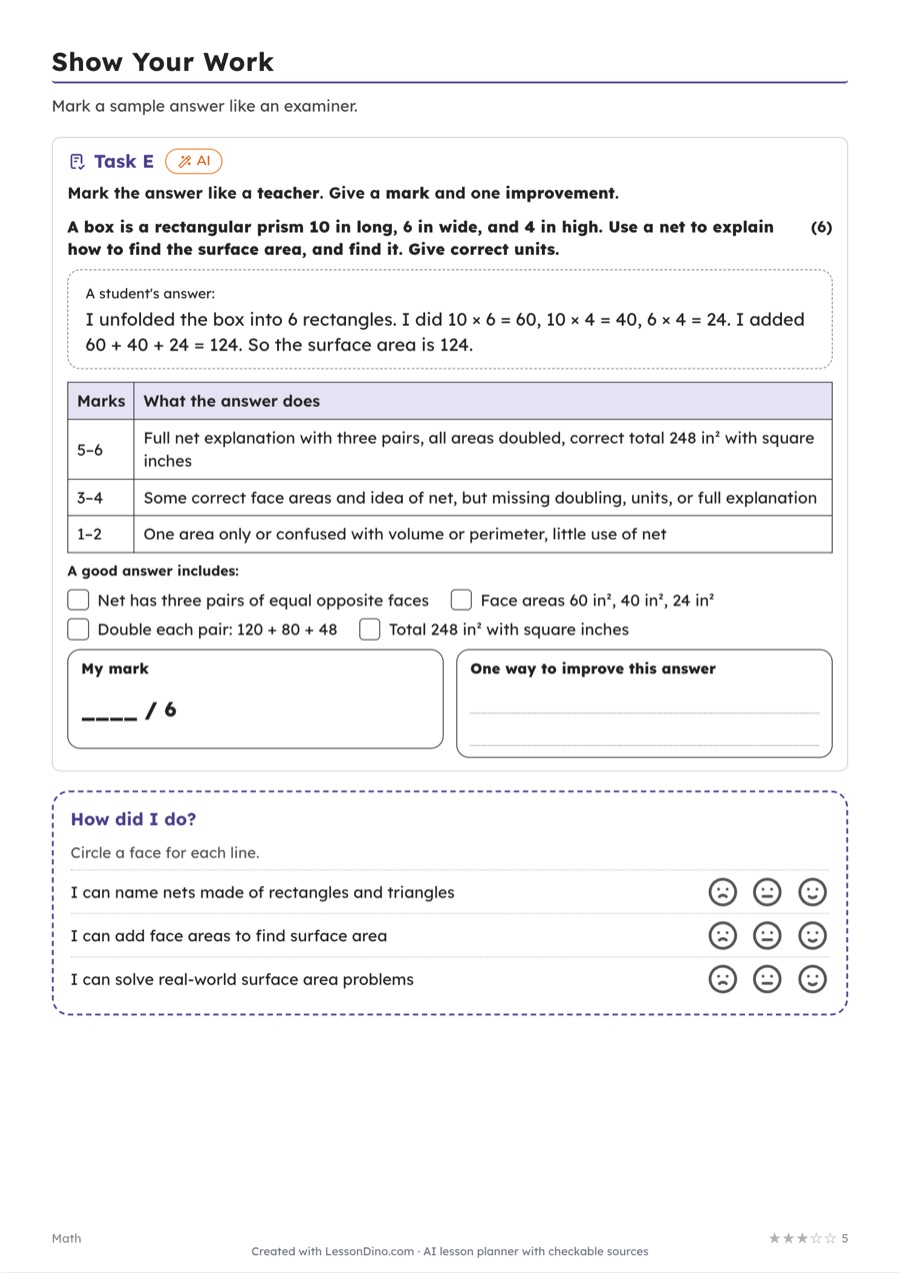
Show Your Work
Mark a sample answer like an examiner.
Mark the answer like a teacher. Give a mark and one improvement.
Answers
Show the answers
- Find the area of a rectangle 5 in by 4 in. 20 in²
- Find the area of a triangle with base 6 in and height 4 in. 12 in²
- A cube has edge 2 in. Find the area of one face. 4 in²
- Find the surface area of that cube. 24 in²
- A rectangular prism net shows three pairs: 6 in × 4 in, 6 in × 2 in, and 4 in × 2 in. Find the surface area. 88 in²
- A rectangular prism net shows three pairs: 9 in × 5 in, 9 in × 2 in, and 5 in × 2 in. Find the surface area. 146 in²
- A rectangular prism net shows three pairs: 7 in × 3 in, 7 in × 2 in, and 3 in × 2 in. Find the surface area. 82 in²
- A box is 12 in long, 3 in wide, and 3 in high. Find its surface area. 162 in²
- A gift box is 12 in long, 8 in wide, and 4 in high. How much wrapping paper is needed to cover the whole outside? Give units. 352 in²
- A cube storage box has edge 7 in. Find its surface area. 294 in²
- A student says finding surface area is the same as finding volume. Explain how you know they are different. Surface area adds the areas of all faces in square inches to cover the outside, while volume multiplies length × width × height in cubic inches to measure inside space.
- A net has six squares but two squares would overlap when folded. Explain how you know it will not make a cube. Overlapping squares would land on the same face, so one face would be missing and the shape would not close.
- Find the area of a triangle with base 10 in and height 6 in. 30 in²
- Find the area of a rectangle 7 in by 4 in. 28 in²
- Find the area of a triangle with base 8 in and height 3 in. 12 in²
- Find the area of a rectangle 9 in by 6 in. 54 in²
- Triangular prism net: two triangles with base 3 in and height 4 in, and rectangles 3 in × 7 in, 4 in × 7 in, 5 in × 7 in. Find the surface area. 96 in²
- Triangular prism net: two triangles with base 6 in and height 8 in, and rectangles 6 in × 5 in, 8 in × 5 in, 10 in × 5 in. Find the surface area. 168 in²
- Square pyramid net: base 5 in × 5 in and four triangles with base 5 in and height 6 in. Find the surface area. 85 in²
- Square pyramid net: base 4 in × 4 in and four triangles with base 4 in and height 7 in. Find the surface area. 72 in²
- A jewelry box shaped like a square pyramid has base 6 in × 6 in and four triangular faces with base 6 in and height 9 in. How much cardboard is needed to make it? 144 in²
- A wooden block is a triangular prism. The triangles have base 6 in and height 8 in. The three rectangles are 6 in × 9 in, 8 in × 9 in, and 10 in × 9 in. Find the surface area to paint. 264 in²
- A net shows 2 triangles and 3 rectangles. Explain how you know it folds into a triangular prism. The two triangles are the two same bases and the three rectangles join matching sides to connect them.
- Explain how finding surface area with a net is different from finding volume. A net shows every face, so surface area adds all face areas in square inches. Volume measures inside space with length × width × height in cubic inches.
The answer sheet is the last picture above.
Curriculum
Represent three-dimensional figures using nets made up of rectangles and triangles, and use the nets to find the surface area of these figures. Apply these techniques in the context of solving real-world and mathematical problems.
Made with Lesson Dino's AI on 19 October 2026. AI can make mistakes, so check the answers and facts against the sources before you teach.