Slides
Lesson plan
Wrap It Right: Nets to Surface Area
Students learn to show solids as nets and add face areas. They design a gift-box net and find wrapping paper needed.
Objectives
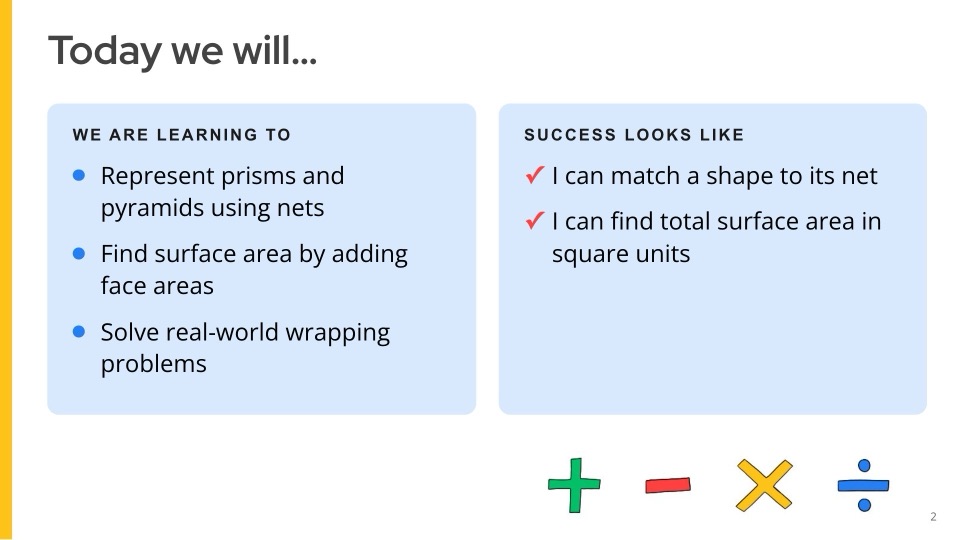
- Students will represent prisms and pyramids using nets of rectangles and triangles.
- Students will find surface area by adding areas of all faces in a net.
- Students will solve real-world wrapping problems using nets and surface area.
Success criteria
- I can match a solid to its net made of rectangles and triangles.
- I can find surface area by adding all face areas in square units.
- I can use a net to find wrapping paper needed for a box.
Key words
| Word | Meaning |
|---|---|
| net | a flat pattern that can be folded to make a solid shape |
| surface area | total amount covering the outside of a solid, counted in square units |
| face | one flat side of a solid shape |
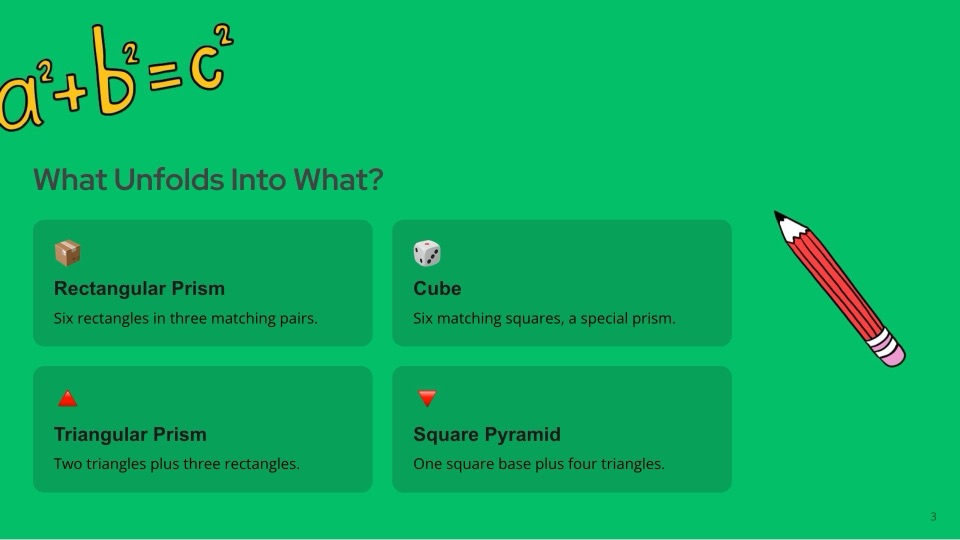
| rectangular prism | a box shape with six rectangle sides in three matching pairs |
| triangular prism | a solid with two triangle ends and three rectangle sides |
Timed plan (60 minutes)
| Time | Stage | What happens |
|---|---|---|
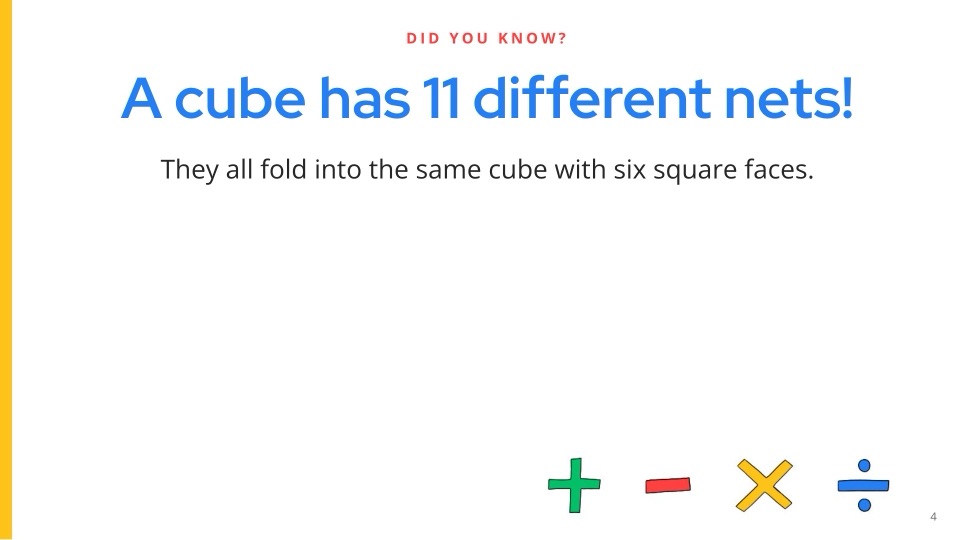
| 8 min | Starter | Activate area knowledge and hook students on nets as gift-shop wrapping problems. Show Slide 1 title and Slide 2 objectives, read the three goals with the class. Show Slide 3 cards and ask students to name the rectangular prism, cube, and triangular prism from faces. Show Slide 4 fact and deliver the hook: You run a gift shop — how much paper do you need to wrap this box with zero waste? Take quick answers on what shapes they would see if a box was cut open and laid flat. |
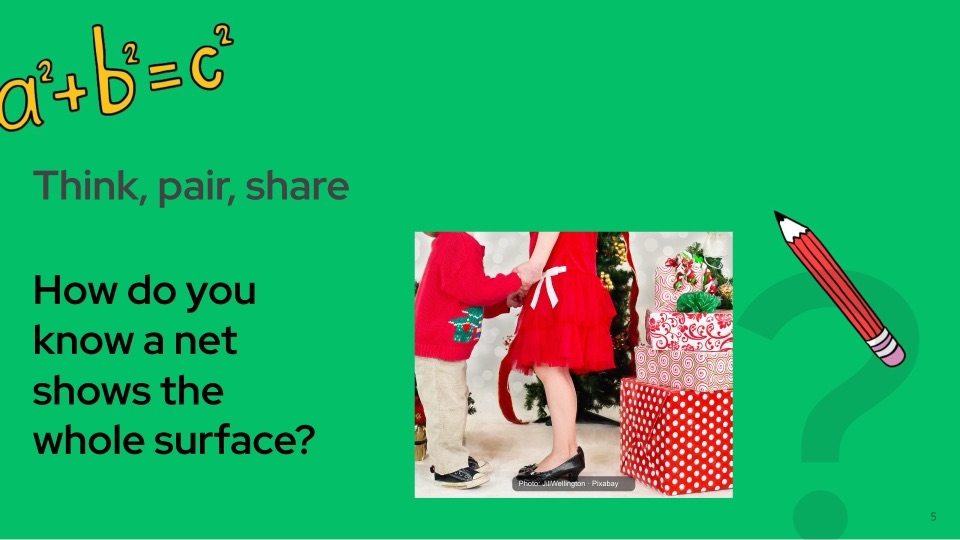
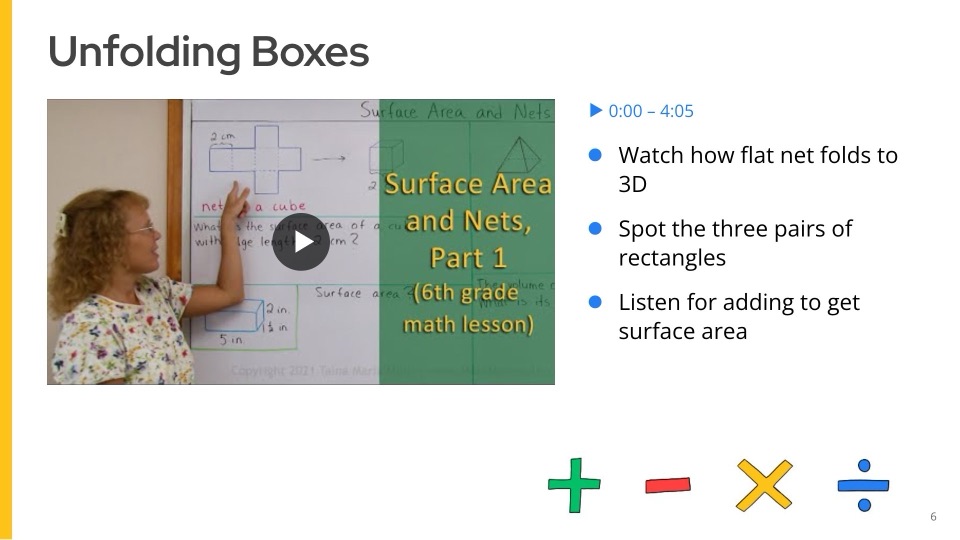
| 10 min | Teaching | Teach what a net shows and how prism and pyramid nets are built. Show Slide 5 question: How do you know a net shows the whole surface? Take pair ideas. Play Video clip 1 (0:00-4:05) on Slide 6 and ask students to spot the three pairs of rectangles. Explain prism and pyramid rules using models: a prism has two identical parallel bases with rectangles for sides, a pyramid has one base with triangles meeting at a point. Model finger-tracing a fold to find where faces would overlap, since some arrangements overlap and are not nets. |
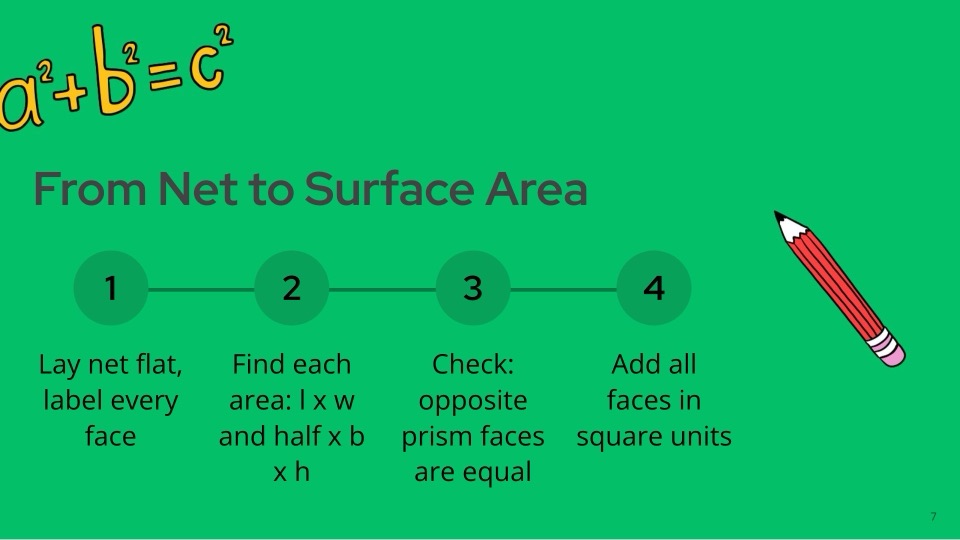
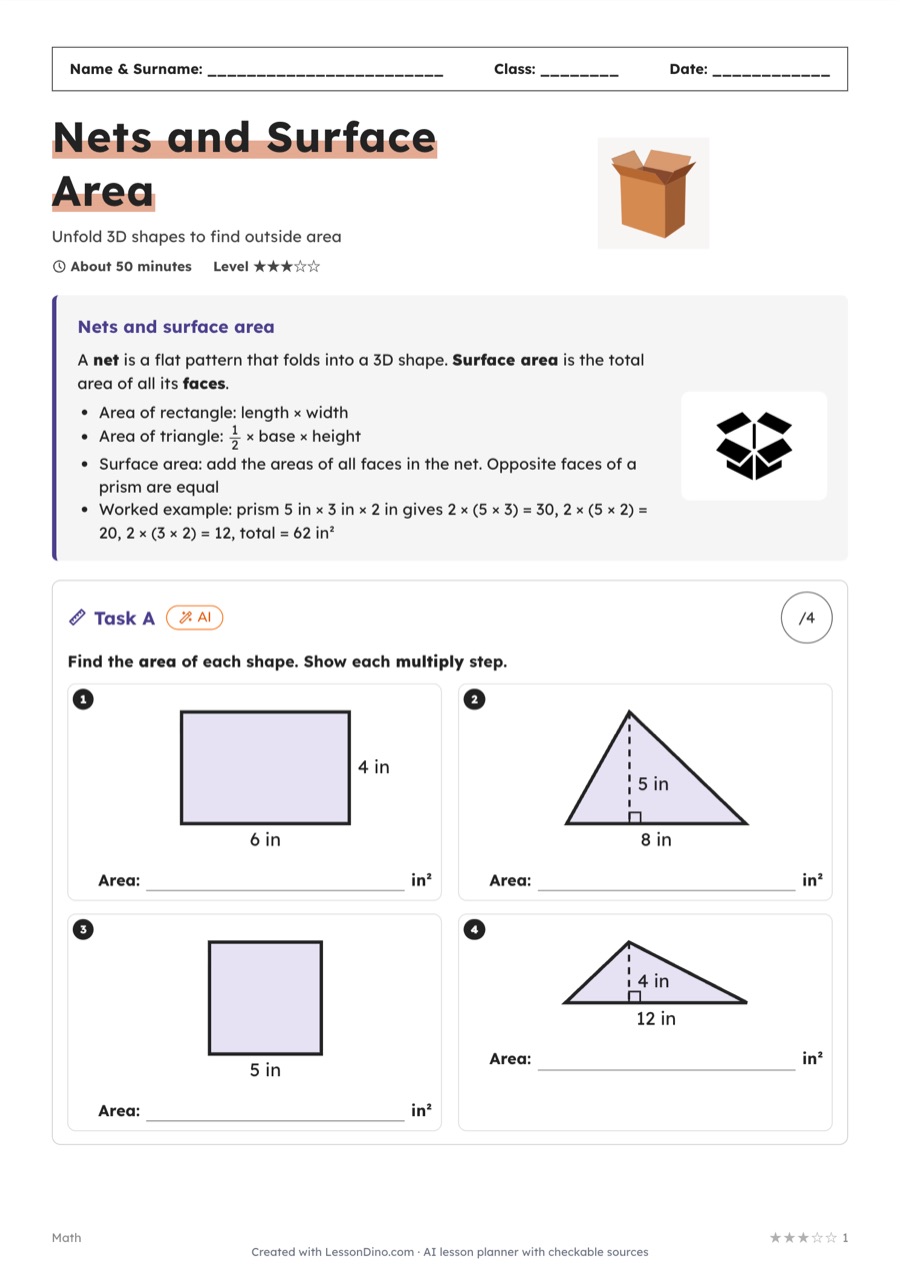
| 12 min | Guided Practice | Model finding surface area from a net by adding rectangle and triangle areas. Show Slide 7 steps: lay net flat, label every face, find each area, check opposites match, add in square units. Model rectangle area as length times width and triangle area as base times height divided by two. Work the triangular prism example on the board, writing each face area beside it before adding. Have class complete Worksheet Task A for area recall, then check answers together. |
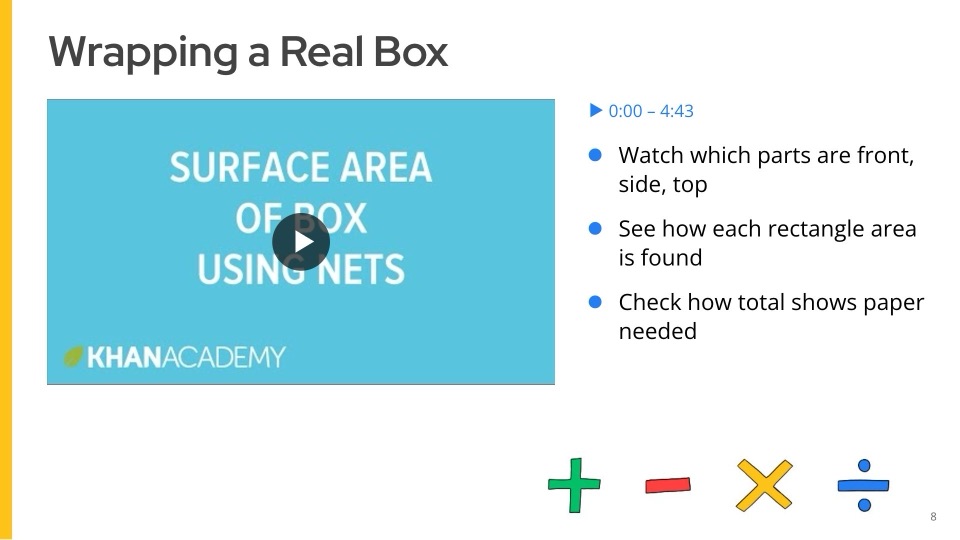
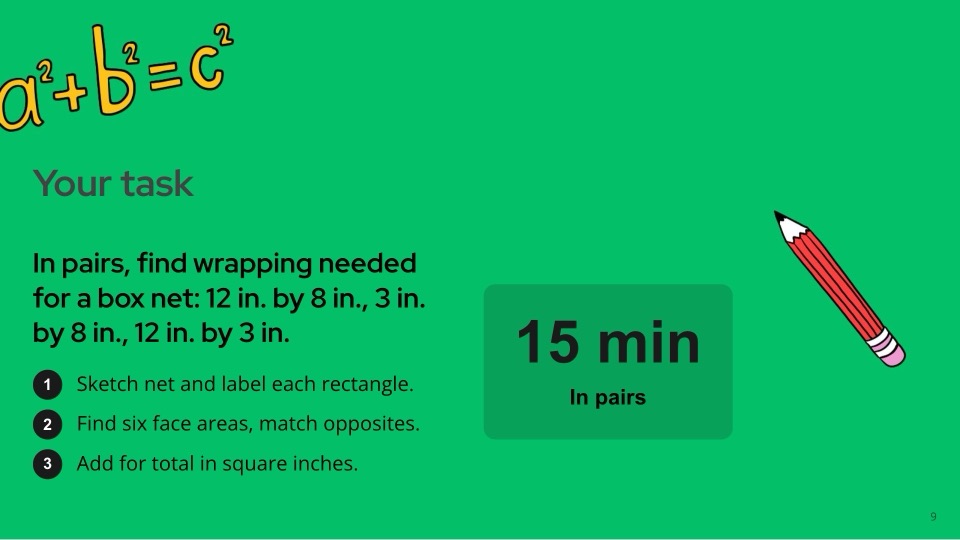
| 22 min | Main Activity | Use a box net to calculate wrapping paper needed and cost in a real problem. Show Slide 8 and play Video clip 4 (0:00-4:43) to model front, side, and top areas. Show Slide 9 task and hand out grid paper, rulers, colored pencils, price cards, and Worksheet Task B. Direct pairs to sketch the 12 in. by 8 in. by 3 in. box net, label six face areas, match opposites, and add for total. Circulate to check totals, then ask pairs to multiply square inches by $0.05 to get cost in dollars. |
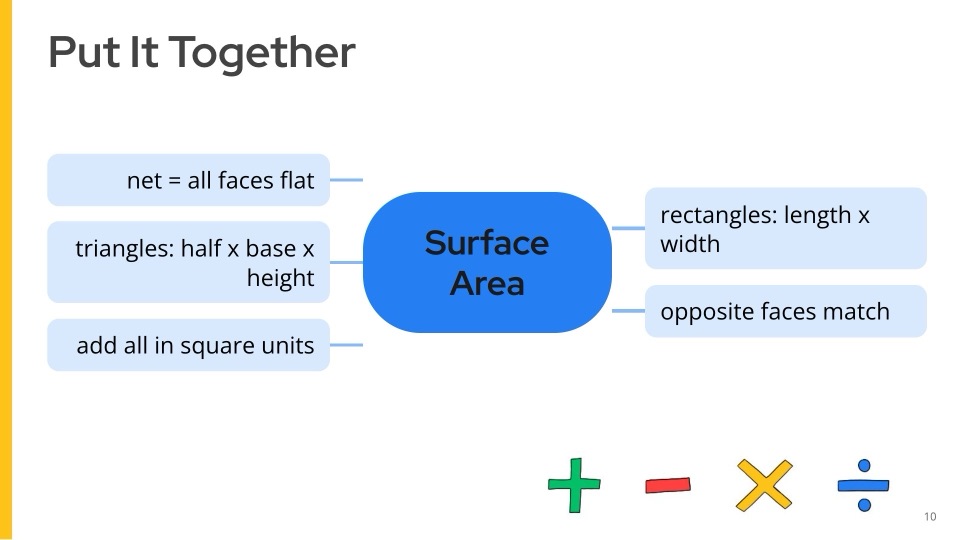
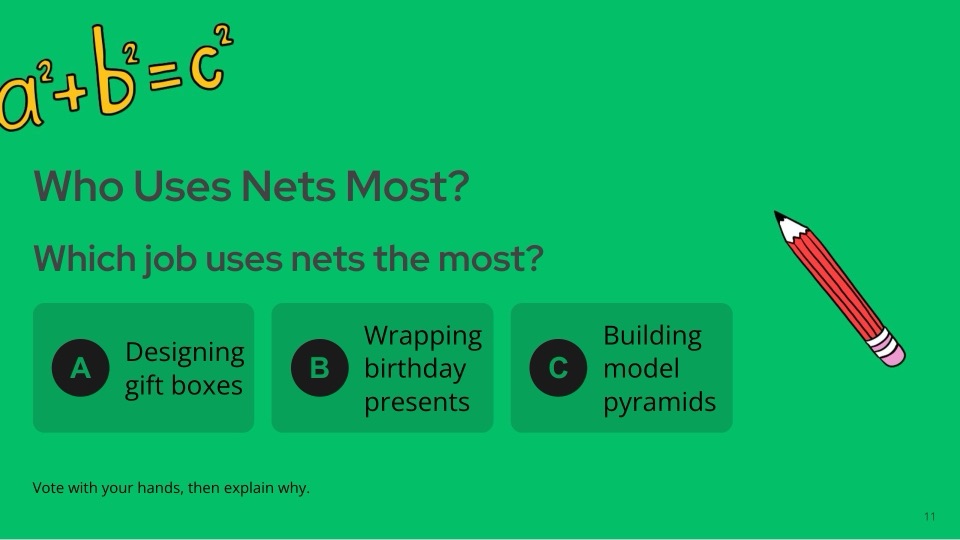
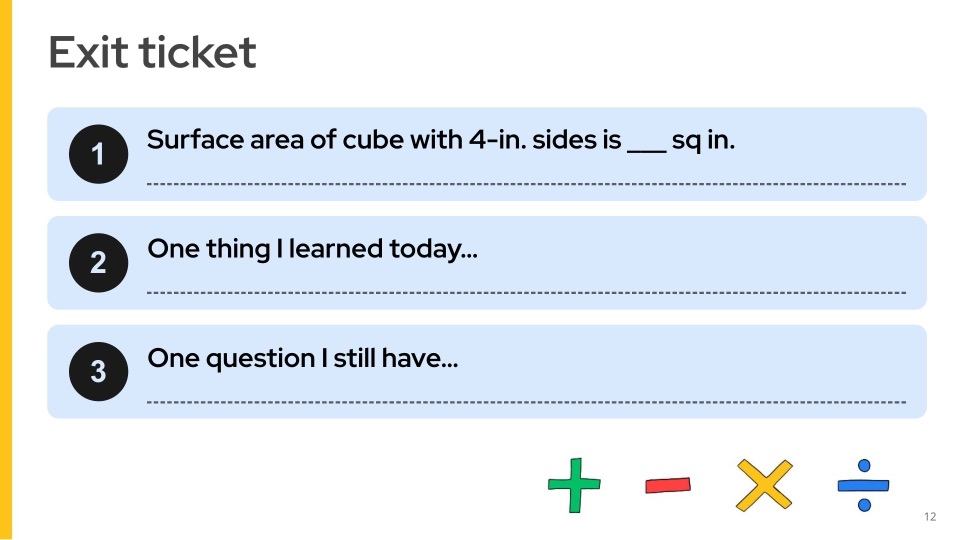
| 8 min | Plenary | Review nets and surface area and check who can apply them. Show Slide 10 mindmap and have students chorally complete: net = all faces flat, rectangles length x width, triangles half x base x height. Run Slide 11 vote: Which job uses nets the most? Take reasons for designing gift boxes, wrapping presents, building model pyramids. Show Slide 12 exit ticket and have students write answers on paper. Preview next step: pyramids with one square base and four triangles that meet at a point. |
Common mistakes
- Multiplying length x width x height and reporting volume as surface area.
How to spot it: Answer is in cubic units or far too large and no face areas are listed.
Stress surface area covers the outside only: list every face area, then add in square units. - Counting only faces seen in a drawing and forgetting back and bottom.
How to spot it: Total has only 3-4 faces, often missing one pair.
Use the net which shows every face, and check opposite faces of a prism came out equal. - Accepting any six connected squares as a cube net.
How to spot it: Student cannot name opposite faces or faces overlap when folded.
Trace the fold with a finger or cut from paper; some arrangements overlap when folded.
Support
- Provide starter net outline with length and width marked beside each rectangle
- Color opposite faces the same to show opposite sides are the same
- Keep one worked station showing each face area written beside it before adding
Stretch
- Add flaps to the gift-box net and estimate extra square inches needed
- Draw a second, different net layout for the same prism and compare totals
- Test what happens to surface area when one measurement is multiplied by 2
Check questions
- Surface area of cube with 4-in. sides is ___ sq in.
Answer: 96 sq in. (16 x 6) - A box net has faces 12x8, 12x8, 3x8, 3x8, 12x3, 12x3. What is the surface area?
Answer: 312 sq in. (192 + 48 + 72) - A square pyramid net has a 5-in. square base and four triangles with base 5 in. and height 6 in. What is the surface area?
Answer: 85 sq in. (25 + 15+15+15+15)
Curriculum
Represent three-dimensional figures using nets made up of rectangles and triangles, and use the nets to find the surface area of these figures. Apply these techniques in the context of solving real-world and mathematical problems.
Video clips
Clips on YouTube, from the start and end times we chose. Check each one before you show it.
-
Surface area and nets with a cube and box from 0:00 to 4:05
Math Mammoth: Surface area and nets, part 1 (6th grade math lesson)
Made as a 6th-grade lesson and directly teaches nets and surface area of a cube and rectangular prism for ages 11-12.
-
Surface area of a box using nets from 0:00 to 4:43
Khan Academy: Surface area of a box using nets
Khan Academy real-world box example perfect for Grade 6 that uses a net of rectangles to find surface area.
Worksheet
Sources
- Grade 6 Advanced Math Curriculum What is taught in grade 6 Advanced Mathematics? fcps.edu
- SST Grade 6 Mathematics TEKS - Texas Education Agency tea.texas.gov
- Surface Area - Nets, Definition, Formulae, Interactives and Examples flexbooks.ck12.org
- 5.2: Nets and Surface Area - Mathematics LibreTexts math.libretexts.org
- Surface Area using Nets Worksheets - Math Worksheets 4 Kids mathworksheets4kids.com
- Surface Area Using Nets Worksheets | Printable Free Online PDFs - Cuemath cuemath.com
- 6th Grade Math: Nets and Surface Area — Free Practice | PlutoABC plutoabc.com
- 6th grade surface area using nets worksheets - free PDF onemoresheet.com
- Surface Area of Prisms and Pyramids | Flexi Homework help & answers | CK-12 Foundation ck12.org
- Learn Surface Area - GeoGebra Math Resources geogebra.org
- MATH 6 : Nets and surface area - UnboundEd lessons.unbounded.org
- Surface Area Using Nets (Prisms & Pyramids) Math Video for Kids ... generationgenius.com
Picture credits
Made with Lesson Dino's AI on 19 October 2026. AI can make mistakes, so check facts against the sources before you teach.