The worksheet
About this worksheet
Students learn to find GCF, LCM, and rewrite sums with the distributive property. They hunt and fix mistakes in pairs and prove the corrections. This Grade 6 Math worksheet gives students (ages 11–12) five pages of practice on greatest common factor and least common multiple, part of the the number system unit. It goes with our free Greatest common factor and least common multiple lesson, which has the slides and a timed lesson plan.
What it covers
By the end, students should be able to:
- Students will find the GCF of two whole numbers up to 100.
- Students will find the LCM of two whole numbers up to 12.
- Students will rewrite a sum 1-100 as GCF times a simpler sum.
How to use it
- Main activity: Fix My Mistake (20 minutes): Hand out error cards and correction slips and assign Worksheet Tasks B and C.
- Support: Provide factor-pair starters, highlighted multiplication charts, and pre-listed multiples for 4 and 12.
- Stretch: Challenge students to write new error cards and to find GCFs up to 100 with proof of complete lists.
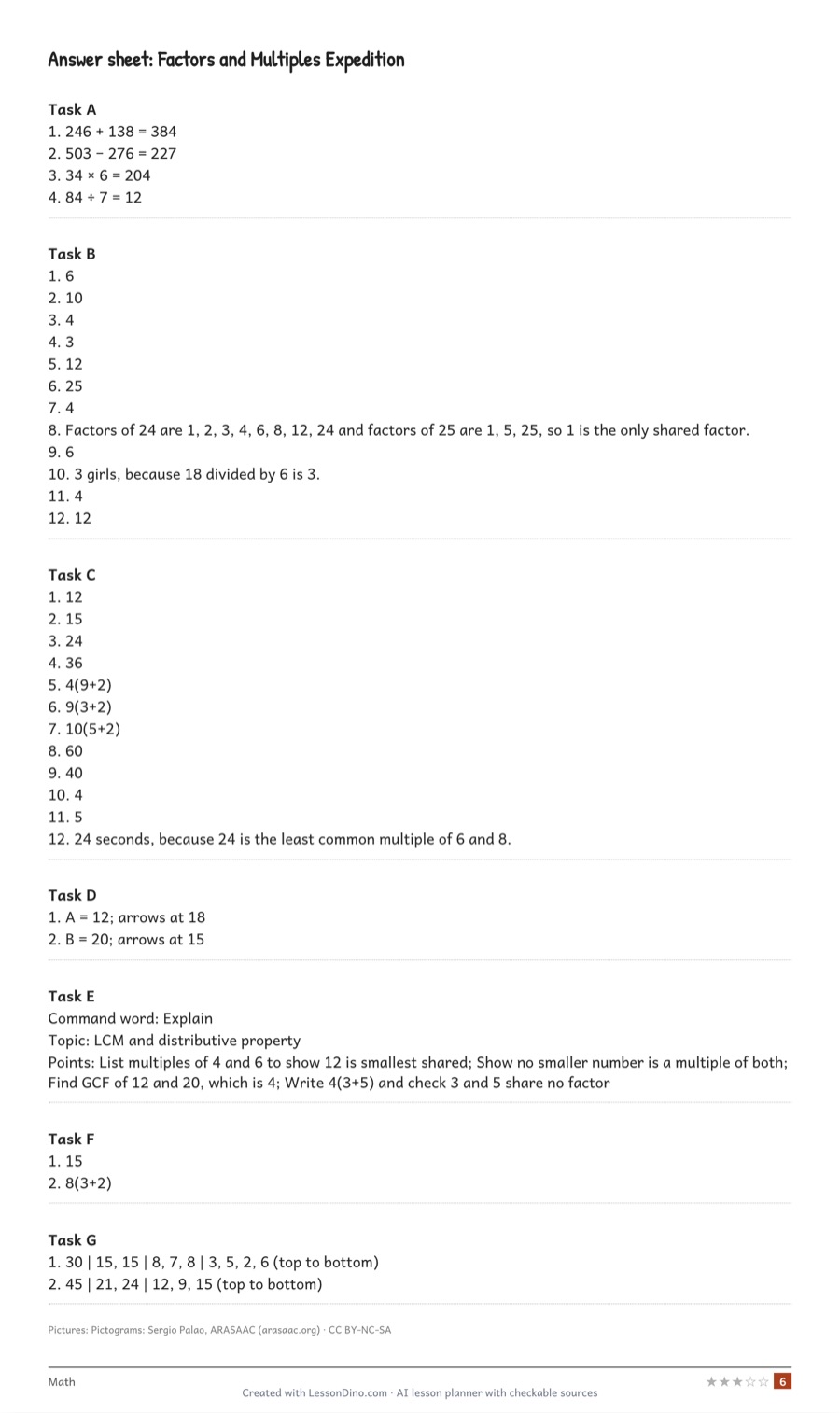
- The answer sheet is the last page, so you can print it on its own or let students check their own work.
Key vocabulary
- factor: a whole number that goes into another number with no remainder
- multiple: a number in that number's times table
- greatest common factor: the largest number that goes into both numbers evenly
- least common multiple: the smallest number found in both times tables
- distributive property: a rule to rewrite a sum as an outside number times an inside sum, as in 36 + 8 as 4 (9 + 2)
Mistakes to watch for
- Mixing up GCF and LCM and picking a large multiple for GCF. Ask: do we split into groups or wait for a shared time? Use factors for biggest divider and multiples in times tables for smallest shared multiple.
- Stopping at any common factor when rewriting a sum, like 36 + 8 as 2 (18 + 4). Require outside to be the GCF and check inside has no common factor, so correct to 4 (9 + 2).
- Missing factors or skipping multiples so first match is wrong. Rewrite lists in order: multiples of 4 are 4, 8, 12, 16 and check factor pairs until they repeat.
What's on the worksheet
Finding Common Factors
How GCF, LCM and the distributive property work.
GCF, LCM and Rewriting Sums
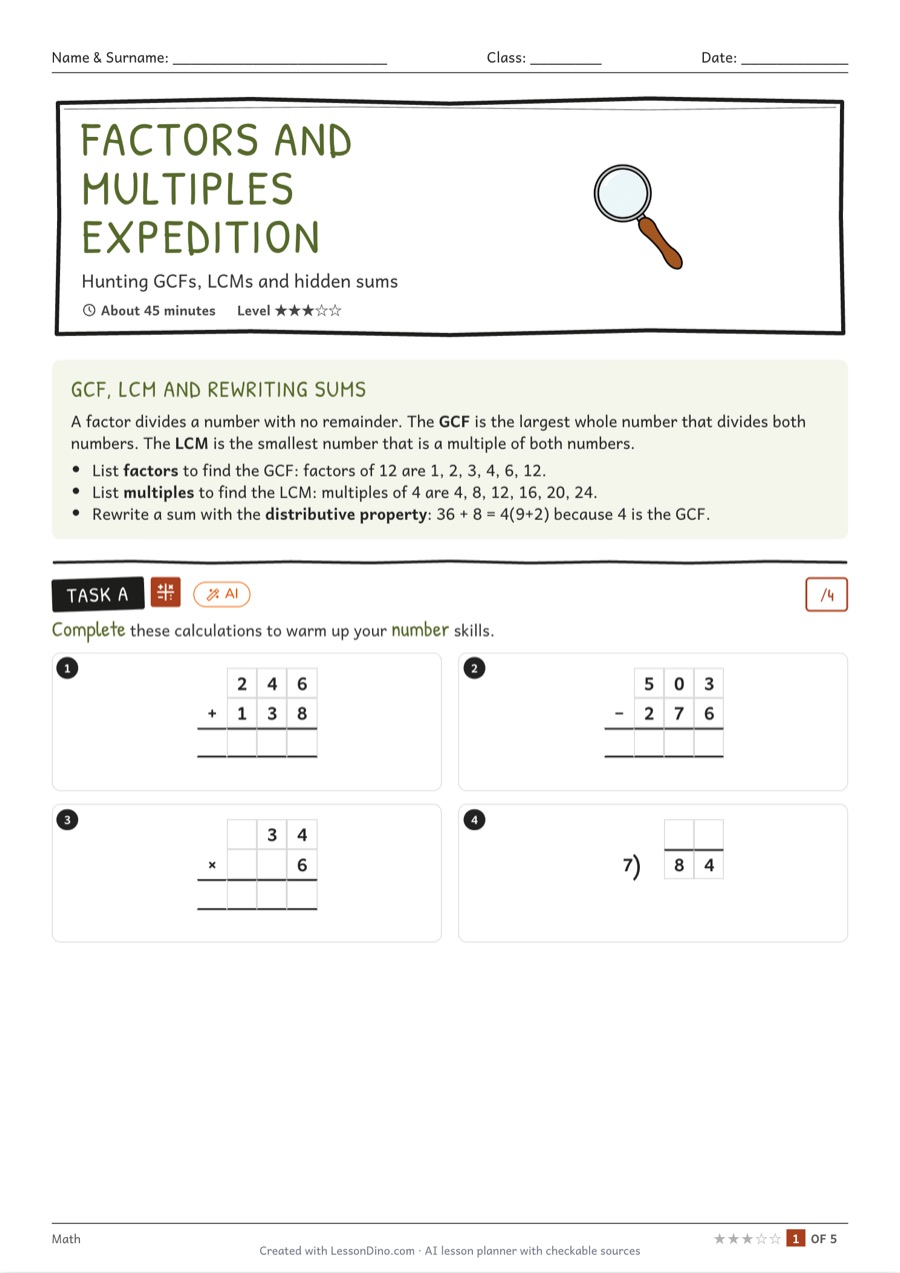
- A factor divides a number with no remainder. The GCF is the largest whole number that divides both numbers. The LCM is the smallest number that is a multiple of both numbers.
- List factors to find the GCF: factors of 12 are 1, 2, 3, 4, 6, 12.
- List multiples to find the LCM: multiples of 4 are 4, 8, 12, 16, 20, 24.
- Rewrite a sum with the distributive property: 36 + 8 = 4(9+2) because 4 is the GCF.
Complete these calculations to warm up your number skills.
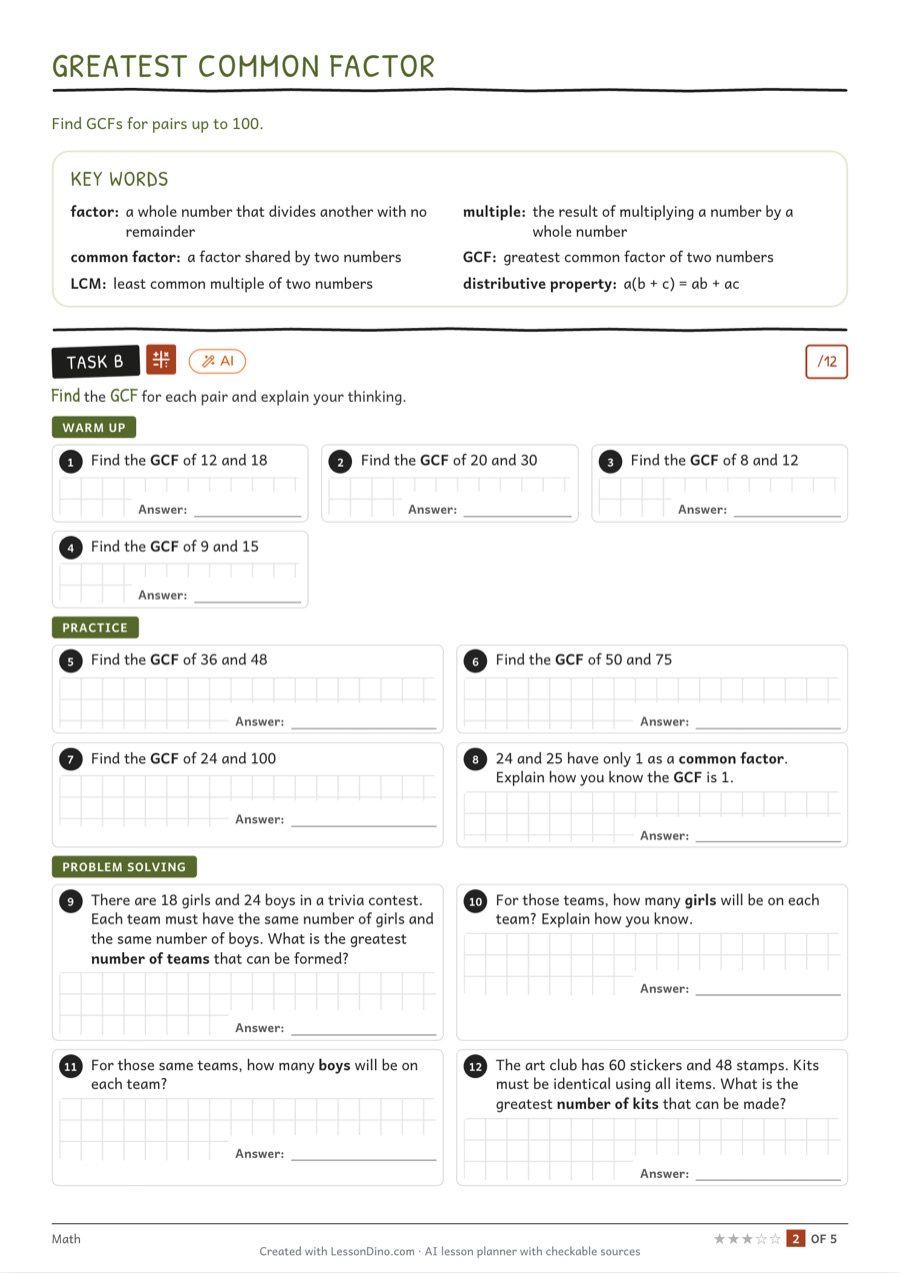
Greatest Common Factor
Find GCFs for pairs up to 100.
| Word | Meaning |
|---|---|
| factor | a whole number that divides another with no remainder |
| multiple | the result of multiplying a number by a whole number |
| common factor | a factor shared by two numbers |
| GCF | greatest common factor of two numbers |
| LCM | least common multiple of two numbers |
| distributive property | a(b + c) = ab + ac |
Find the GCF for each pair and explain your thinking.
Warm up
- Find the GCF of 12 and 18
- Find the GCF of 20 and 30
- Find the GCF of 8 and 12
- Find the GCF of 9 and 15
Practice
- Find the GCF of 36 and 48
- Find the GCF of 50 and 75
- Find the GCF of 24 and 100
- 24 and 25 have only 1 as a common factor. Explain how you know the GCF is 1.
Problem solving
- There are 18 girls and 24 boys in a trivia contest. Each team must have the same number of girls and the same number of boys. What is the greatest number of teams that can be formed?
- For those teams, how many girls will be on each team? Explain how you know.
- For those same teams, how many boys will be on each team?
- The art club has 60 stickers and 48 stamps. Kits must be identical using all items. What is the greatest number of kits that can be made?
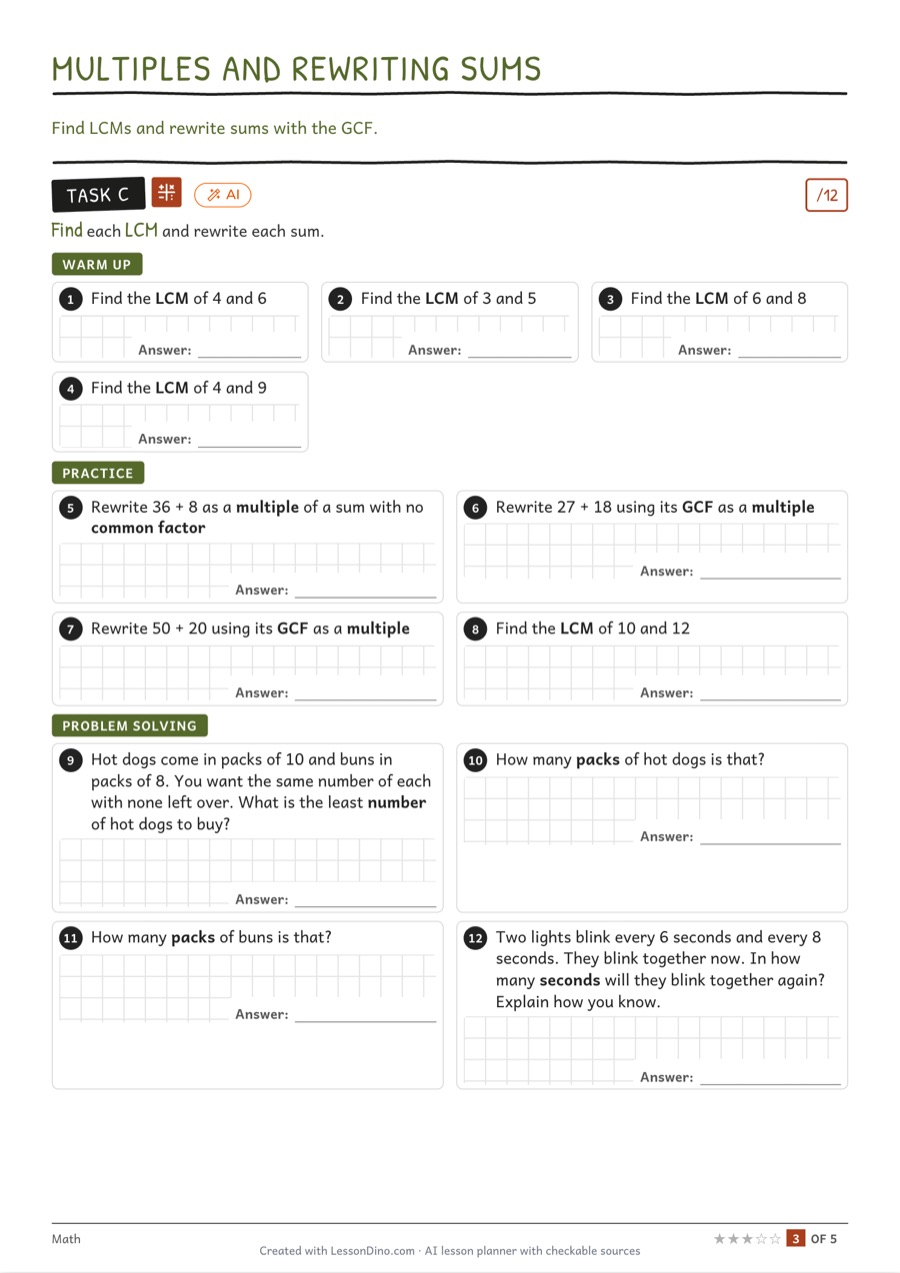
Multiples and Rewriting Sums
Find LCMs and rewrite sums with the GCF.
Find each LCM and rewrite each sum.
Warm up
- Find the LCM of 4 and 6
- Find the LCM of 3 and 5
- Find the LCM of 6 and 8
- Find the LCM of 4 and 9
Practice
- Rewrite 36 + 8 as a multiple of a sum with no common factor
- Rewrite 27 + 18 using its GCF as a multiple
- Rewrite 50 + 20 using its GCF as a multiple
- Find the LCM of 10 and 12
Problem solving
- Hot dogs come in packs of 10 and buns in packs of 8. You want the same number of each with none left over. What is the least number of hot dogs to buy?
- How many packs of hot dogs is that?
- How many packs of buns is that?
- Two lights blink every 6 seconds and every 8 seconds. They blink together now. In how many seconds will they blink together again? Explain how you know.
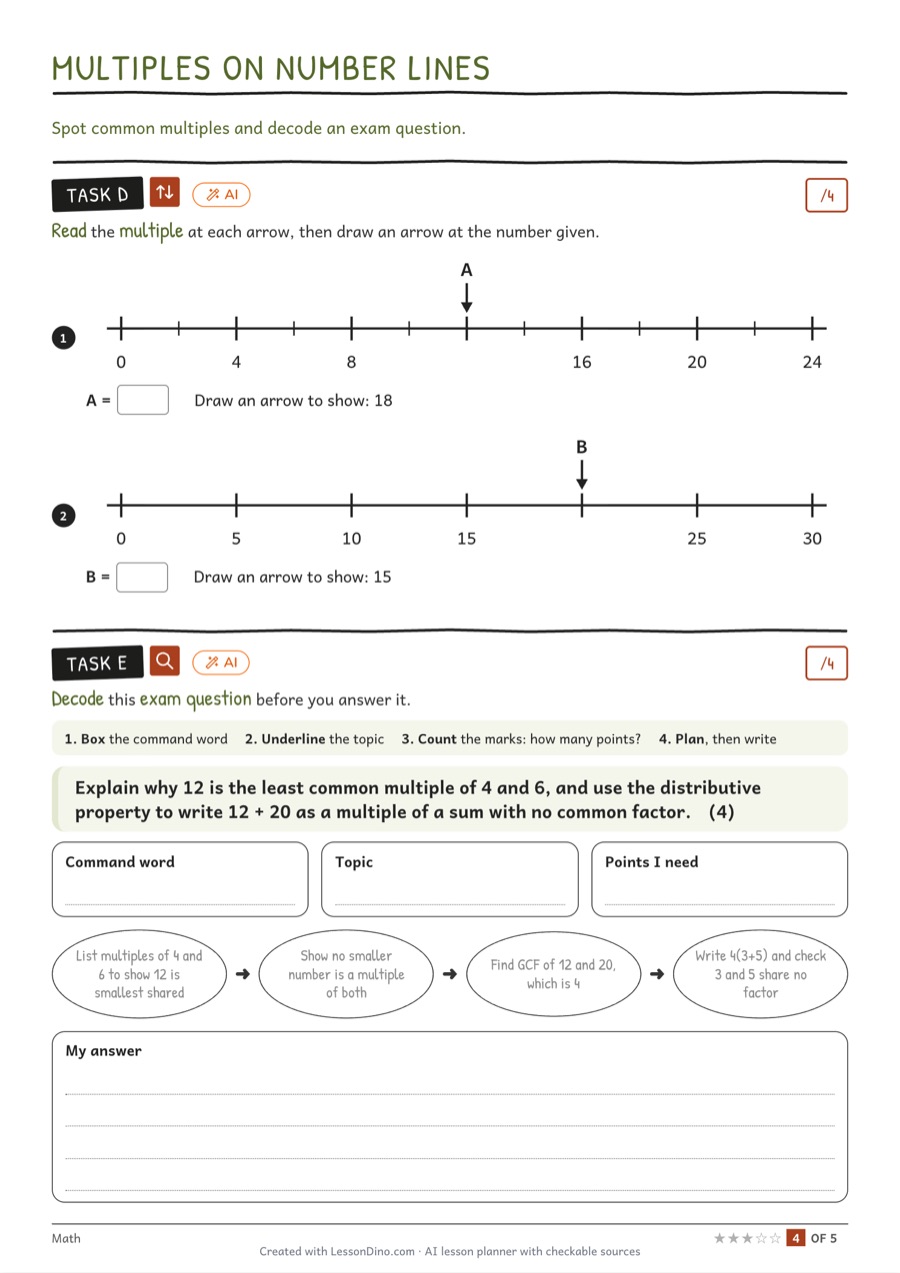
Multiples on Number Lines
Spot common multiples and decode an exam question.
Read the multiple at each arrow, then draw an arrow at the number given.
Decode this exam question before you answer it.
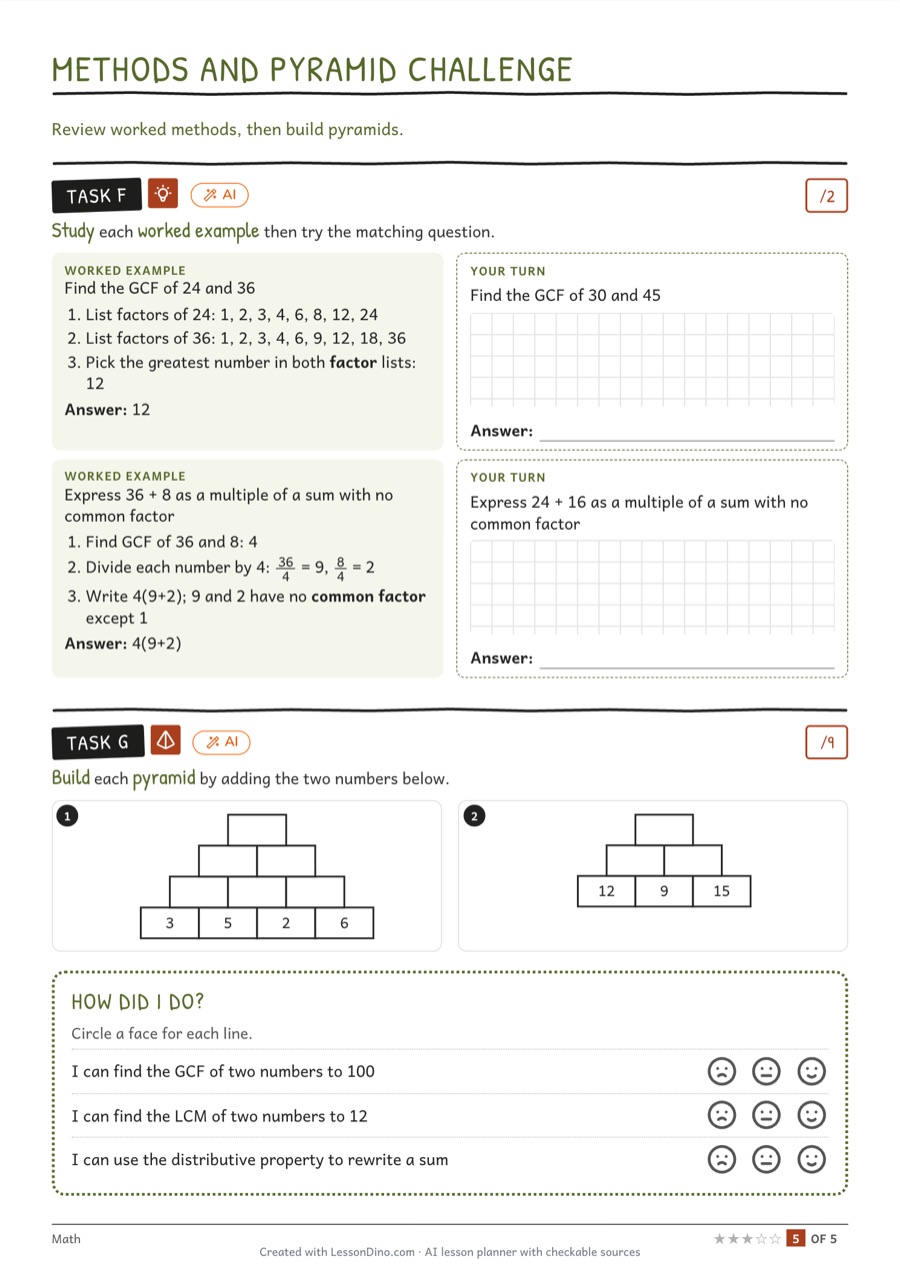
Methods and Pyramid Challenge
Review worked methods, then build pyramids.
Study each worked example then try the matching question.
Build each pyramid by adding the two numbers below.
Answers
Show the answers
- Find the GCF of 12 and 18 6
- Find the GCF of 20 and 30 10
- Find the GCF of 8 and 12 4
- Find the GCF of 9 and 15 3
- Find the GCF of 36 and 48 12
- Find the GCF of 50 and 75 25
- Find the GCF of 24 and 100 4
- 24 and 25 have only 1 as a common factor. Explain how you know the GCF is 1. Factors of 24 are 1, 2, 3, 4, 6, 8, 12, 24 and factors of 25 are 1, 5, 25, so 1 is the only shared factor.
- There are 18 girls and 24 boys in a trivia contest. Each team must have the same number of girls and the same number of boys. What is the greatest number of teams that can be formed? 6
- For those teams, how many girls will be on each team? Explain how you know. 3 girls, because 18 divided by 6 is 3.
- For those same teams, how many boys will be on each team? 4
- The art club has 60 stickers and 48 stamps. Kits must be identical using all items. What is the greatest number of kits that can be made? 12
- Find the LCM of 4 and 6 12
- Find the LCM of 3 and 5 15
- Find the LCM of 6 and 8 24
- Find the LCM of 4 and 9 36
- Rewrite 36 + 8 as a multiple of a sum with no common factor 4(9+2)
- Rewrite 27 + 18 using its GCF as a multiple 9(3+2)
- Rewrite 50 + 20 using its GCF as a multiple 10(5+2)
- Find the LCM of 10 and 12 60
- Hot dogs come in packs of 10 and buns in packs of 8. You want the same number of each with none left over. What is the least number of hot dogs to buy? 40
- How many packs of hot dogs is that? 4
- How many packs of buns is that? 5
- Two lights blink every 6 seconds and every 8 seconds. They blink together now. In how many seconds will they blink together again? Explain how you know. 24 seconds, because 24 is the least common multiple of 6 and 8.
The answer sheet is the last picture above.
Curriculum
Find the greatest common factor of two whole numbers less than or equal to 100 and the least common multiple of two whole numbers less than or equal to 12. Use the distributive property to express a sum of two whole numbers 1-100 with a common factor as a multiple of a sum of two whole numbers with no common factor. For example, express 36 + 8 as 4 (9 + 2).
Made with Lesson Dino's AI on 19 October 2026. AI can make mistakes, so check the answers and facts against the sources before you teach.