Slides


Lesson plan
Fair Teams, Same Time, Smaller Sums
Students learn to find GCF, LCM, and rewrite sums with the distributive property. They hunt and fix mistakes in pairs and prove the corrections.
Objectives
- Students will find the GCF of two whole numbers up to 100.
- Students will find the LCM of two whole numbers up to 12.
- Students will rewrite a sum 1-100 as GCF times a simpler sum.
Success criteria
- I can list factors and pick the greatest shared factor.
- I can list multiples and pick the least shared multiple.
- I can factor a sum with the GCF using parentheses.
Key words
| Word | Meaning |
|---|---|
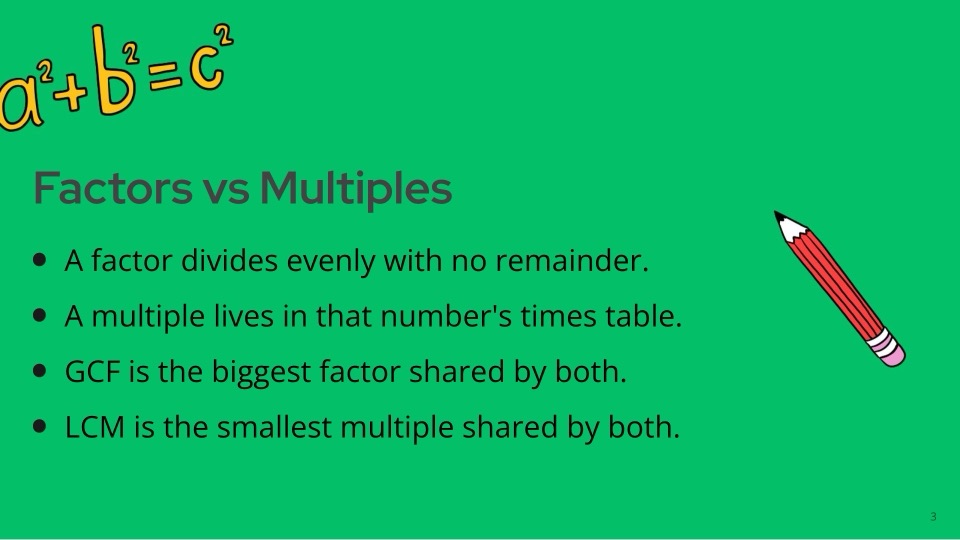
| factor | a whole number that goes into another number with no remainder |
| multiple | a number in that number's times table |
| greatest common factor | the largest number that goes into both numbers evenly |
| least common multiple | the smallest number found in both times tables |
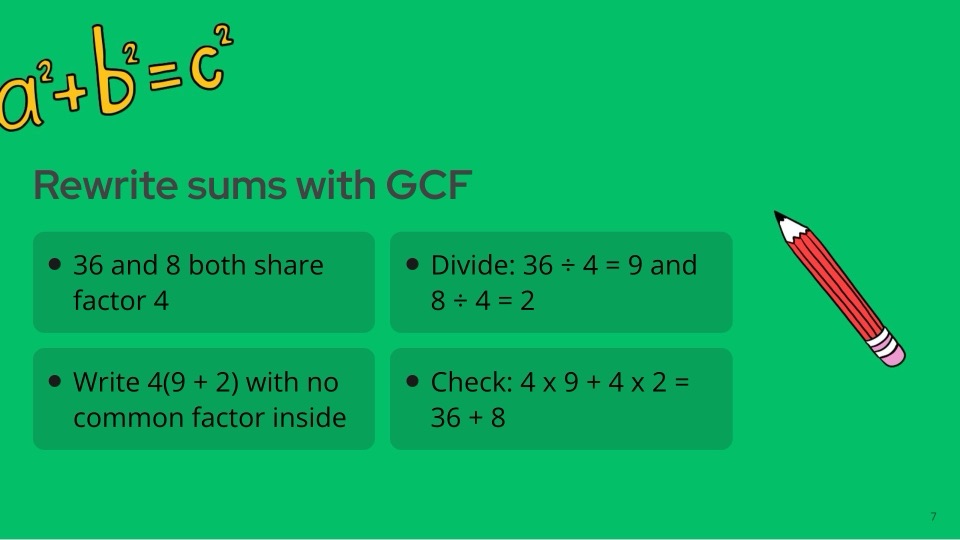
| distributive property | a rule to rewrite a sum as an outside number times an inside sum, as in 36 + 8 as 4 (9 + 2) |
Timed plan (60 minutes)
| Time | Stage | What happens |
|---|---|---|
| 8 min | Starter | Recall factor and multiple language and hook students as error checkers. Show Slide 1 GCF and LCM title and read Share fairly, meet on time, and rewrite sums. Say the hook: I did last night's math in a hurry and I think I messed up. Will you be my teacher? Show Slide 2 on identical packs and repeating buses and Slide 3 on factors vs multiples. Ask students to signal factor or multiple for 4 of 12 and 24 of 6 and fix wording. |
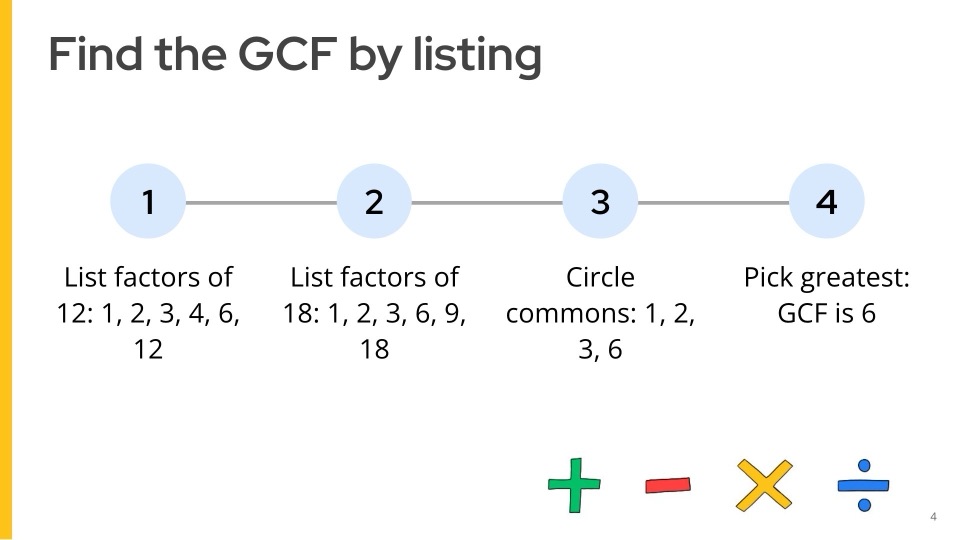
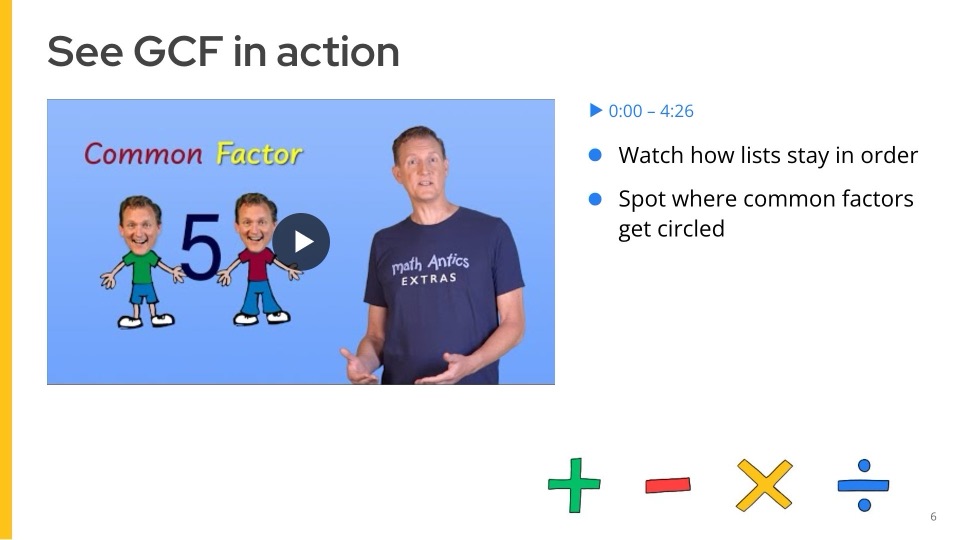
| 12 min | Teaching: GCF and shrinking sums | Model finding GCF by listing and rewriting a sum with the GCF outside. Show Slide 4 steps and think aloud listing factors in order without missing pairs. Play Video clip 1 and pause where common factors get circled to name 1, 2, 3, 6. Show Slide 5 mystery with 36 and 8 tiles and Slide 7 steps to divide by the GCF. Model checking by multiplying back out to get the original sum. |
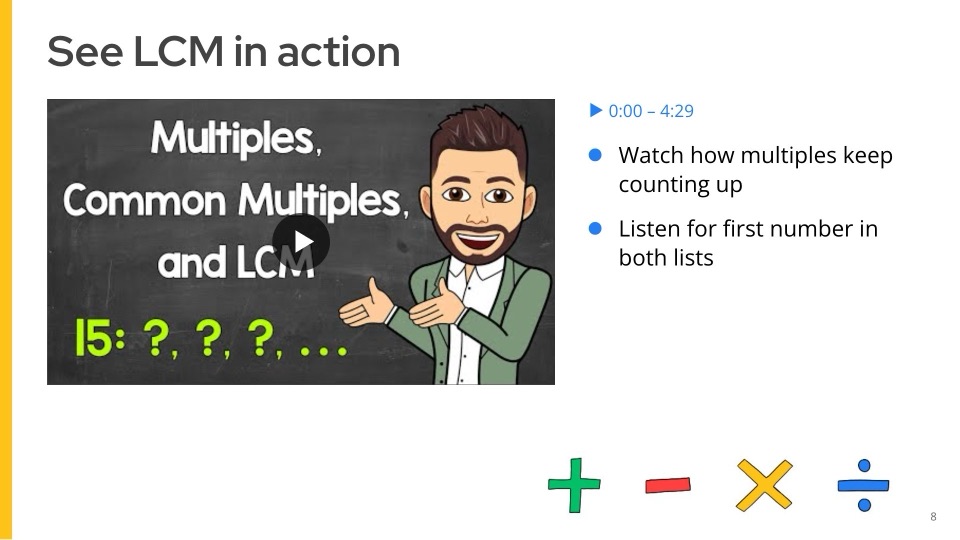
| 10 min | Teaching: LCM | Model finding LCM by listing multiples and spotting the first match. Show Slide 8 and ask students to predict where jumps of 6 and 8 first land together. Play Video clip 2 and have students track how multiples keep counting up. Think aloud writing both lists in order and starring the first shared number. Contrast with GCF: GCF splits into biggest equal groups, LCM finds the next shared time. |
| 20 min | Main activity: Fix My Mistake | Correct errors in GCF, LCM, and distributive work to secure the methods. Hand out error cards and correction slips and assign Worksheet Tasks B and C. Direct pairs to first prove each error with ordered lists, then rewrite correctly. Circulate, prompt for underlining the proving line, and push for no-common-factor check inside. Stop at 15 minutes for two pairs to model a fixed LCM card and a fixed sum card. |
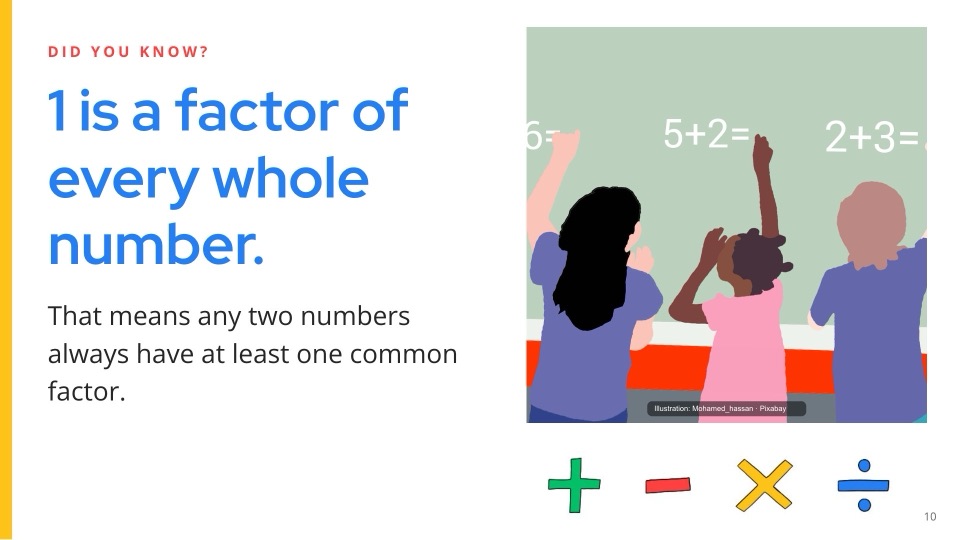
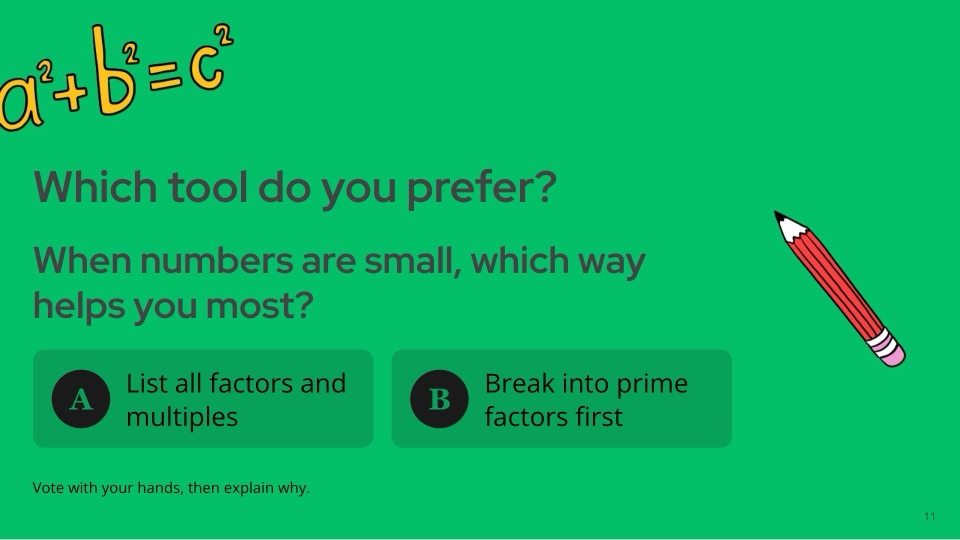
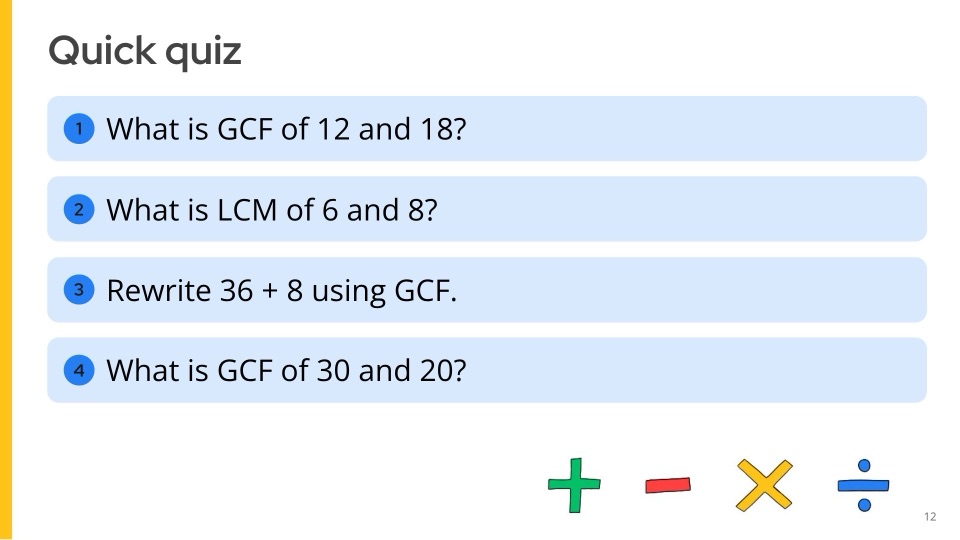
| 10 min | Plenary | Check GCF, LCM, and distributive skill against success criteria. Show Slide 10 fact that 1 is always a common factor and link to pairs like 5 and 7. Run Slide 12 quick quiz one question at a time with whiteboard answers. Narrate why 36 + 8 must be 4 (9 + 2) and not a smaller factor outside. Have students self-rate success criteria and name which tool helped most. |
Common mistakes
- Mixing up GCF and LCM and picking a large multiple for GCF.
How to spot it: Student circles 24 for GCF of 6 and 8 or lists multiples when asked for factors.
Ask: do we split into groups or wait for a shared time? Use factors for biggest divider and multiples in times tables for smallest shared multiple. - Stopping at any common factor when rewriting a sum, like 36 + 8 as 2 (18 + 4).
How to spot it: Inside numbers still share a factor greater than 1.
Require outside to be the GCF and check inside has no common factor, so correct to 4 (9 + 2). - Missing factors or skipping multiples so first match is wrong.
How to spot it: Lists out of order or gaps, such as missing 12 in multiples of 4.
Rewrite lists in order: multiples of 4 are 4, 8, 12, 16 and check factor pairs until they repeat.
Support
- Provide factor-pair starters, highlighted multiplication charts, and pre-listed multiples for 4 and 12.
- Allow oral explanation on correction slips with LSE scribing lists in order.
Stretch
- Challenge students to write new error cards and to find GCFs up to 100 with proof of complete lists.
- Ask for explanation of prime overlap for 24 and 36 to show GCF of 12.
Check questions
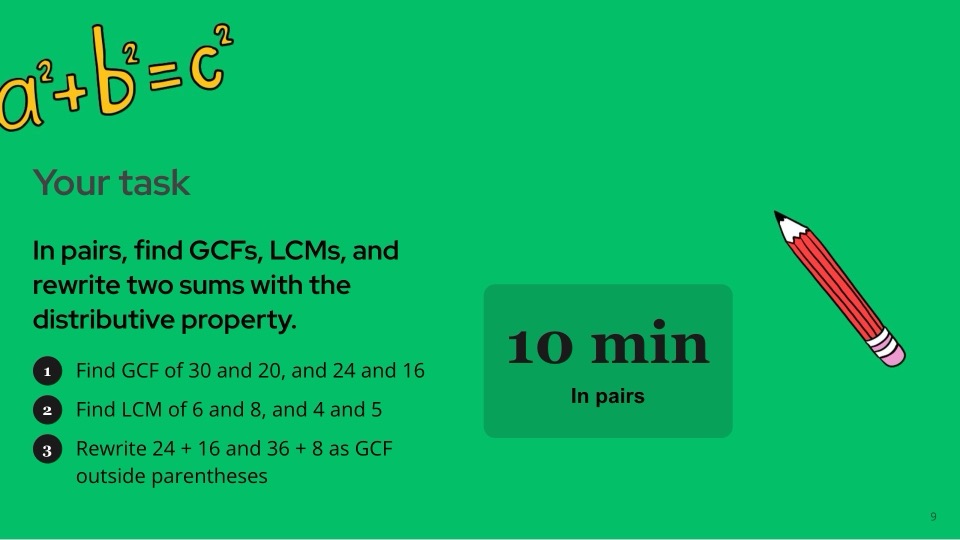
- What is the GCF of 30 and 20?
Answer: 10 - What is the LCM of 4 and 5?
Answer: 20 - Rewrite 24 + 16 using the GCF.
Answer: 8 (3 + 2)
Curriculum
Find the greatest common factor of two whole numbers less than or equal to 100 and the least common multiple of two whole numbers less than or equal to 12. Use the distributive property to express a sum of two whole numbers 1-100 with a common factor as a multiple of a sum of two whole numbers with no common factor. For example, express 36 + 8 as 4 (9 + 2).
Video clips
Clips on YouTube, from the start and end times we chose. Check each one before you show it.
-
GCF by listing factors from 0:00 to 4:26
mathantics: GCF: Greatest Common Factor - Math Antics Extras
Clear Math Antics visuals and middle-school pace are perfect for ages 11-12 learning GCF up to 100.
-
LCM by listing multiples from 0:00 to 4:29
Math with Mr. J: Multiples | Common Multiples | Least Common Multiple (LCM) | Math with Mr. J
Slow listing-multiples method with simple examples fits ages 11-12 learning LCM up to 12.
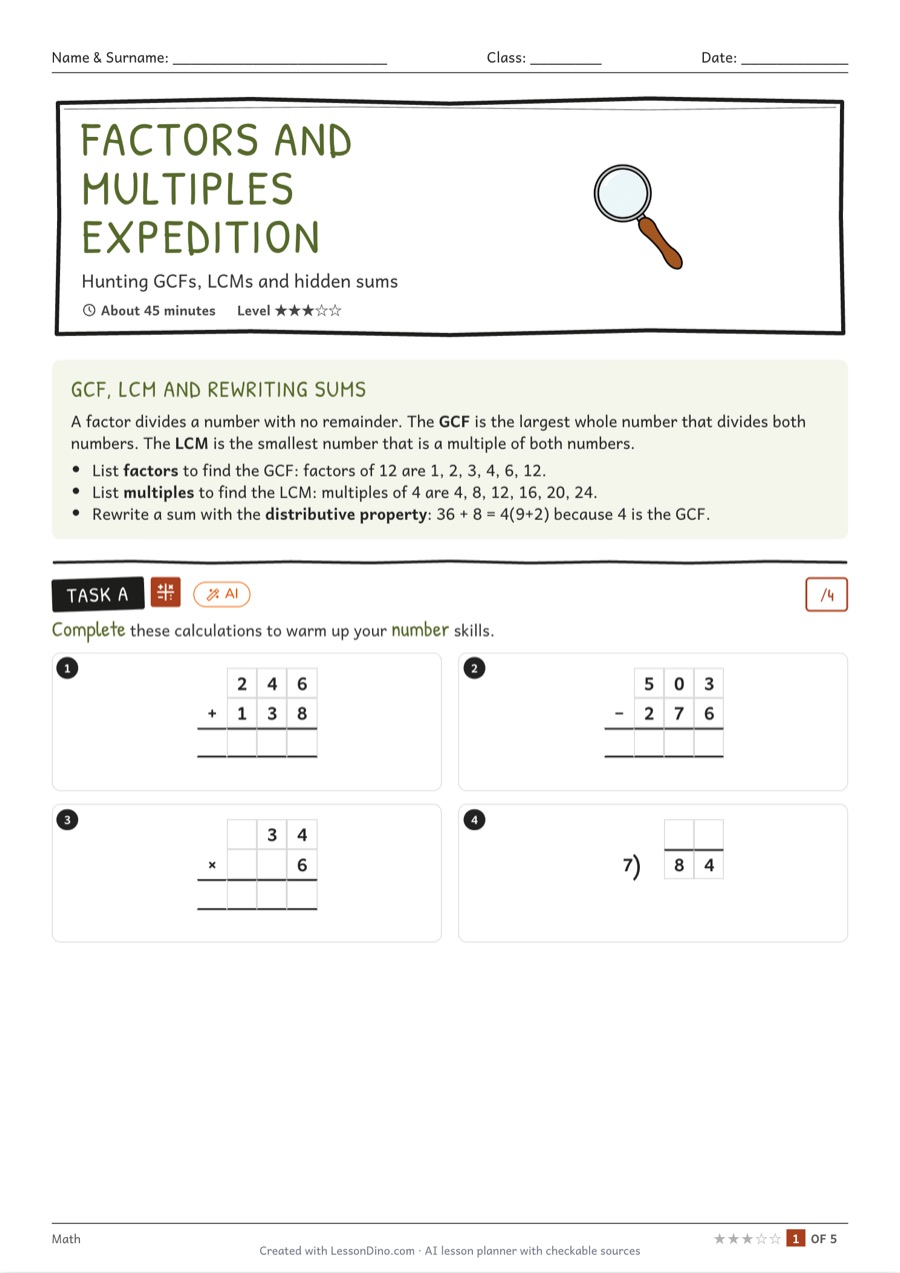
Worksheet
Sources
- Grade 6 » The Number System | Common Core State Standards Initiative thecorestandards.org
- SST Grade 6 Mathematics TEKS - Texas Education Agency tea.texas.gov
- 1.7 Greatest Common Factor and Least Common Multiple spot.pcc.edu
- 1. a) 2 2 2 3 b) 2 2 3 3 - hunter.cuny.edu www2.hunter.cuny.edu
- Factors and multiples in common - Ximera ximera.osu.edu
- 3. Greatest Common Divisor - Least Common Multiple online.math.uh.edu
- Highest Common Factor and Lowest Common Multiple - BBC bbc.co.uk
- What is a common factor in maths? - BBC Bitesize bbc.co.uk
- Least common multiple (video) | 4th quarter | Khan Academy en.khanacademy.org
- Greatest common factor (GCF) and least common multiple (LCM) mathmammoth.com
- Least Common Multiple and Greatest Common Factor Worksheets easyteacherworksheets.com
- Greatest Common Factor and Least Common Multiple Worksheets mathworksheetsland.com
- Least Common Multiple and Greatest Common Factor onlinemathlearning.com
- Greatest Common Factor and Least Common Multiple mometrix.com
- Greatest Common Factor & Least Common Multiple Math Video for Kids ... generationgenius.com
- Greatest Common Factor and Least Common Multiple – GeoGebra geogebra.org
- Lesson 18: Least Common Multiple and Greatest Common Factor opencurriculum.org
Picture credits
- Photo: an_photos · Pixabay
- Photo: StockSnap · Pixabay
- Illustration: Mohamed_hassan · Pixabay
- Pictograms: Sergio Palao, ARASAAC (arasaac.org) · CC BY-NC-SA
Made with Lesson Dino's AI on 19 October 2026. AI can make mistakes, so check facts against the sources before you teach.