Slides
Lesson plan
Round and Round the Sun
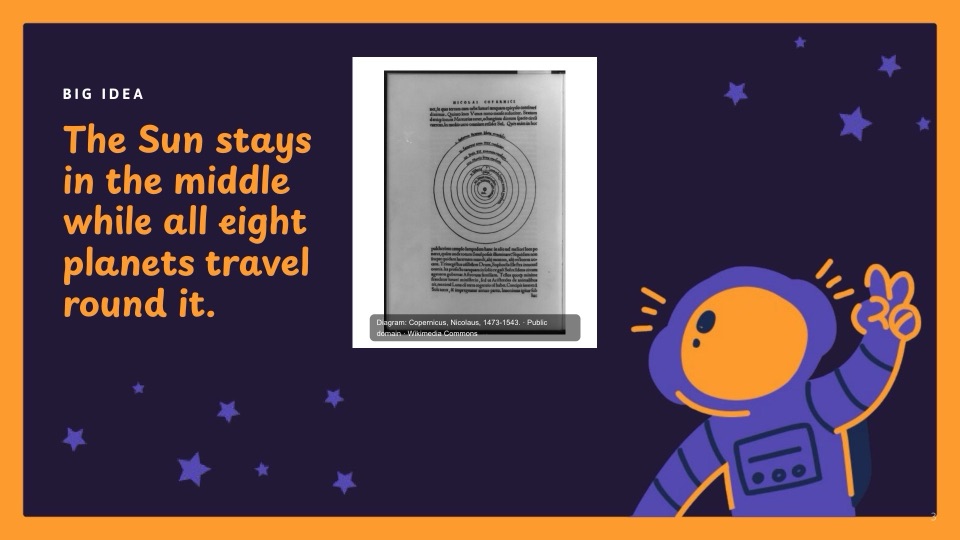
We learn how Earth and the other planets travel round the Sun. We become the solar system and walk each orbit.
Objectives
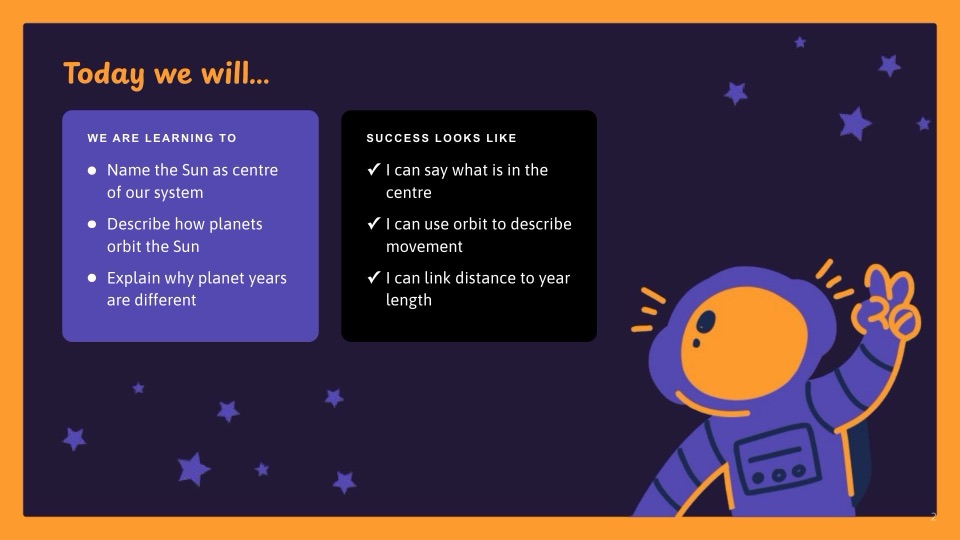
- Students will name the Sun as the centre of the solar system.
- Students will describe how planets orbit the Sun anticlockwise.
- Students will explain why outer planets take longer to orbit.
Success criteria
- I can say what is in the centre of the solar system.
- I can use orbit and anticlockwise to describe movement.
- I can explain why different planets have different years.
Key words
| Word | Meaning |
|---|---|
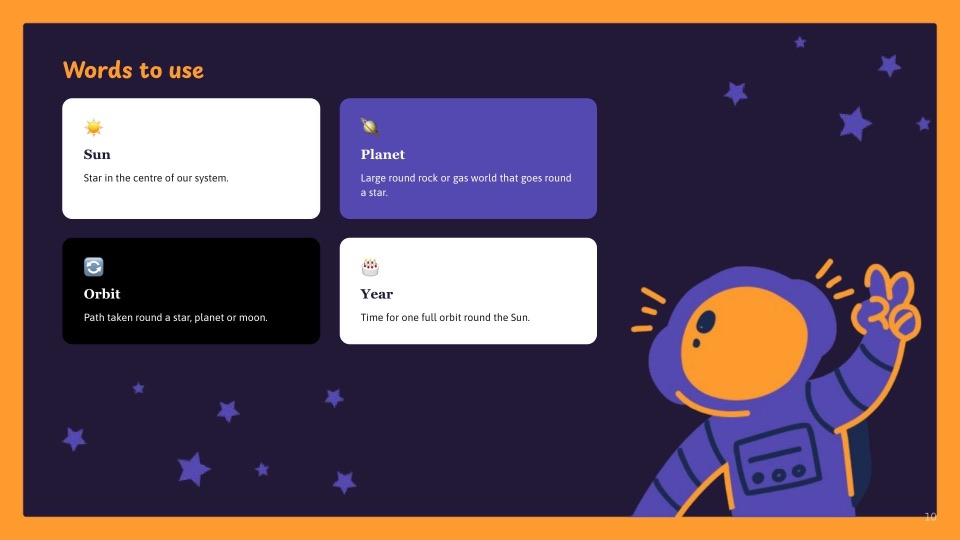
| Sun | bright hot star at the middle of our family of worlds |
| planet | large round world of rock or gas that travels round a star |
| orbit | path taken round a star, planet or moon |
| anticlockwise | going in the opposite direction to the hands on a clock |
Timed plan (60 minutes)
| Time | Stage | What happens |
|---|---|---|
| 5 min | Starter | Hook interest and check what pupils think sits at the centre. Show Slide 1 and say the hook to invite the class to become the solar system. Show Slide 2 and share the three I can ideas for today in own words. Ask what pupils think is in the middle and take 3 answers. Choose a student to hold the Sun marker and stand ready as the Sun. |
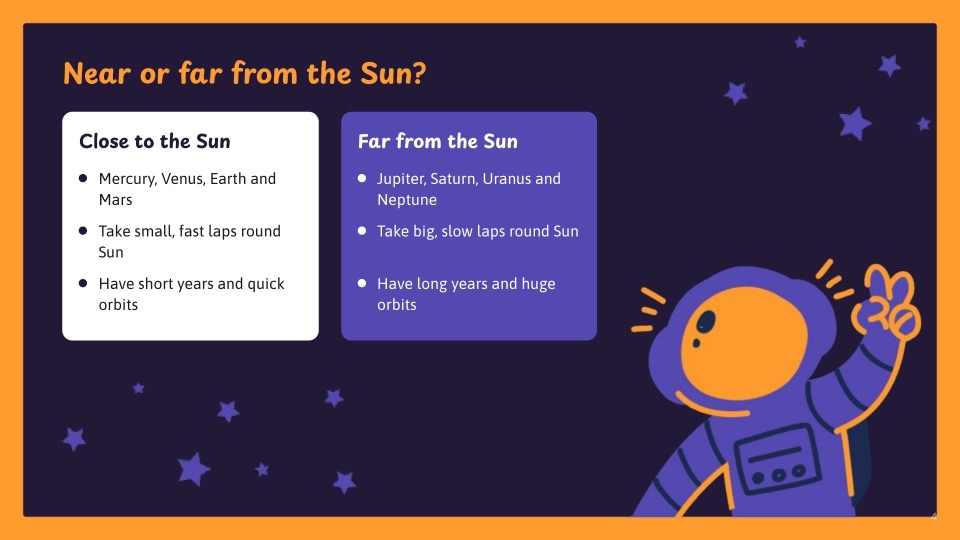
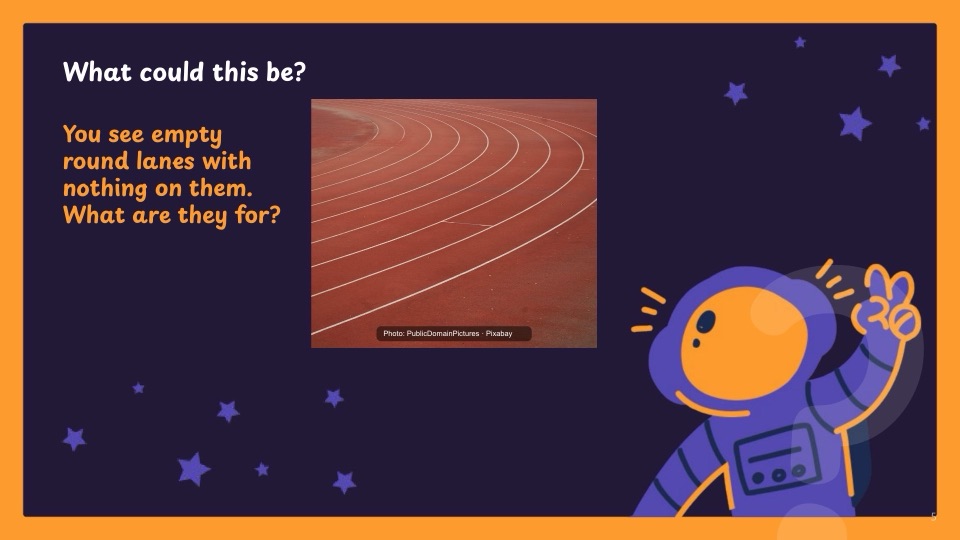
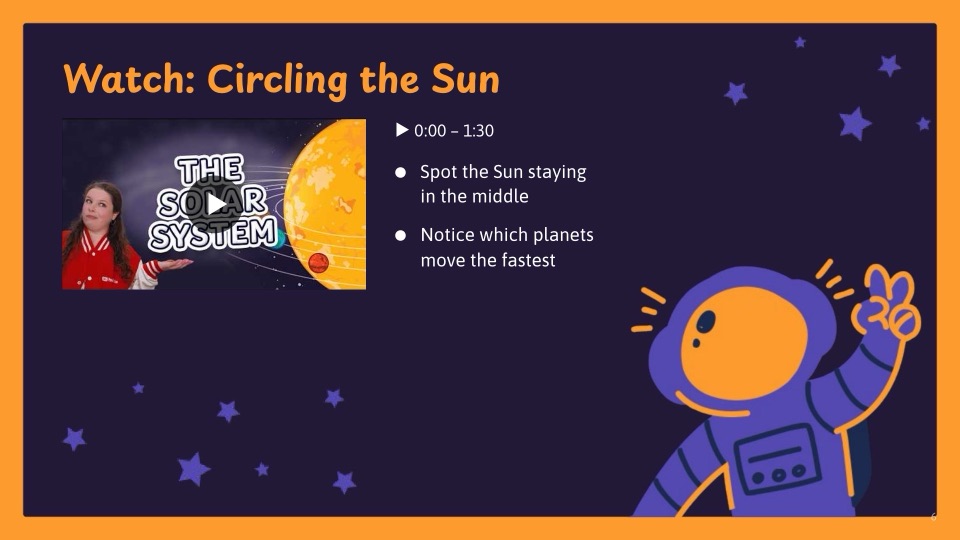
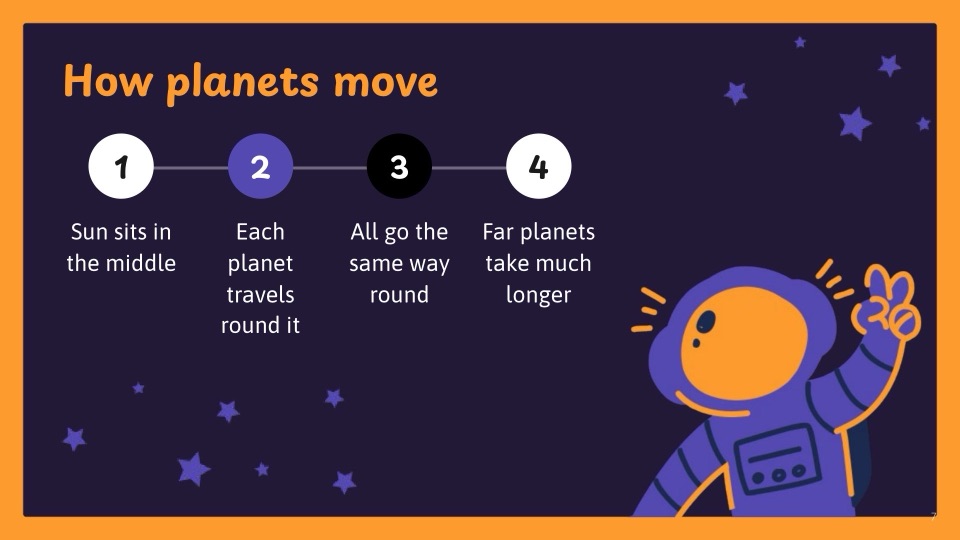
| 10 min | Teaching | Teach orbit, anticlockwise and different speeds with a model. Show Slides 4-5 and explain close planets take small fast laps and far ones take long slow laps. Play Video clip 1 on Slide 6 and ask pupils to spot the Sun staying still and which planets move fastest. Model with two volunteers using Slide 7 steps: Sun stands still while Earth walks one anticlockwise lap. Narrate direction, shape and time for one Earth lap. |
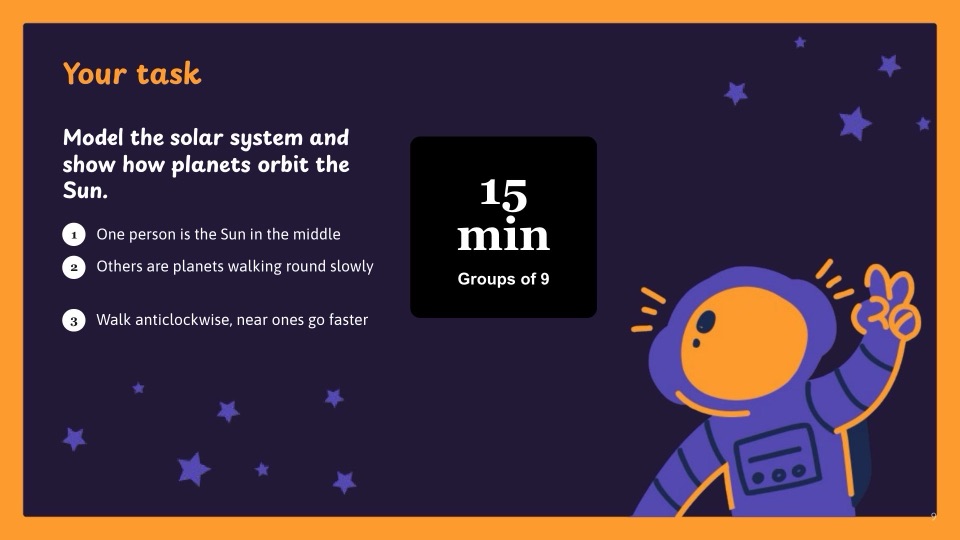
| 25 min | Main activity | Practise describing movement by walking the orbits as planets. Lead class to clear space and place the Sun marker in the middle. Give eight pupils planet labels in order Mercury, Venus, Earth, Mars, Jupiter, Saturn, Uranus and Neptune and place them on chalk circles. Direct all walkers to walk slowly anticlockwise, inner circles with small fast steps and outer with slower steps. Call freeze, ask each walker to say a sentence with Sun, planet, orbit and anticlockwise, then swap roles. |
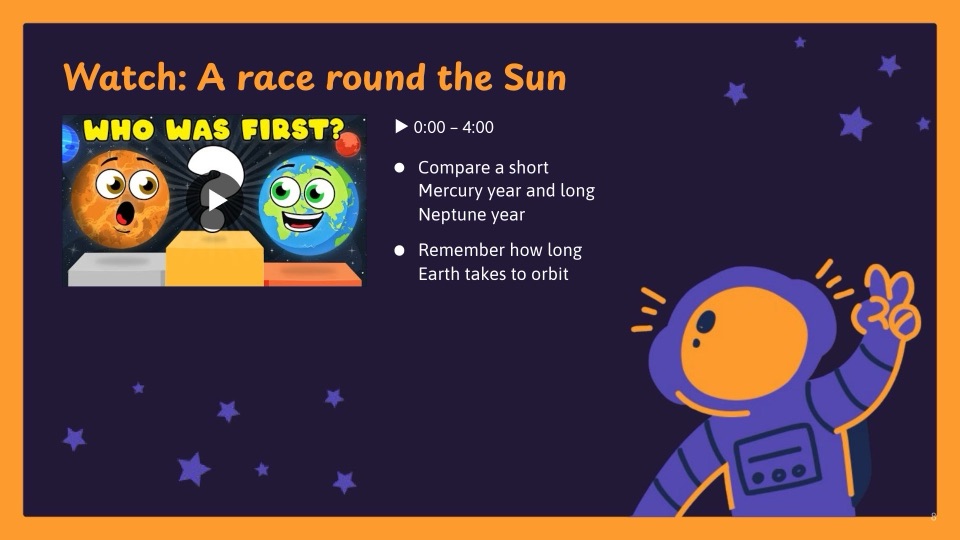
| 10 min | Compare years | Explain why planet years are different lengths. Show Slide 8 and play Video clip 4 comparing a short Mercury year and long Neptune year. Mark one Earth lap on a strip as 365 1/4 days, or one year. Add Neptune much further along because one year on Neptune takes almost 165 Earth years. Ask pairs to order Mercury, Earth and Neptune cards and explain using distance. |
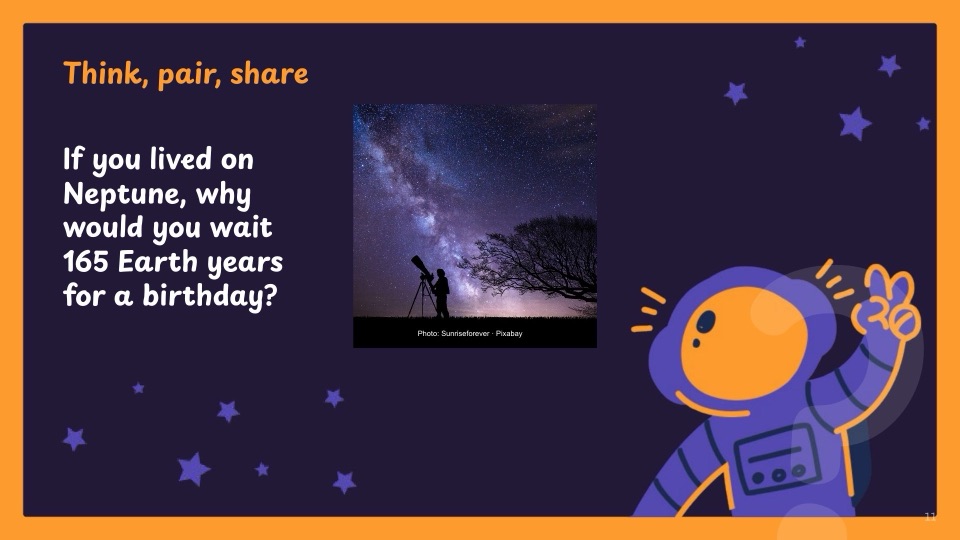
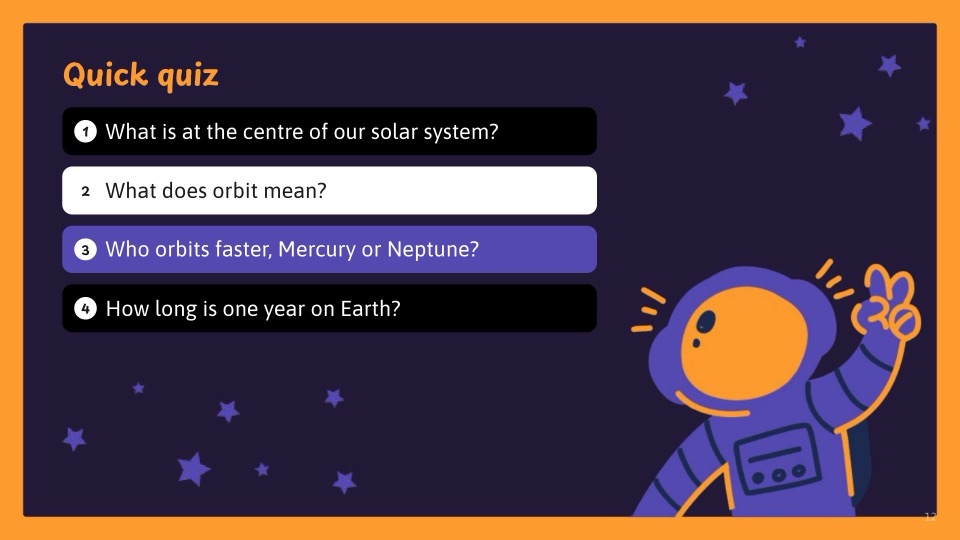
| 10 min | Plenary | Check the I can ideas and fix any gaps about orbiting. Show Slide 11 and ask pairs to discuss the Neptune birthday question. Show Slide 12 and run the quick quiz with cold-call answers. Hand out Worksheet Task D and ask pupils to tick the best answer about orbits on their own. Link answers back to the three I can ideas. |
Common mistakes
- Thinking Earth is in the middle with the Sun going round it
How to spot it: Draws or says Earth stays still in the middle
Re-model with Sun marker still: the Sun is a star at the centre while Earth travels round it - Thinking all planets take the same time to orbit
How to spot it: Says Mercury and Neptune both take one year
Point to strip: times depend on distance from the Sun; Earth takes one year but Neptune takes almost 165 Earth years - Thinking planets go different ways or in perfect circles
How to spot it: Walks clockwise or draws a perfect circle with a compass only
Practise arrows: all go anticlockwise on paths that are almost circular, like a nearly round oval
Support
- Pre-draw circles with arrows and pair each walker with a partner who points direction and reads labels.
Stretch
- Explain what would change if a walker went the wrong way or left the flat shared circle.
Check questions
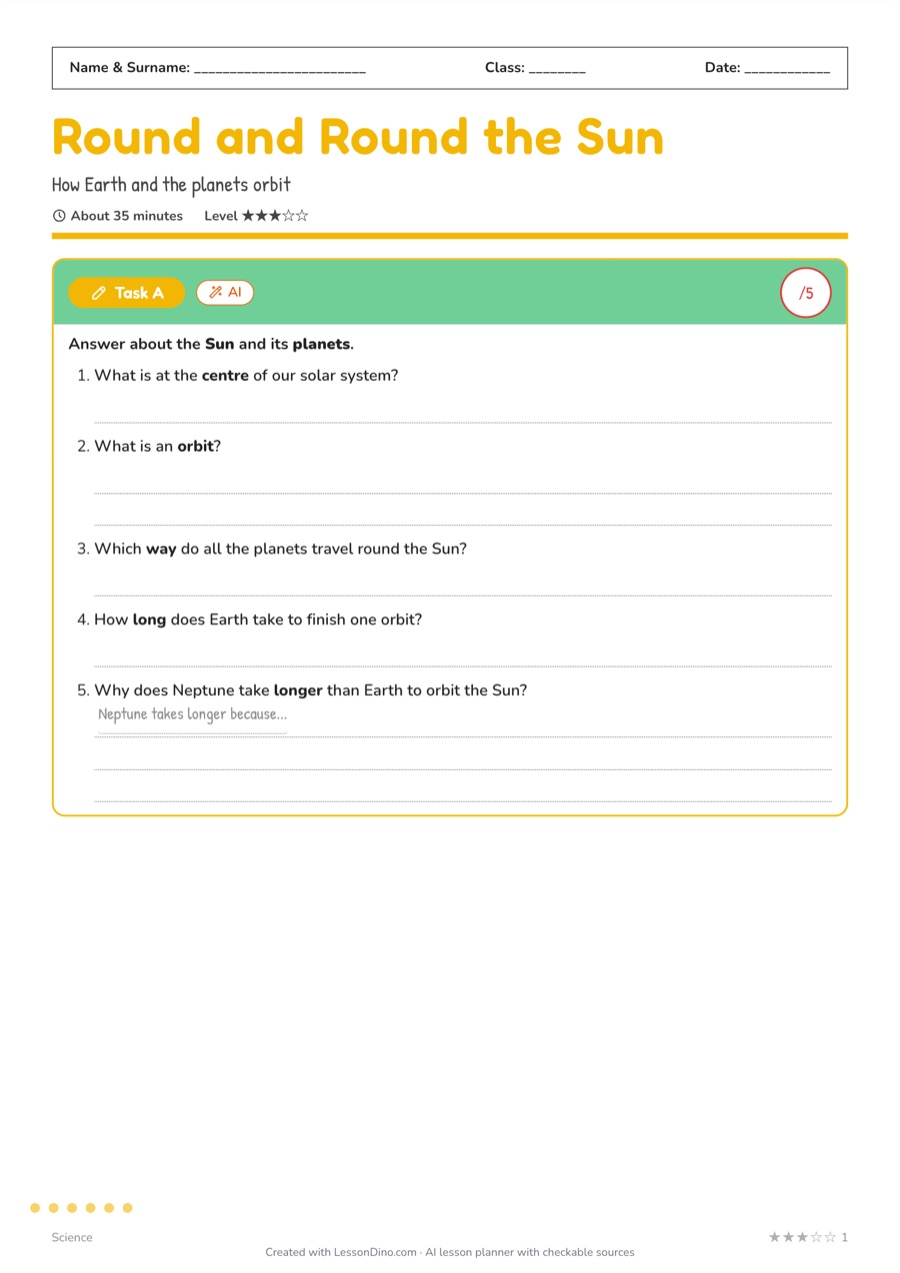
- What is at the centre of our solar system?
Answer: The Sun. - Describe how planets move relative to the Sun.
Answer: They travel round it on orbits, all going anticlockwise. - Why does Neptune take longer to orbit than Earth?
Answer: Because it is further from the Sun.
Curriculum
describe the movement of the Earth and other planets relative to the sun in the solar system
Video clips
Clips on YouTube, from the start and end times we chose. Check each one before you show it.
-
Planets circling the Sun from 0:00 to 1:30
Twinkl Educational Publishing: Movement of the Planets in our Solar System Animation | Twinkl Go!
Twinkl animation clearly shows every planet moving round the Sun with simple language and pace that suits Year 5 aged 9-10.
-
Orbit race year lengths from 0:00 to 4:00
KLT: Orbit Race!: How Long Does Each Solar System Planet Take To Travel Around The Sun? | KLT
Compares how long each planet takes to orbit using lively visuals and song that engage 9-10-year-olds.
Worksheet
Sources
- National curriculum in England: science programmes of study gov.uk
- Science programmes of study: key stages 1 and 2 - GOV.UK assets.publishing.service.gov.uk
- Planets of our Solar System - BBC Bitesize bbc.co.uk
- Planets and how they orbit the Sun — Explain Like I'm 10 eli10.co.uk
- 1,997 Planets Orbiting The Sun Images and Stock Photos gettyimages.co.uk
- Planet - Wikipedia en.wikipedia.org
- How do the planets stay in orbit around the sun? - Cool Cosmos coolcosmos.ipac.caltech.edu
- What is a Planet? - National Geographic Kids kids.nationalgeographic.com
- Flexi answers - Why do planets orbit the Sun? | CK-12 Foundation ck12.org
- What is a Planet? - Science@NASA science.nasa.gov
- Dwarf Planets - National Geographic Kids kids.nationalgeographic.com
- The movement of the planets around the Sun KS2 | Y5 Science ... thenational.academy
- Planets in Order From the Sun | Pictures, Facts, and Sizes astrobackyard.com
- Planets in Order From the Sun | Learn About The Solar System galactic-hunter.com
- Solar System orbits. Artwork of Earth's solar system, showing the eight planets that orbit the Sun. Most of the mass of the solar system is found in the Sun. The eight planets, from inner to outer, ar alamy.com
- About the Planets - Science@NASA science.nasa.gov
- planets - Kids | Britannica Kids | Homework Help kids.britannica.com
- What Is an Orbit? | NASA Space Place – NASA Science for Kids spaceplace.nasa.gov
- How planets orbit the sun {a Montessori-inspired activity} giftofcuriosity.com
Picture credits
Made with Lesson Dino's AI on 17 October 2026. AI can make mistakes, so check facts against the sources before you teach.