The worksheet
About this worksheet
Pupils learn how rivers change from source to mouth. They build a tray river and explain waterfalls and meanders. This Year 8 Geography worksheet gives students (ages 12–13) six pages of practice on rivers and river landforms, part of the rivers unit. It goes with our free Rivers and river landforms lesson, which has the slides and a timed lesson plan.
What it covers
By the end, students should be able to:
- Students will trace a river from source to mouth and name valley features.
- Students will explain erosion, transportation and deposition in shaping river channels.
- Students will describe how waterfalls retreat and meanders form oxbow lakes over time.
How to use it
- Use it for practice after the teaching part of the lesson, once students have seen the worked examples on the slides.
- Support: Labelled diagrams of three courses and sentence starters for each explanation.
- Stretch: Add arrows for cutting down versus building up and justify choices.
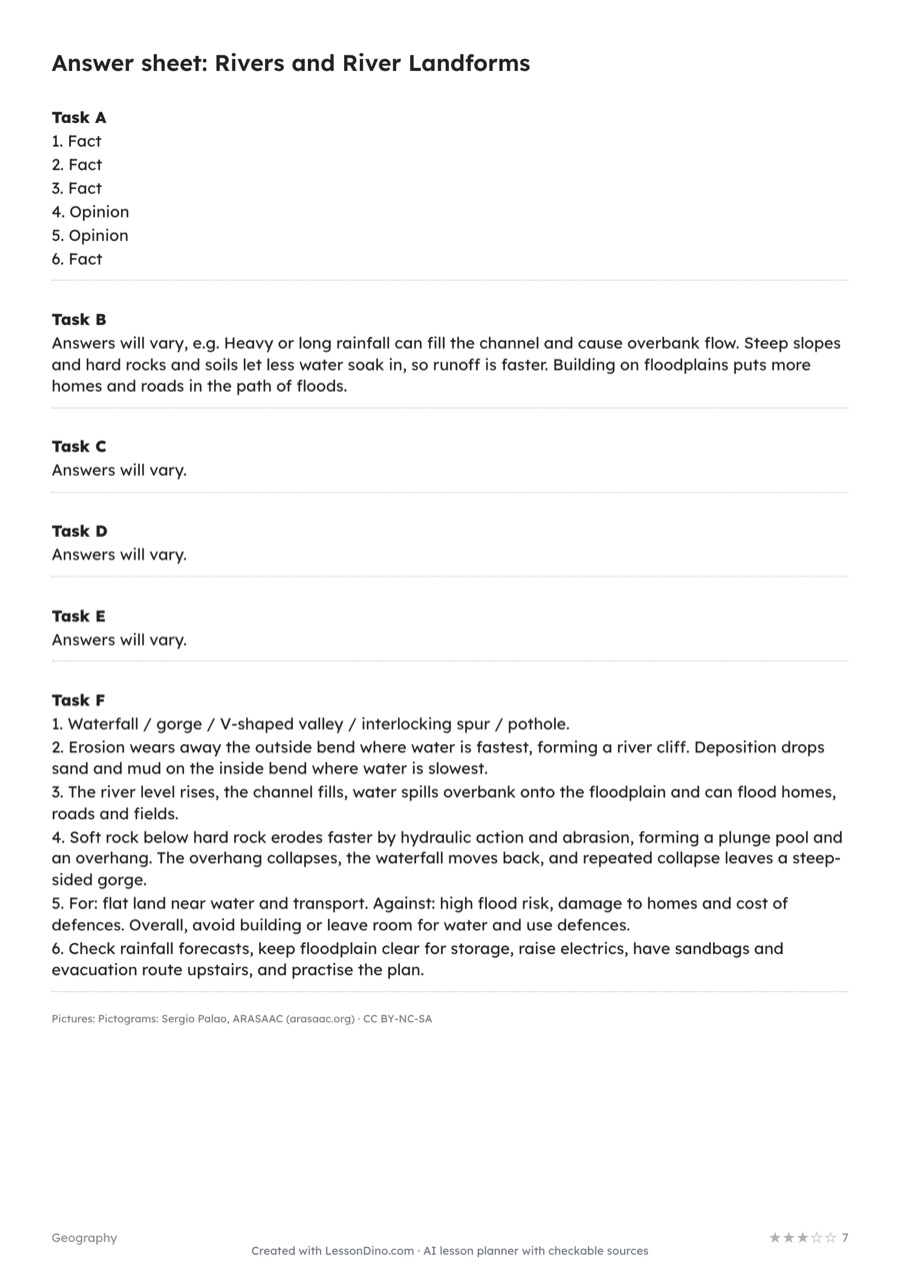
- The answer sheet is the last page, so you can print it on its own or let students check their own work.
Key vocabulary
- source: high place where a river starts as a narrow stream
- erosion: wearing away of rock and soil by moving water and stones
- transportation: carrying of sand and pebbles downstream by flowing water
- deposition: leaving behind of sand and mud when water slows down
- waterfall: steep drop where a river falls from one level to a lower level
- meander: large curve in a river that grows bigger further downstream
Mistakes to watch for
- Thinking a waterfall stays in one place. Retell collapse sequence: soft rock erodes first, hard lip collapses, fall retreats upstream leaving a steep-sided gorge.
- Mixing up erosion and deposition sides of a meander. Remind fastest water is outside leading to erosion and river cliff, slowest inside leading to deposition.
- Placing deposition upstream and deep cutting downstream. Revisit model: vertical erosion cuts V-valleys upstream, lateral erosion widens midstream, deposition builds deltas downstream.
What's on the worksheet
Source to Mouth
Follow a river on its journey from its start to the sea.
How Rivers Shape the Land
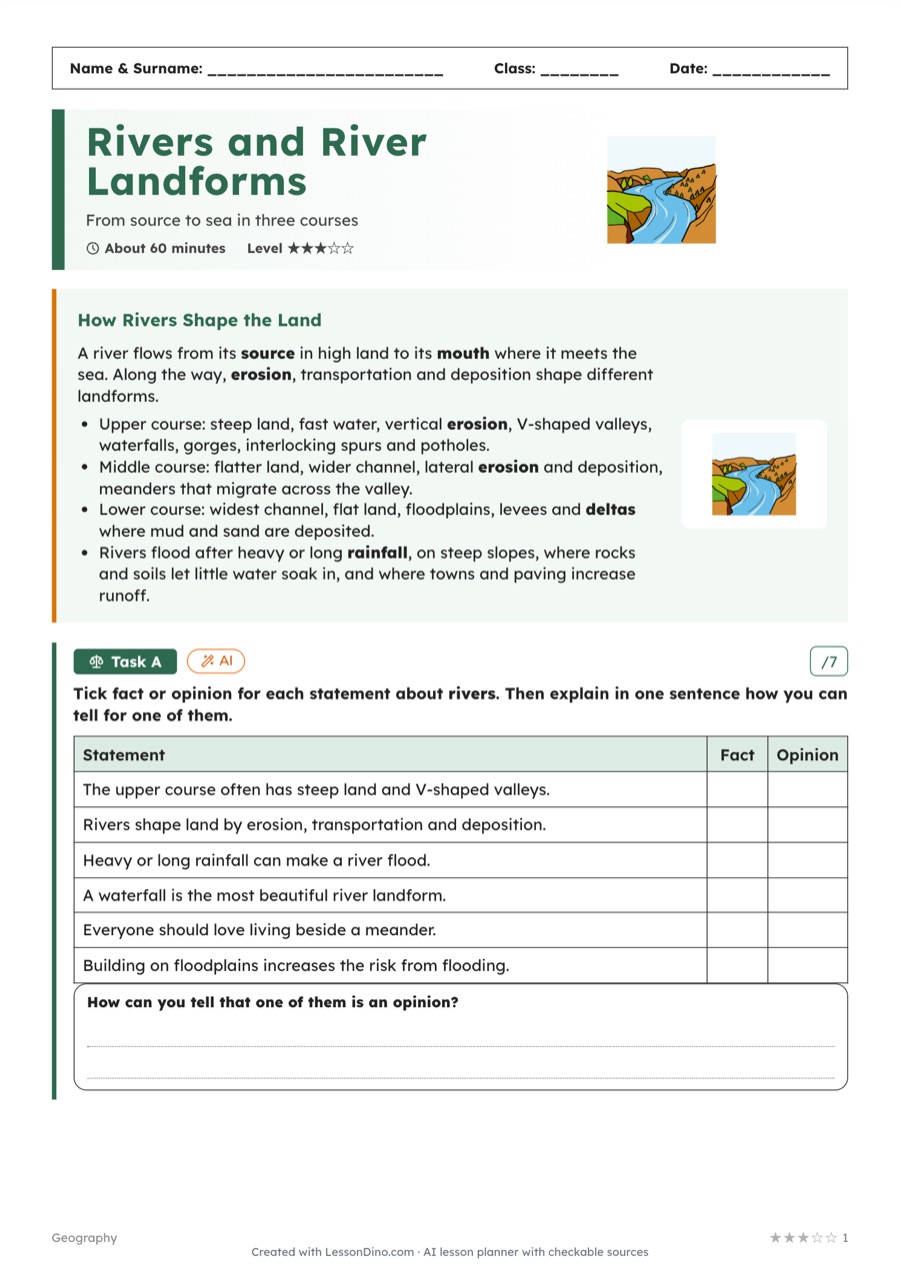
- A river flows from its source in high land to its mouth where it meets the sea. Along the way, erosion, transportation and deposition shape different landforms.
- Upper course: steep land, fast water, vertical erosion, V-shaped valleys, waterfalls, gorges, interlocking spurs and potholes.
- Middle course: flatter land, wider channel, lateral erosion and deposition, meanders that migrate across the valley.
- Lower course: widest channel, flat land, floodplains, levees and deltas where mud and sand are deposited.
- Rivers flood after heavy or long rainfall, on steep slopes, where rocks and soils let little water soak in, and where towns and paving increase runoff.
Tick fact or opinion for each statement about rivers. Then explain in one sentence how you can tell for one of them.
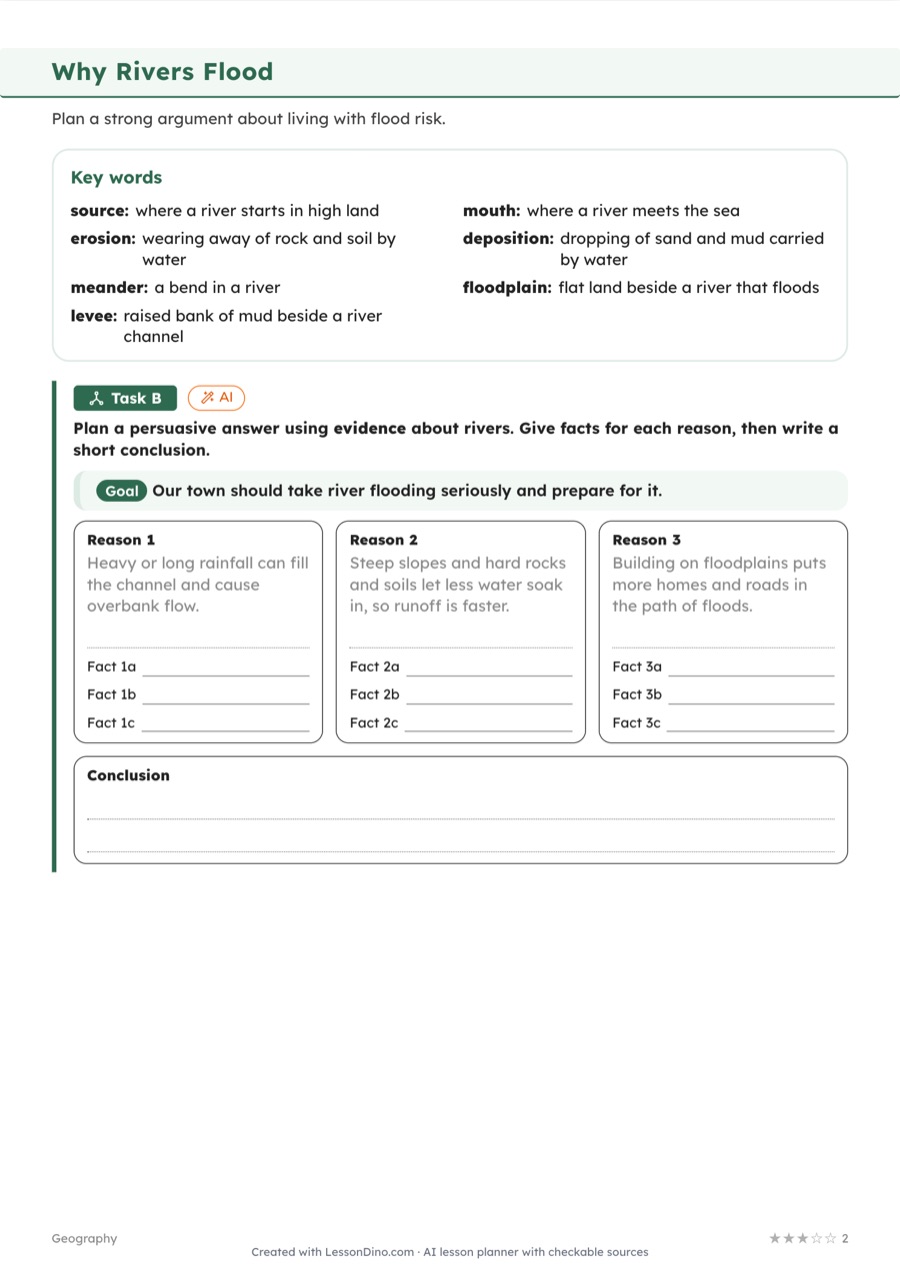
Why Rivers Flood
Plan a strong argument about living with flood risk.
| Word | Meaning |
|---|---|
| source | where a river starts in high land |
| mouth | where a river meets the sea |
| erosion | wearing away of rock and soil by water |
| deposition | dropping of sand and mud carried by water |
| meander | a bend in a river |
| floodplain | flat land beside a river that floods |
| levee | raised bank of mud beside a river channel |
Plan a persuasive answer using evidence about rivers. Give facts for each reason, then write a short conclusion.
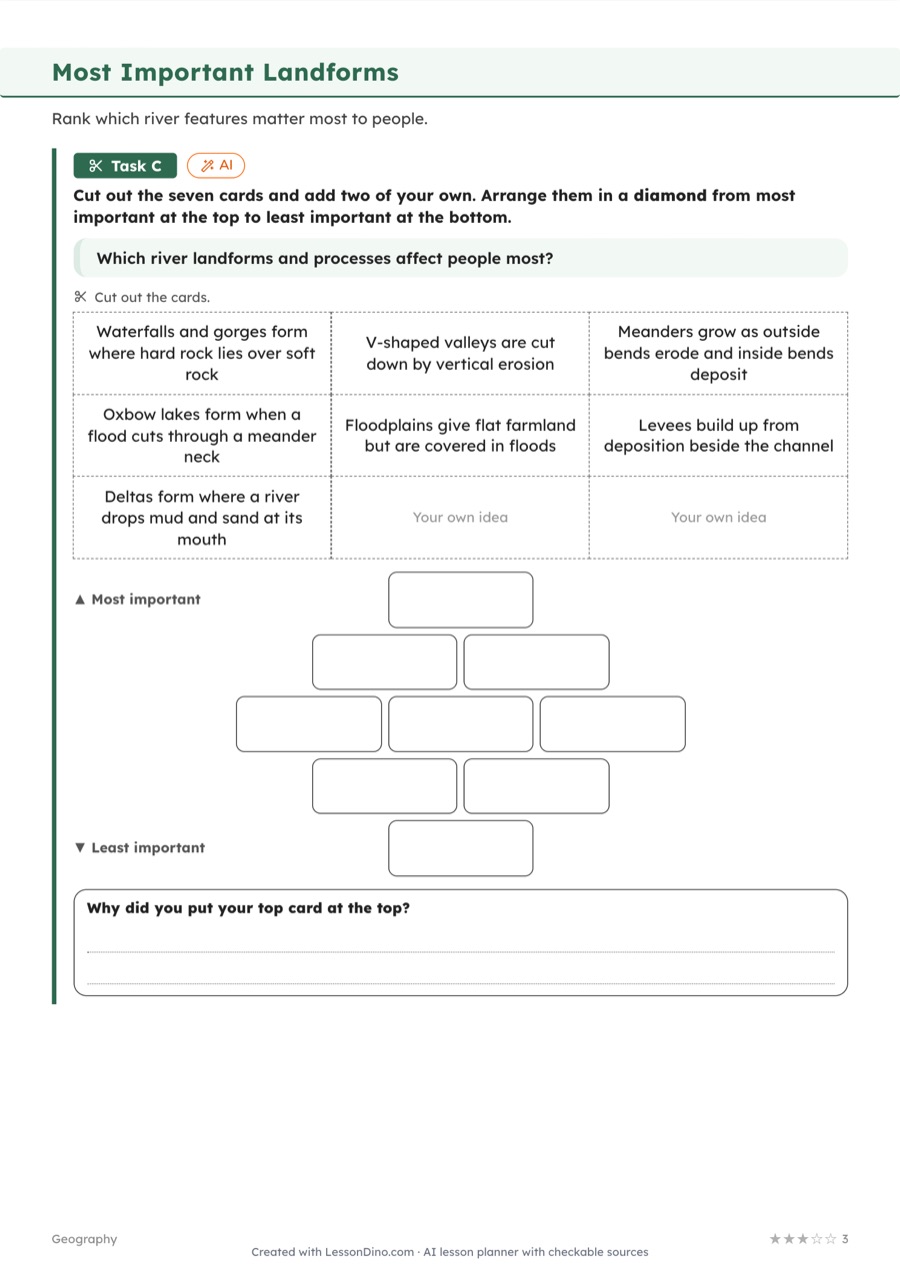
Most Important Landforms
Rank which river features matter most to people.
Cut out the seven cards and add two of your own. Arrange them in a diamond from most important at the top to least important at the bottom.
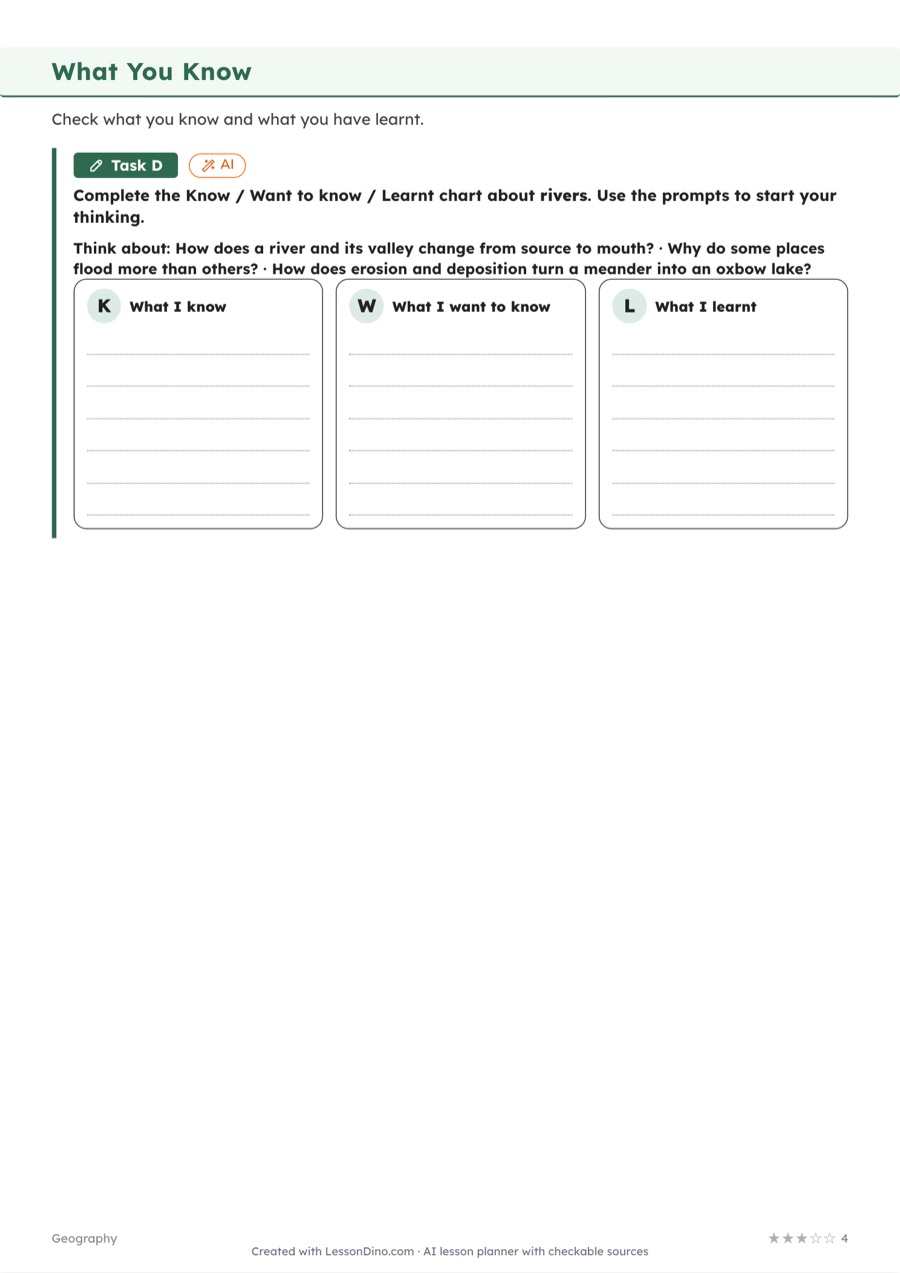
What You Know
Check what you know and what you have learnt.
Complete the Know / Want to know / Learnt chart about rivers. Use the prompts to start your thinking.
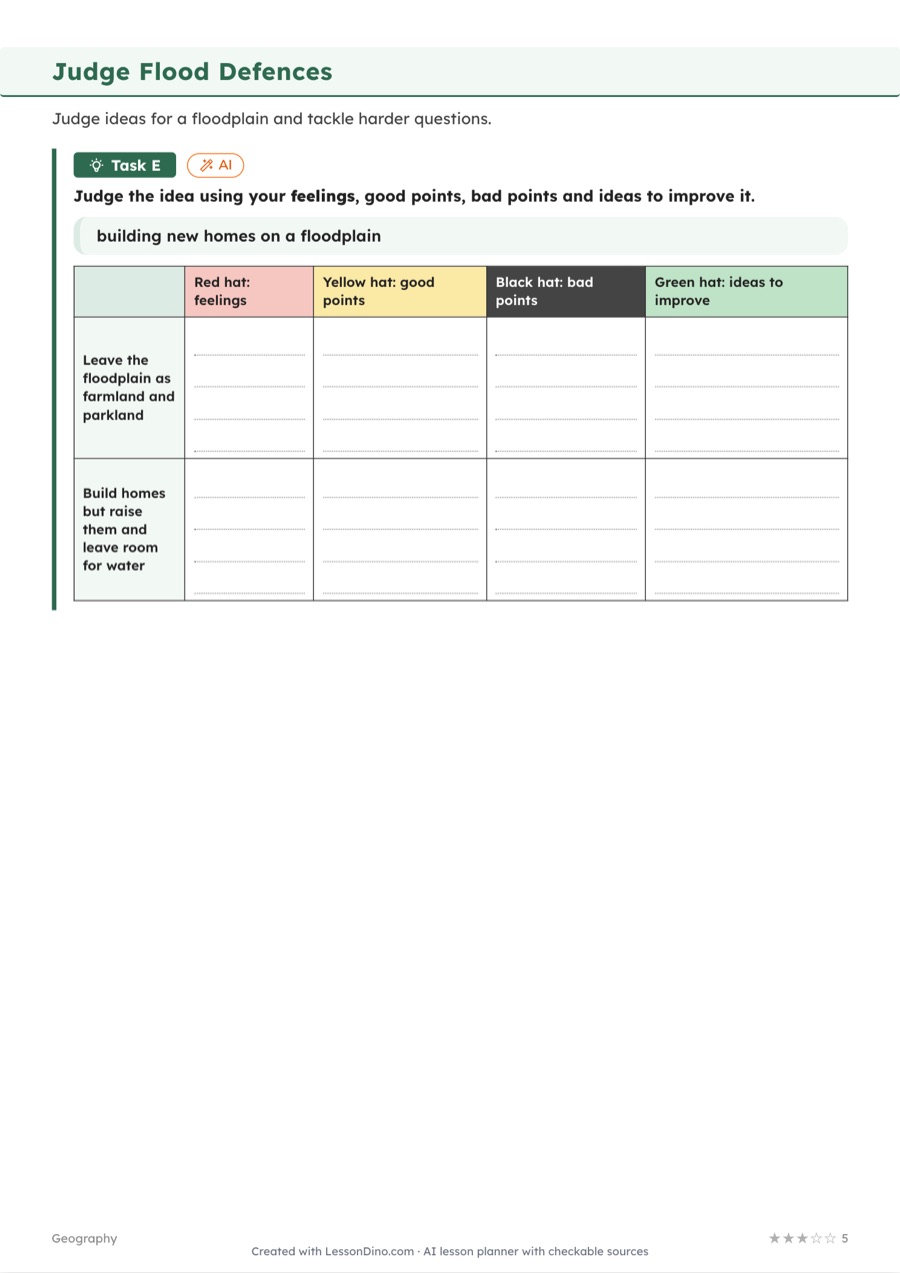
Judge Flood Defences
Judge ideas for a floodplain and tackle harder questions.
Judge the idea using your feelings, good points, bad points and ideas to improve it.
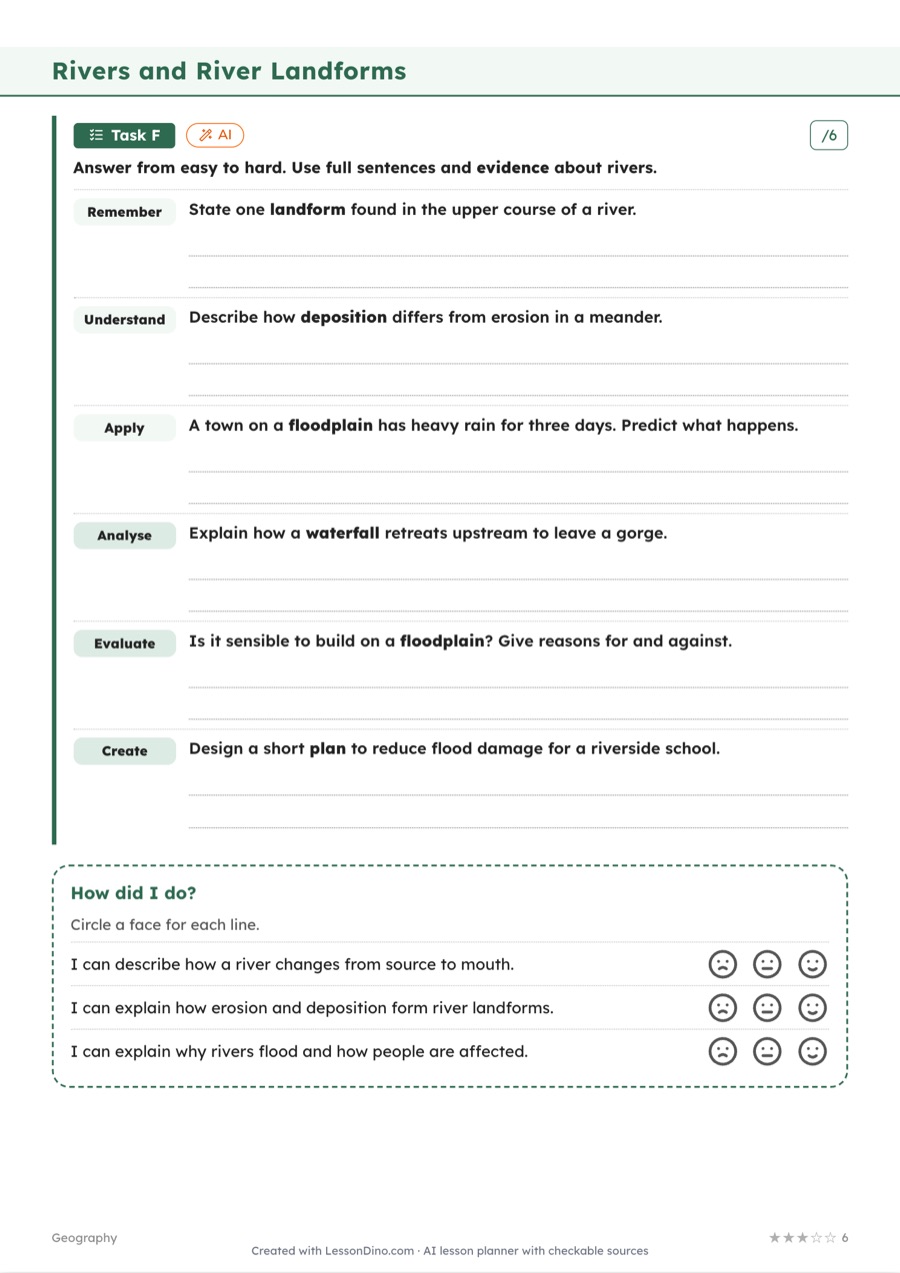
Page 6
Answer from easy to hard. Use full sentences and evidence about rivers.
- State one landform found in the upper course of a river.
- Describe how deposition differs from erosion in a meander.
- A town on a floodplain has heavy rain for three days. Predict what happens.
- Explain how a waterfall retreats upstream to leave a gorge.
- Is it sensible to build on a floodplain? Give reasons for and against.
- Design a short plan to reduce flood damage for a riverside school.
Answers
Show the answers
- State one landform found in the upper course of a river. Waterfall / gorge / V-shaped valley / interlocking spur / pothole.
- Describe how deposition differs from erosion in a meander. Erosion wears away the outside bend where water is fastest, forming a river cliff. Deposition drops sand and mud on the inside bend where water is slowest.
- A town on a floodplain has heavy rain for three days. Predict what happens. The river level rises, the channel fills, water spills overbank onto the floodplain and can flood homes, roads and fields.
- Explain how a waterfall retreats upstream to leave a gorge. Soft rock below hard rock erodes faster by hydraulic action and abrasion, forming a plunge pool and an overhang. The overhang collapses, the waterfall moves back, and repeated collapse leaves a steep-sided gorge.
- Is it sensible to build on a floodplain? Give reasons for and against. For: flat land near water and transport. Against: high flood risk, damage to homes and cost of defences. Overall, avoid building or leave room for water and use defences.
- Design a short plan to reduce flood damage for a riverside school. Check rainfall forecasts, keep floodplain clear for storage, raise electrics, have sandbags and evacuation route upstairs, and practise the plan.
The answer sheet is the last picture above.
Curriculum
physical geography relating to: geological timescales and plate tectonics; rocks, weathering and soils; weather and climate, including the change in climate from the Ice Age to the present; and glaciation, hydrology and coasts
Made with Lesson Dino's AI on 17 October 2026. AI can make mistakes, so check the answers and facts against the sources before you teach.