Slides
Lesson plan
Why the Earth Shakes and Erupts
Students learn how plate movement causes earthquakes and volcanoes. They draw and label an eruption cross-section to show magma, lava and ash.
Objectives
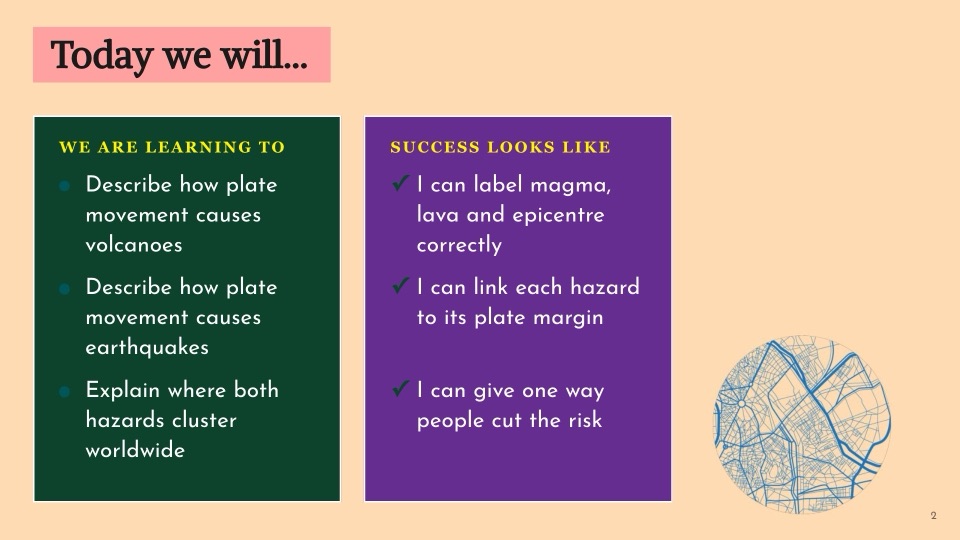
- Students will describe how plate movement causes earthquakes and volcanoes.
- Students will explain where earthquakes and volcanoes cluster worldwide.
- Students will label magma, lava and ash in an eruption diagram.
Success criteria
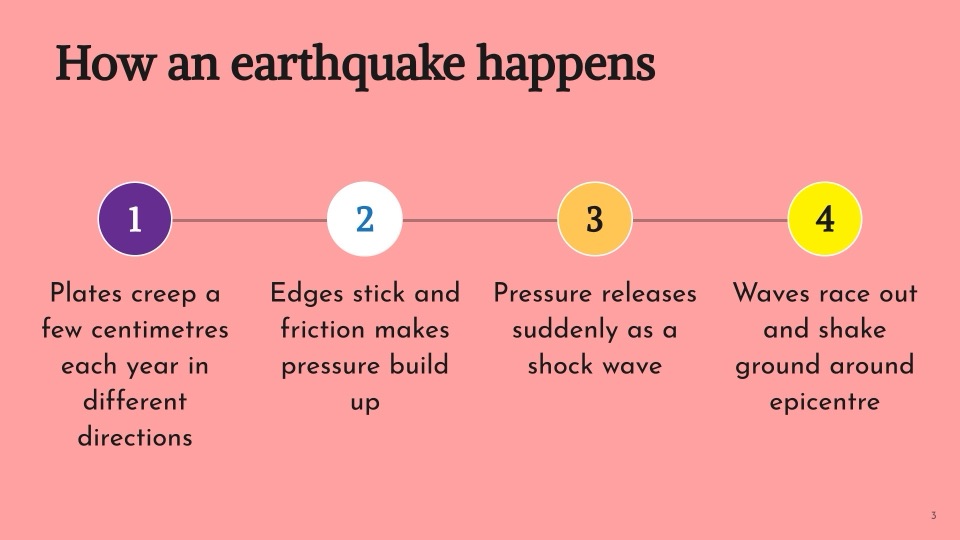
- I can explain how stuck plates release energy as an earthquake.
- I can describe where volcanoes and earthquakes cluster worldwide.
- I can label magma, lava and ash on my diagram.
Key words
| Word | Meaning |
|---|---|
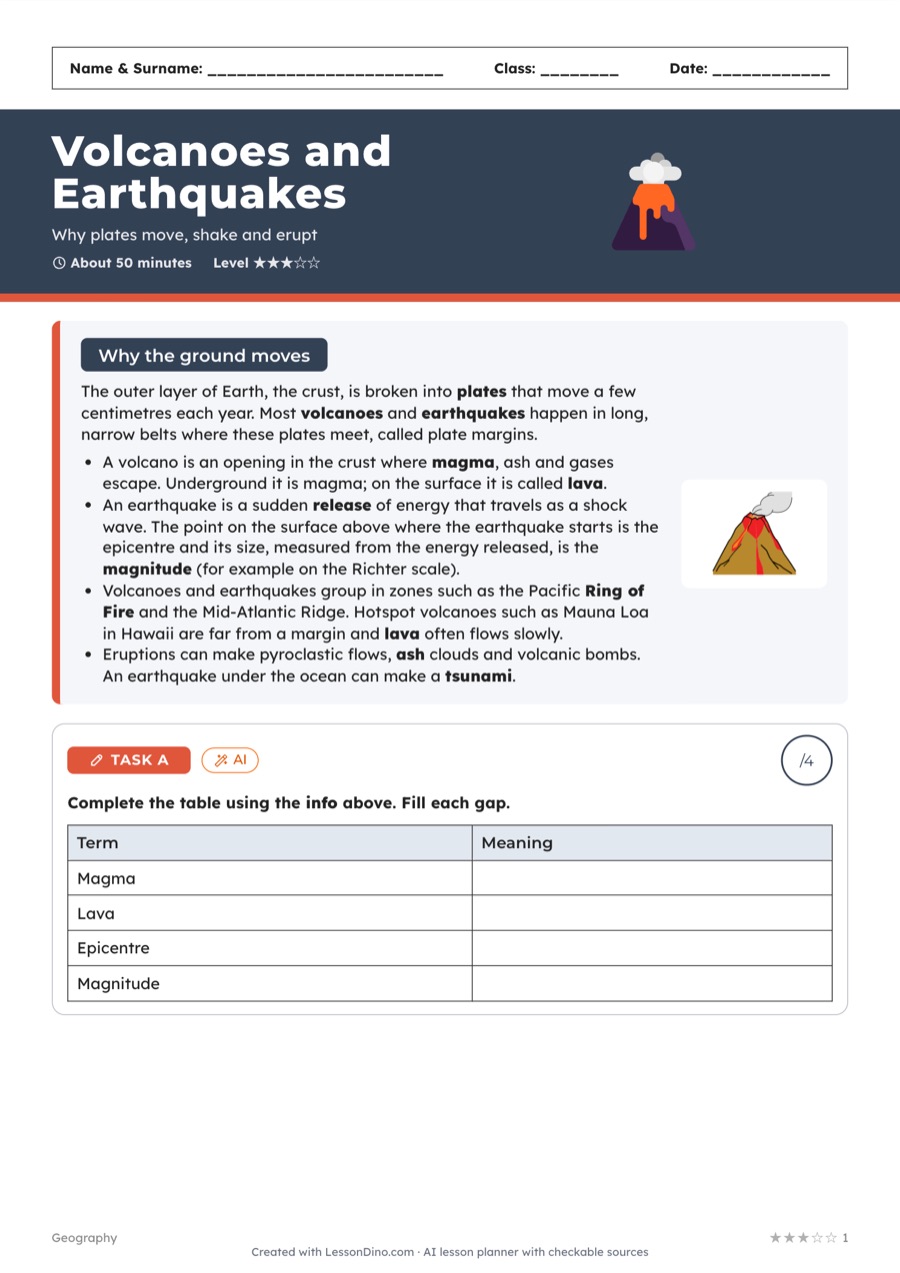
| magma | very hot melted rock found below the ground |
| lava | hot melted rock that has come out onto the surface |
| epicentre | point on the surface directly above where a shake starts below |
| plate margin | the edge where two moving slabs of crust meet |
| hotspot | place where unusually hot melted rock rises far from an edge |
Timed plan (60 minutes)
| Time | Stage | What happens |
|---|---|---|
| 5 min | Starter | Hook interest in eruptions and recall what students know about volcanoes. Show Slide 1 title and read the hook: Draw me an eruption that a scientist would actually believe. Show Slide 2 objectives and read the three goals for the lesson. Ask pairs to list in 1 minute what comes out of a volcano. Take 3 quick answers and keep the labelled diagram challenge for later. |
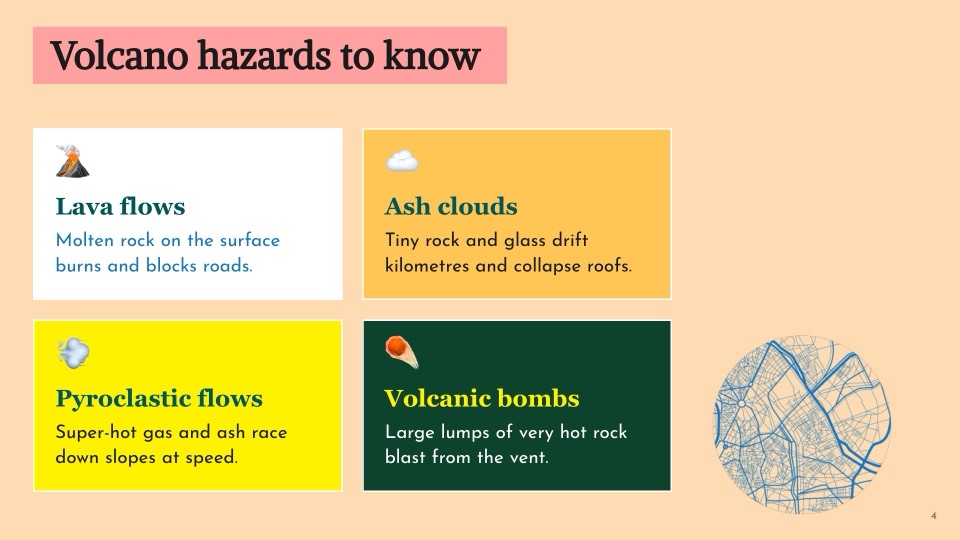
| 10 min | Teaching | Explain how plate movement causes earthquakes and what volcanoes produce. Show Slide 3 steps and model plates creeping then sticking with hands. Explain friction makes pressure build until it releases suddenly as a shock wave. Show Slide 4 cards for lava flows, ash clouds and pyroclastic flows. Define magma as molten rock and lava when it reaches the surface. |
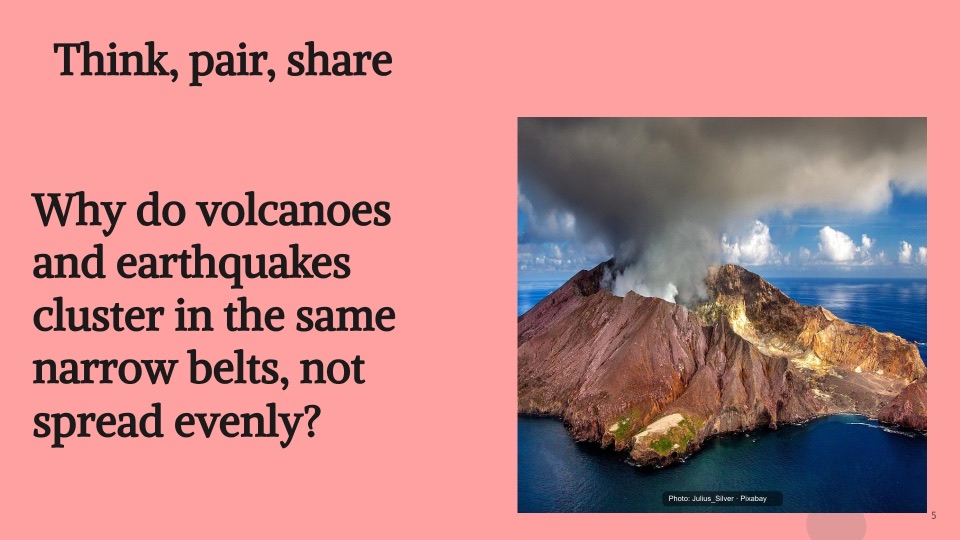
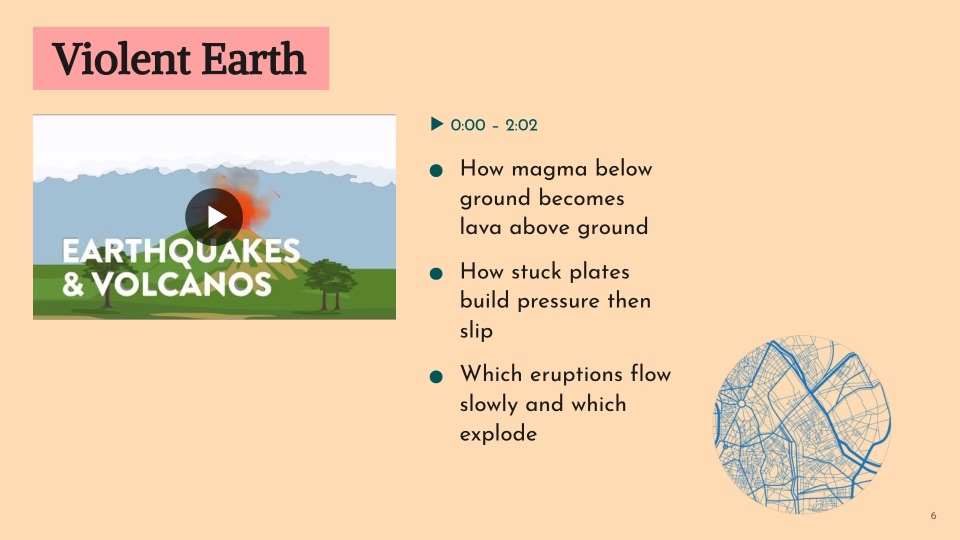
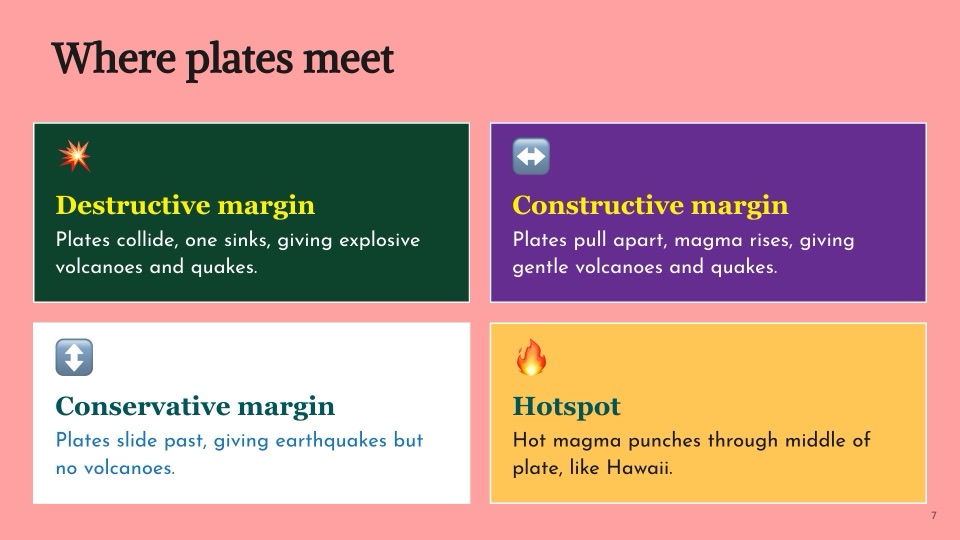
| 10 min | Patterns worldwide | Show that quakes and volcanoes cluster in narrow belts at margins. Show Slide 5 question about clustering in narrow belts. Play Video clip 1 (0:00-2:02) on Slide 6 about magma, lava and stuck plates. Show Slide 7 cards for destructive and constructive margins. Teach Ring of Fire and Mid-Atlantic Ridge as narrow zones of activity. |
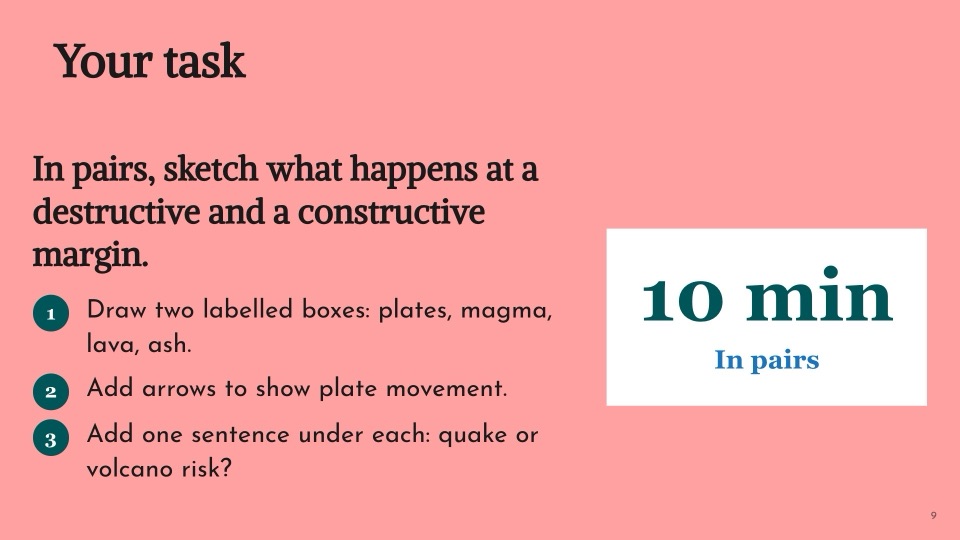
| 20 min | Main activity | Draw and label a scientific cross-section of a volcanic eruption. Show Slide 9 task: draw two labelled boxes with plates, magma, lava and ash. Model a cross-section on the board with magma chamber, vent, lava and ash cloud. Hand out A3 paper, coloured pencils and rulers for paired sketching. Remind pairs to add arrows for movement and one risk sentence under each box. |
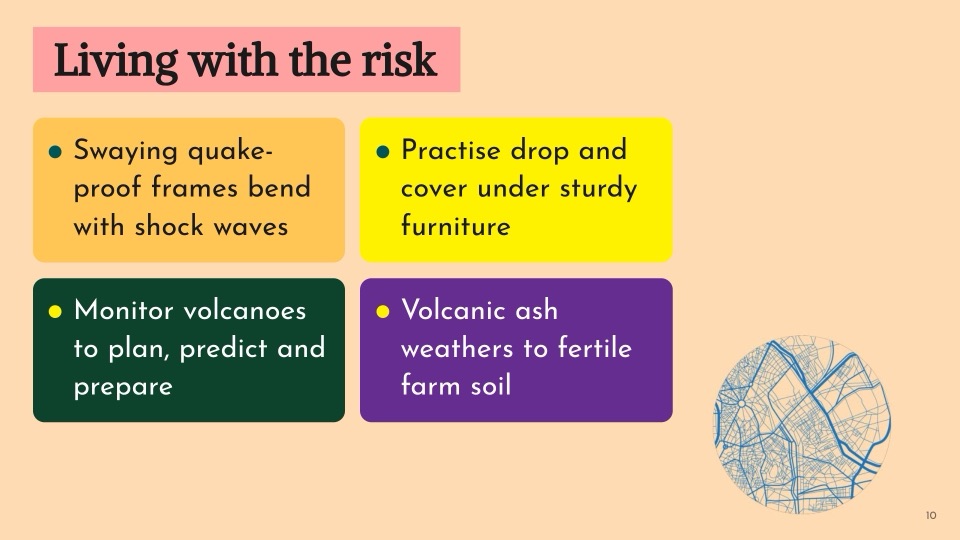
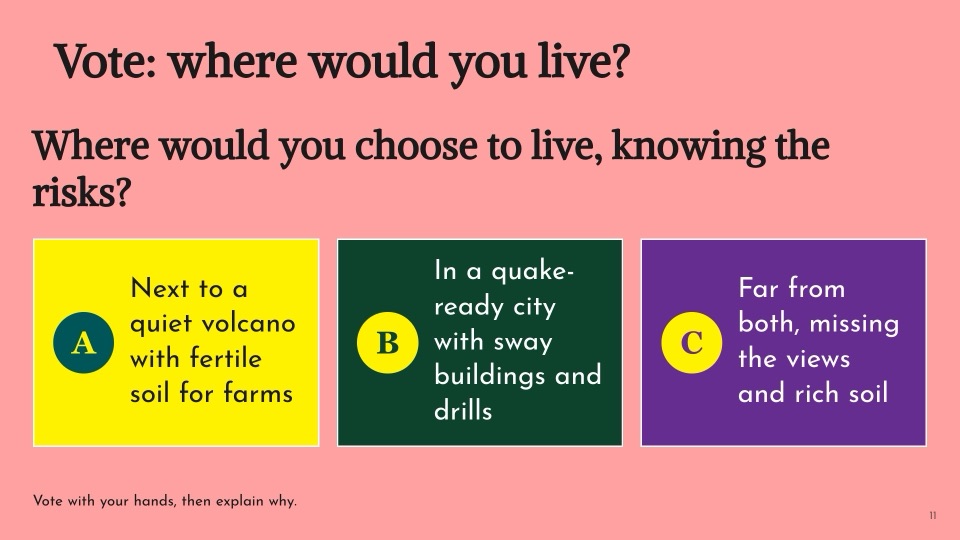
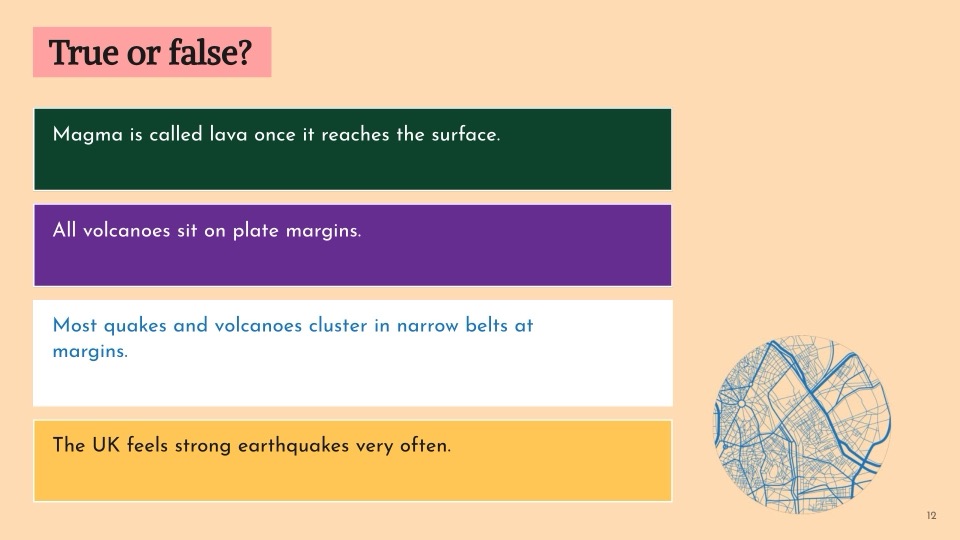
| 15 min | Plenary | Sort ideas about volcanoes, earthquakes and living with risk. Hand out Worksheet Task B Venn diagram for Volcanoes, Earthquakes or both. Show Slide 10 bullets about swaying frames and drop and cover. Run Slide 11 vote on living near a quiet volcano or in a quake-ready city. Finish with Slide 12 true or false on magma, lava and hotspots. |
Common mistakes
- Mixing up magma and lava
How to spot it: Labels swapped on diagram or Venn
Repeat magma is molten rock below, lava is called lava when it reaches the surface. - Thinking quakes and volcanoes are spread evenly
How to spot it: Marks scattered randomly on maps
Stress they occur mostly in long, narrow belts along boundaries and coincide with margins. - Thinking all volcanoes are at plate edges
How to spot it: Claims hotspot volcanoes must be on a margin
Recall Hawaiian Islands formed in the middle of the ocean, more than 3,200 km from the nearest boundary, explained by hotspots.
Support
- Word bank and labelled example diagram to copy for magma, lava and ash
- Sentence starters and pre-shaded belt to show narrow zones
- Paired work and half-finished frames for explanations
Stretch
- Add caption on which eruption product causes most building damage and why
- Predict hotspot pattern compared with margin pattern using distance data
- Justify living choice with magnitude and secondary effects
Check questions
- How does plate movement cause an earthquake?
Answer: Friction makes pressure build until energy releases suddenly as a shock wave. - Where do most volcanoes and earthquakes cluster and why?
Answer: In narrow belts along plate margins, including the Pacific Ring of Fire. - Label this: melted rock below ground and after it erupts?
Answer: Below is magma, once it reaches the surface it is called lava.
Curriculum
physical geography, including: climate zones, biomes and vegetation belts, rivers, mountains, volcanoes and earthquakes, and the water cycle
Video clips
Clips on YouTube, from the start and end times we chose. Check each one before you show it.
-
Violent Earth overview from 0:00 to 2:02
Da Vinci Kids: Earthquakes & Volcanoes - the Story of Earth as a Violent Place | Down to Earth
Covers both volcanoes and earthquakes together in clear, simple language at an ideal pace for 12-13.
-
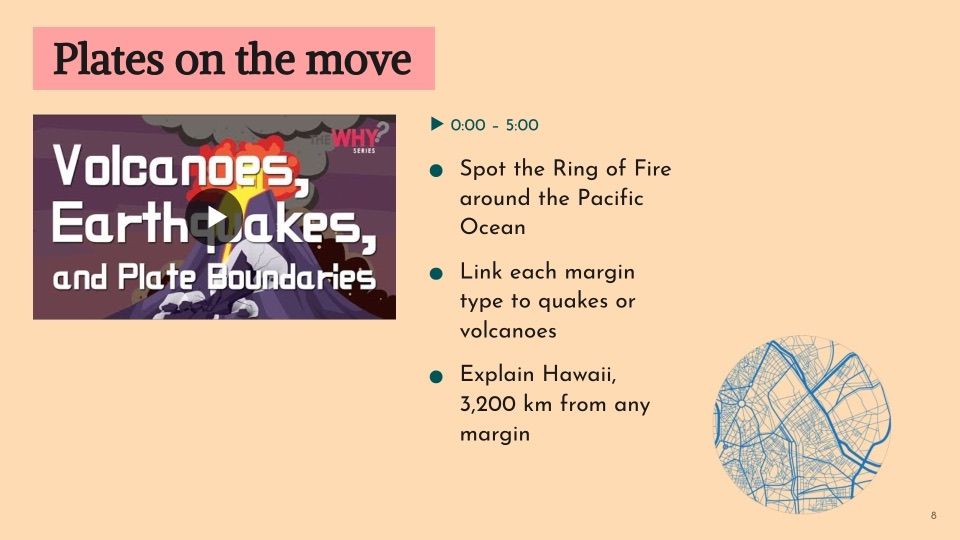
Plates and boundaries link from 0:00 to 5:00
EBSDocumentary (EBS 다큐): [Why series] Earth Science Episode 2 - Volcanoes, Earthquakes, and Plate Boundaries
School-made episode from a broadcaster that links both hazards to plate boundaries with vocabulary suited to Year 8.
Worksheet
Sources
- National curriculum in England: geography programmes of study assets.publishing.service.gov.uk
- geography ladymargaret.lbhf.sch.uk
- Volcanoes and Earthquakes gallery | Natural History Museum nhm.ac.uk
- What are volcanoes and earthquakes? | KS2 Topic | Ages 7-11 ... bbc.co.uk
- Global distribution of earthquakes and volcanoes - Plate ... bbc.co.uk
- Volcanoes and Earthquakes - School Learning Zone school-learningzone.co.uk
- IGCSE Geography; earthquakes and volcanoes - i-study i-study.co.uk
- Global distribution of earthquakes and volcanoes KS4 | Y10 ... thenational.academy
- Lesson: Global distribution of earthquakes and volcanoes ... thenational.academy
- Natural Disasters: Earthquakes, Volcanoes, Tornadoes & More teachengineering.org
- Earthquakes and Volcanoes - Khan Academy khanacademy.org
- Earthquake - National Geographic Society education.nationalgeographic.org
- When did volcanoes and earthquakes start on Earth? | SYFY WIRE syfy.com
- Earthquakes - National Geographic Kids kids.nationalgeographic.com
- Teaching Plate Tectonics with Maps: Earthquakes, Volcanoes ... topostreets.com
- Mega volcanoes caused earthquakes in the UK and Denmark sciencenordic.com
- Earthquakes and Volcanoes Printable (5th - 6th Grade) teachervision.com
- Earthquakes and Volcanoes, Free PDF Download - Learn Bright learnbright.org
- Earthquakes and Volcanoes | Physical Geography Class Notes ... fiveable.me
- Tectonic hazards and volcanoes guide for KS3 geography ... - BBC bbc.co.uk
Picture credits
- Photo: NASA · Public domain · Wikimedia Commons
- Photo: Julius_Silver · Pixabay
- Pictograms: Sergio Palao, ARASAAC (arasaac.org) · CC BY-NC-SA
- Microsoft Fluent Emoji (MIT)
Made with Lesson Dino's AI on 17 October 2026. AI can make mistakes, so check facts against the sources before you teach.