The worksheet
About this worksheet
Students learn to plot points in all four quadrants and find distances with absolute value. They plot four mystery points, build a rectangle, and measure its sides. This Grade 6 Math worksheet gives students (ages 11–12) six pages of practice on points in all four quadrants, part of the the number system unit. It goes with our free Points in all four quadrants lesson, which has the slides and a timed lesson plan.
What it covers
By the end, students should be able to:
- Students will graph integer and decimal ordered pairs in all four quadrants.
- Students will plot four points to build a rectangle and find its side lengths.
- Students will use absolute value to find distances with same x or same y.
How to use it
- Use it for practice after the teaching part of the lesson, once students have seen the worked examples on the slides.
- Support: Show how a missing rectangle corner can be found from the other three corners by keeping sides straight.
- Stretch: Ask for the perimeter in feet and where a fifth point inside the rectangle could go.
- The answer sheet is the last page, so you can print it on its own or let students check their own work.
Key vocabulary
- ordered pair: two numbers in parentheses that give a spot, across first then up or down
- origin: the center point (0, 0) where the flat line and up-down line cross
- quadrant: one of four areas made when the two number lines cross
- x-axis: the flat number line that goes left and right
- absolute value: how far a number sits from zero, always given as a positive count
Mistakes to watch for
- Swapping x and y, thinking (3, -2) is the same as (-2, 3). Rehearse x before y in alphabetical order and across before up; plot both orders to compare.
- Counting moves from the last point or grid corner instead of the origin. Point back to (0, 0) where axes cross for every new plot and start there.
- Using both coordinates or forgetting absolute value for shared-x or shared-y distance. Circle the shared number, use only the numbers that change, and write |y2 - y1| or |x2 - x1|.
What's on the worksheet
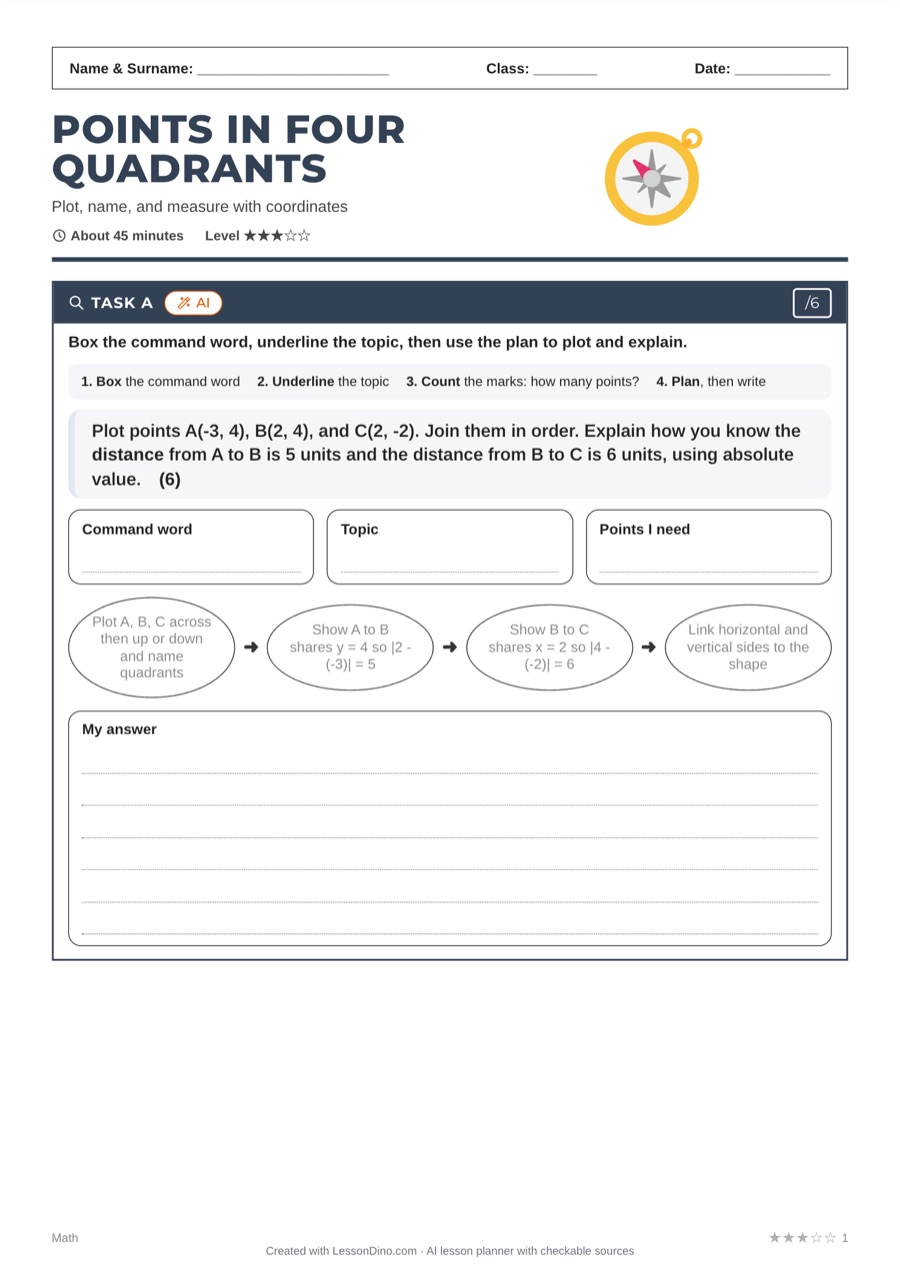
Across Then Up
Learn to plot points and find distances on the coordinate plane.
Box the command word, underline the topic, then use the plan to plot and explain.
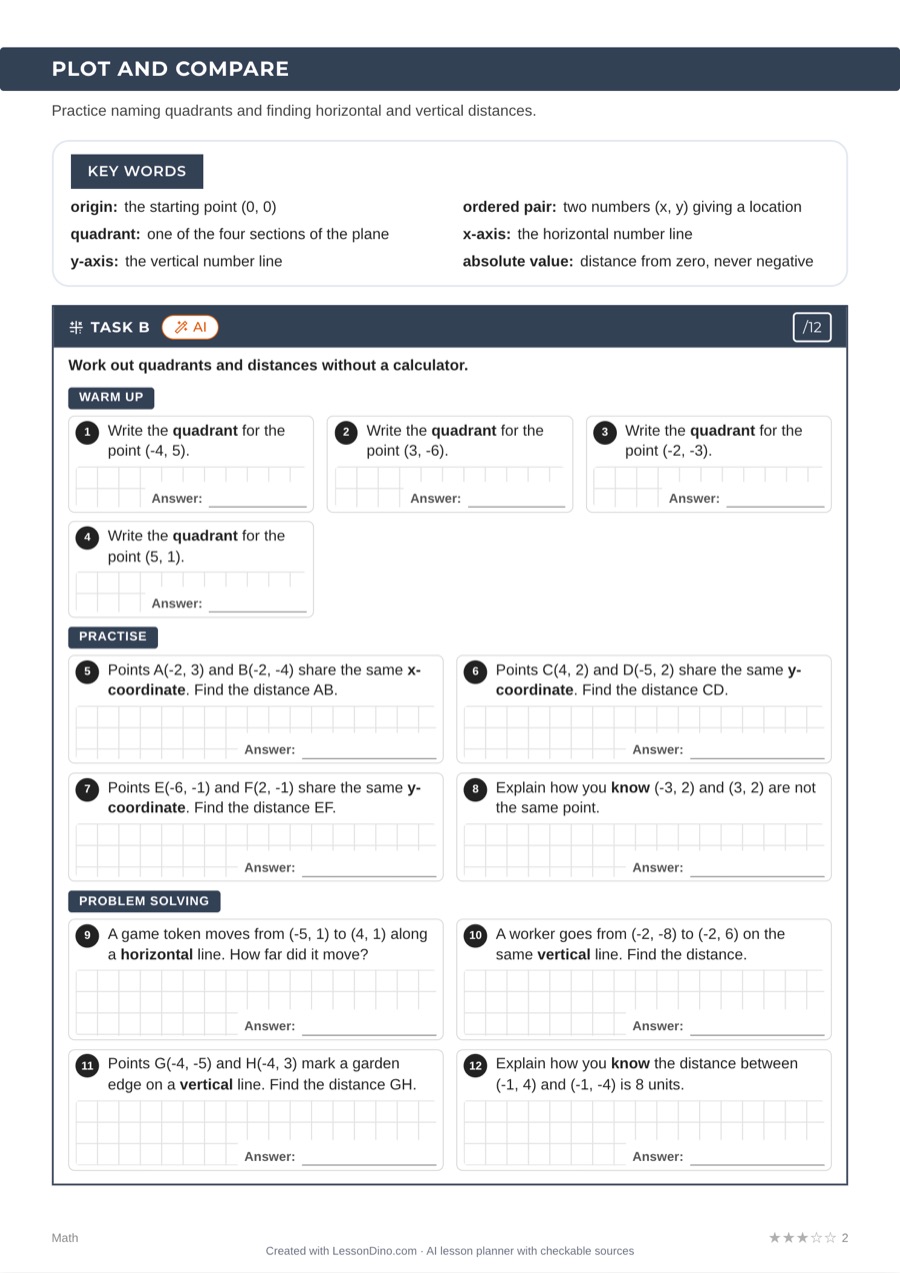
Plot And Compare
Practice naming quadrants and finding horizontal and vertical distances.
| Word | Meaning |
|---|---|
| origin | the starting point (0, 0) |
| ordered pair | two numbers (x, y) giving a location |
| quadrant | one of the four sections of the plane |
| x-axis | the horizontal number line |
| y-axis | the vertical number line |
| absolute value | distance from zero, never negative |
Work out quadrants and distances without a calculator.
Warm up
- Write the quadrant for the point (-4, 5).
- Write the quadrant for the point (3, -6).
- Write the quadrant for the point (-2, -3).
- Write the quadrant for the point (5, 1).
Practise
- Points A(-2, 3) and B(-2, -4) share the same x-coordinate. Find the distance AB.
- Points C(4, 2) and D(-5, 2) share the same y-coordinate. Find the distance CD.
- Points E(-6, -1) and F(2, -1) share the same y-coordinate. Find the distance EF.
- Explain how you know (-3, 2) and (3, 2) are not the same point.
Problem solving
- A game token moves from (-5, 1) to (4, 1) along a horizontal line. How far did it move?
- A worker goes from (-2, -8) to (-2, 6) on the same vertical line. Find the distance.
- Points G(-4, -5) and H(-4, 3) mark a garden edge on a vertical line. Find the distance GH.
- Explain how you know the distance between (-1, 4) and (-1, -4) is 8 units.
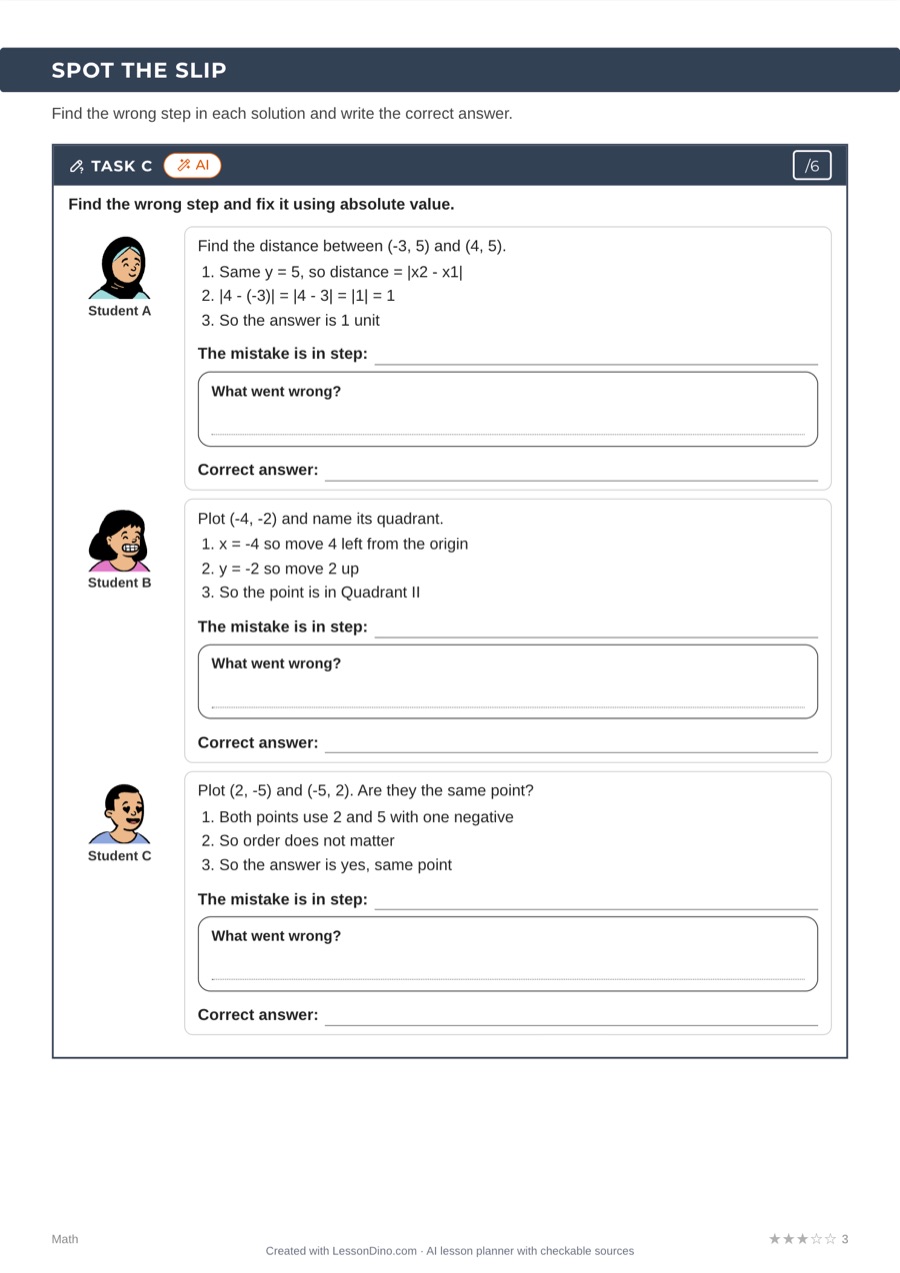
Spot The Slip
Find the wrong step in each solution and write the correct answer.
Find the wrong step and fix it using absolute value.
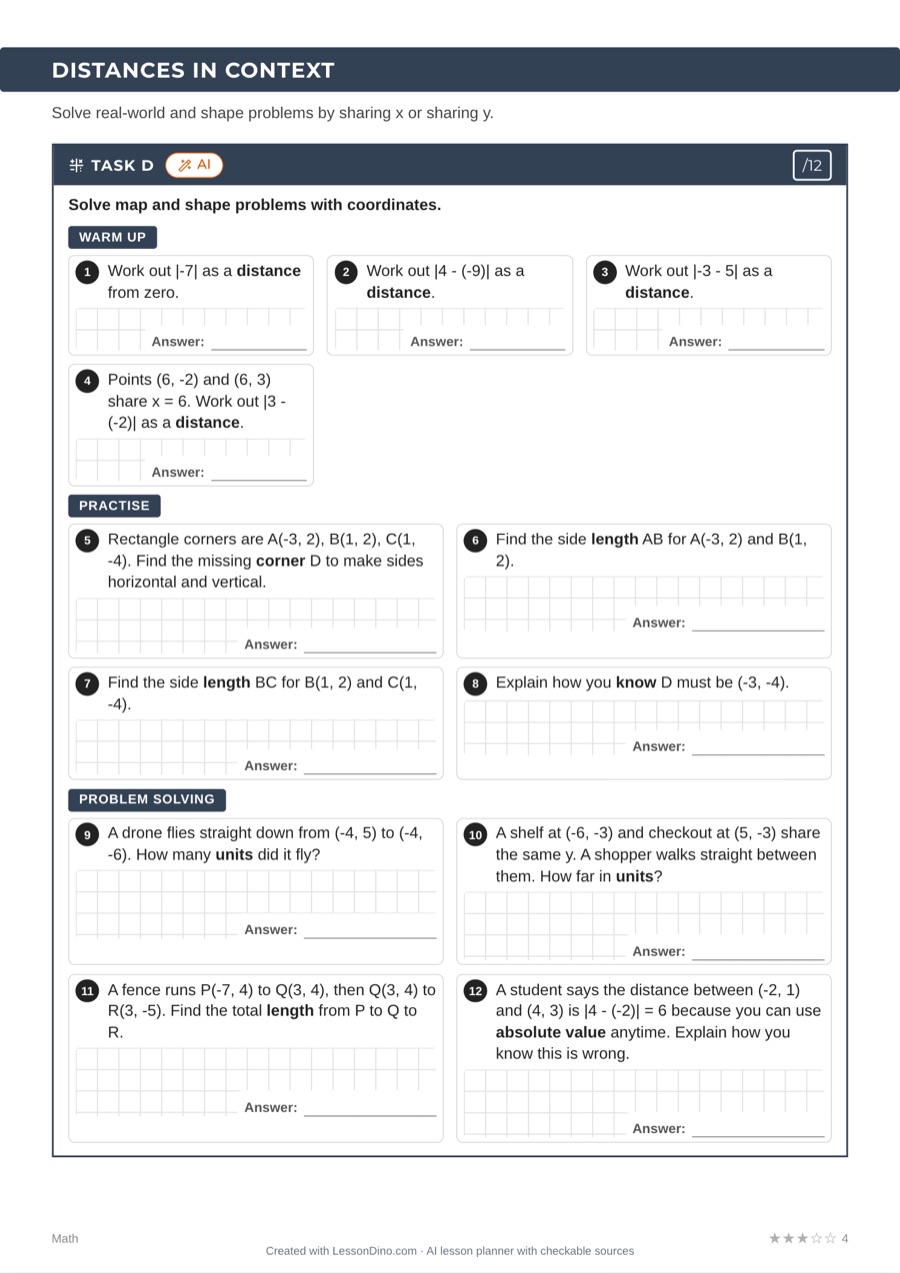
Distances In Context
Solve real-world and shape problems by sharing x or sharing y.
Solve map and shape problems with coordinates.
Warm up
- Work out |-7| as a distance from zero.
- Work out |4 - (-9)| as a distance.
- Work out |-3 - 5| as a distance.
- Points (6, -2) and (6, 3) share x = 6. Work out |3 - (-2)| as a distance.
Practise
- Rectangle corners are A(-3, 2), B(1, 2), C(1, -4). Find the missing corner D to make sides horizontal and vertical.
- Find the side length AB for A(-3, 2) and B(1, 2).
- Find the side length BC for B(1, 2) and C(1, -4).
- Explain how you know D must be (-3, -4).
Problem solving
- A drone flies straight down from (-4, 5) to (-4, -6). How many units did it fly?
- A shelf at (-6, -3) and checkout at (5, -3) share the same y. A shopper walks straight between them. How far in units?
- A fence runs P(-7, 4) to Q(3, 4), then Q(3, 4) to R(3, -5). Find the total length from P to Q to R.
- A student says the distance between (-2, 1) and (4, 3) is |4 - (-2)| = 6 because you can use absolute value anytime. Explain how you know this is wrong.
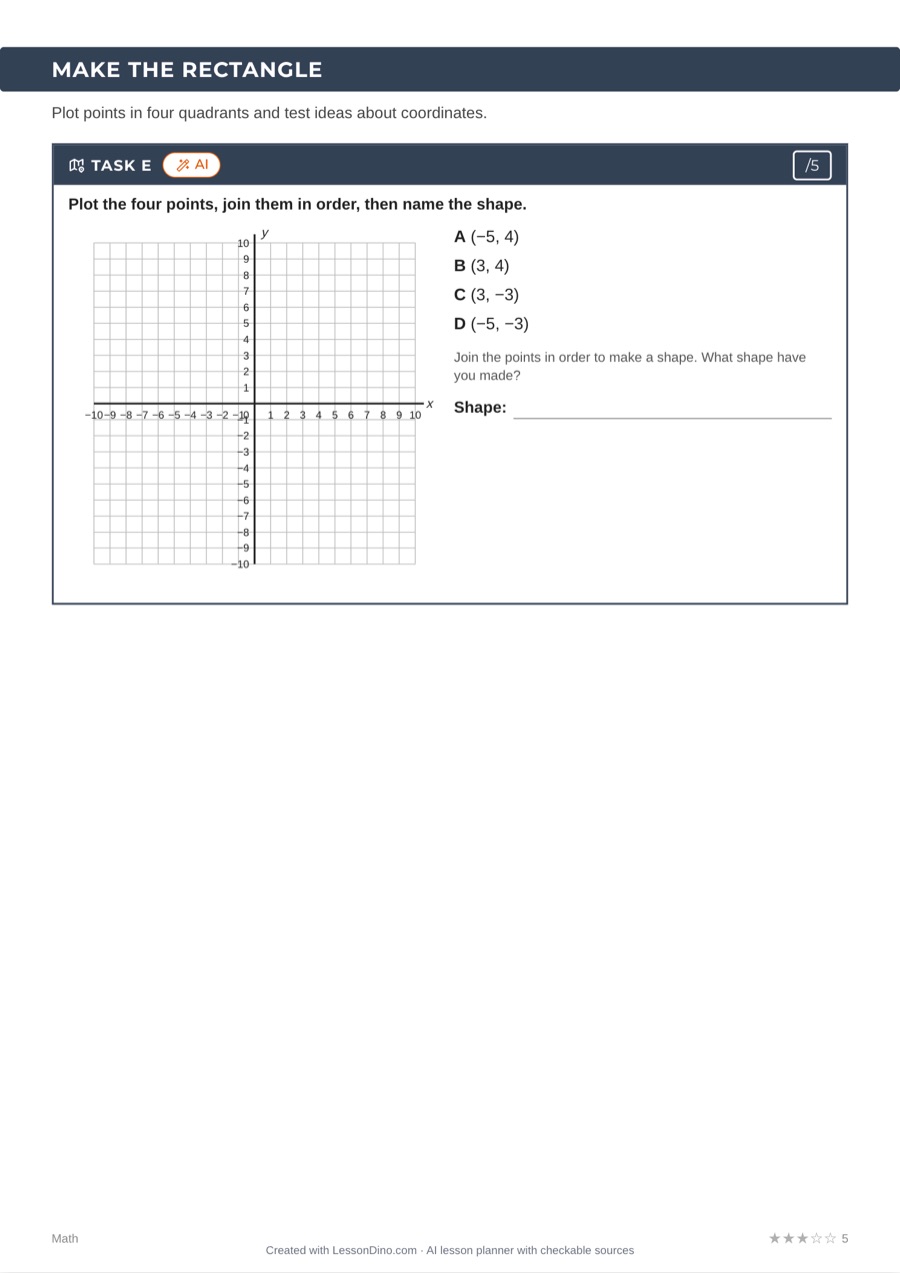
Make The Rectangle
Plot points in four quadrants and test ideas about coordinates.
Plot the four points, join them in order, then name the shape.
Page 6
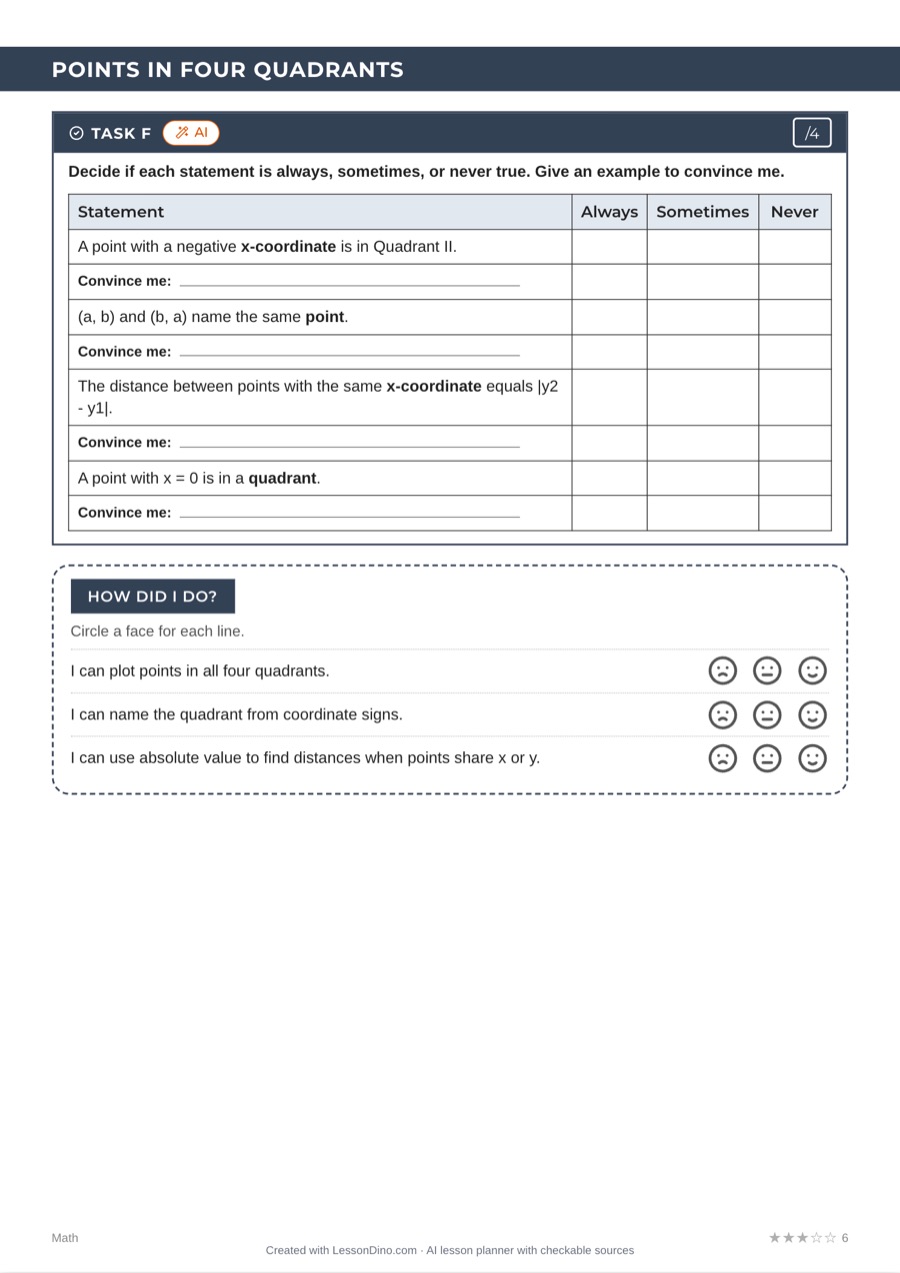
Decide if each statement is always, sometimes, or never true. Give an example to convince me.
Answers
Show the answers
- Write the quadrant for the point (-4, 5). Quadrant II
- Write the quadrant for the point (3, -6). Quadrant IV
- Write the quadrant for the point (-2, -3). Quadrant III
- Write the quadrant for the point (5, 1). Quadrant I
- Points A(-2, 3) and B(-2, -4) share the same x-coordinate. Find the distance AB. 7 units
- Points C(4, 2) and D(-5, 2) share the same y-coordinate. Find the distance CD. 9 units
- Points E(-6, -1) and F(2, -1) share the same y-coordinate. Find the distance EF. 8 units
- Explain how you know (-3, 2) and (3, 2) are not the same point. The x-coordinates have opposite signs, so one point is left of the y-axis and one is right.
- A game token moves from (-5, 1) to (4, 1) along a horizontal line. How far did it move? 9 units
- A worker goes from (-2, -8) to (-2, 6) on the same vertical line. Find the distance. 14 units
- Points G(-4, -5) and H(-4, 3) mark a garden edge on a vertical line. Find the distance GH. 8 units
- Explain how you know the distance between (-1, 4) and (-1, -4) is 8 units. They share x = -1, so distance = |4 - (-4)| = 8 units.
- Work out |-7| as a distance from zero. 7
- Work out |4 - (-9)| as a distance. 13
- Work out |-3 - 5| as a distance. 8
- Points (6, -2) and (6, 3) share x = 6. Work out |3 - (-2)| as a distance. 5
- Rectangle corners are A(-3, 2), B(1, 2), C(1, -4). Find the missing corner D to make sides horizontal and vertical. (-3, -4)
- Find the side length AB for A(-3, 2) and B(1, 2). 4 units
- Find the side length BC for B(1, 2) and C(1, -4). 6 units
- Explain how you know D must be (-3, -4). D must line up with C across y = -4 and with A down x = -3 to make right angles.
- A drone flies straight down from (-4, 5) to (-4, -6). How many units did it fly? 11 units
- A shelf at (-6, -3) and checkout at (5, -3) share the same y. A shopper walks straight between them. How far in units? 11 units
- A fence runs P(-7, 4) to Q(3, 4), then Q(3, 4) to R(3, -5). Find the total length from P to Q to R. 19 units
- A student says the distance between (-2, 1) and (4, 3) is |4 - (-2)| = 6 because you can use absolute value anytime. Explain how you know this is wrong. They share neither x nor y, so the points are not lined up horizontally or vertically and one absolute difference does not work.
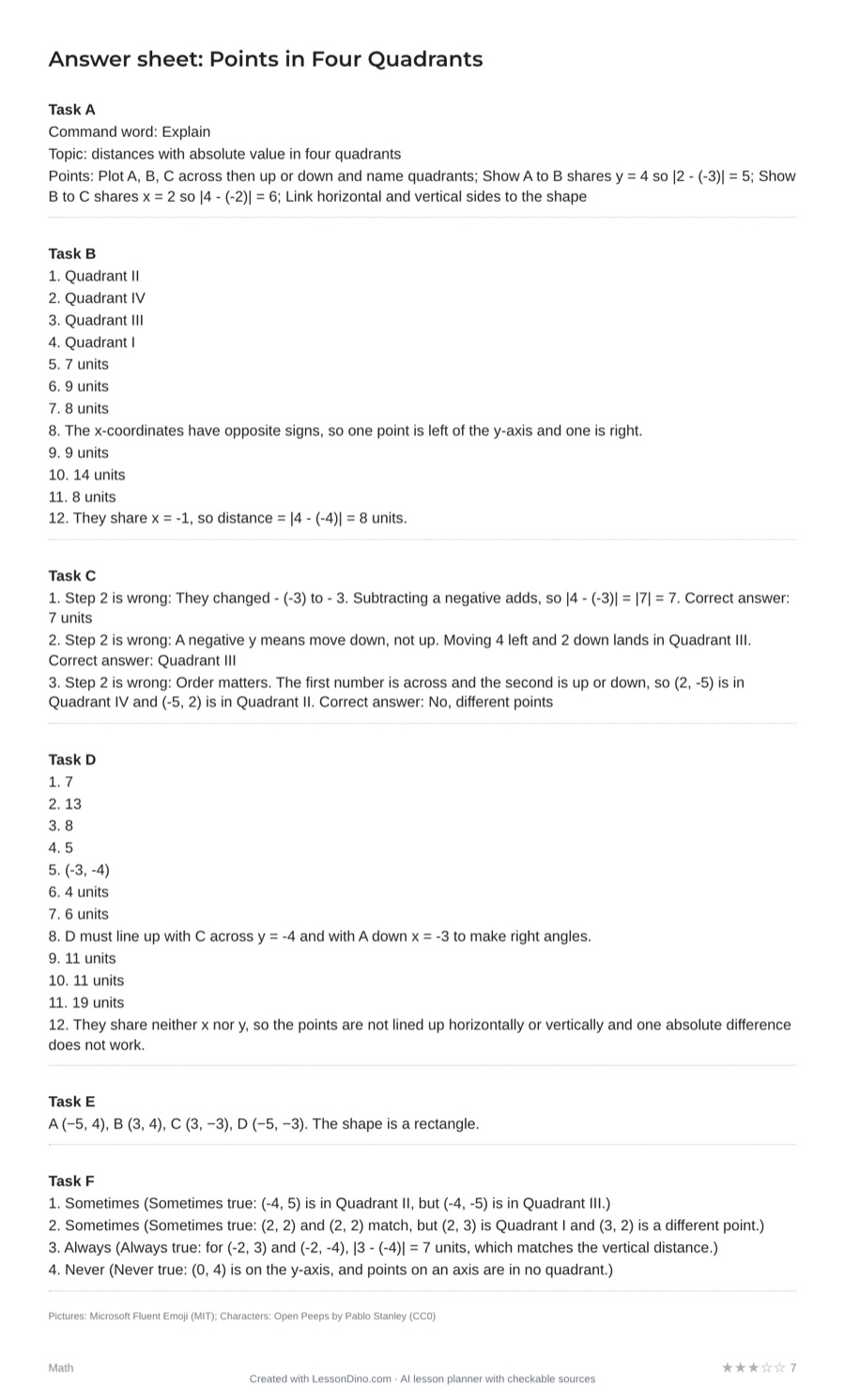
The answer sheet is the last picture above.
Curriculum
Solve real-world and mathematical problems by graphing points in all four quadrants of the coordinate plane. Include use of coordinates and absolute value to find distances between points with the same first coordinate or the same second coordinate.
Made with Lesson Dino's AI on 19 October 2026. AI can make mistakes, so check the answers and facts against the sources before you teach.