The worksheet
About this worksheet
Students learn to fluently divide 3-digit numbers by 2-digit divisors. They estimate, play quotient bingo, and check every answer. This Grade 6 Math worksheet gives students (ages 11–12) six pages of practice on long division, part of the the number system unit. It goes with our free Long division lesson, which has the slides and a timed lesson plan.
What it covers
By the end, students should be able to:
- Students will fluently divide 3-digit by 2-digit numbers using the standard algorithm.
- Students will estimate quotients using easy multiples before dividing exactly.
- Students will check division by multiplying quotient by divisor and explaining remainders.
How to use it
- Use it for practice after the teaching part of the lesson, once students have seen the worked examples on the slides.
- Support: Provide handwritten 1x to 10x multiple lists and a multiplication table for 12, because known facts help estimate the answer.
- Stretch: Require checking every answer with dividend = divisor x quotient + remainder and explaining the leftover in one sentence.
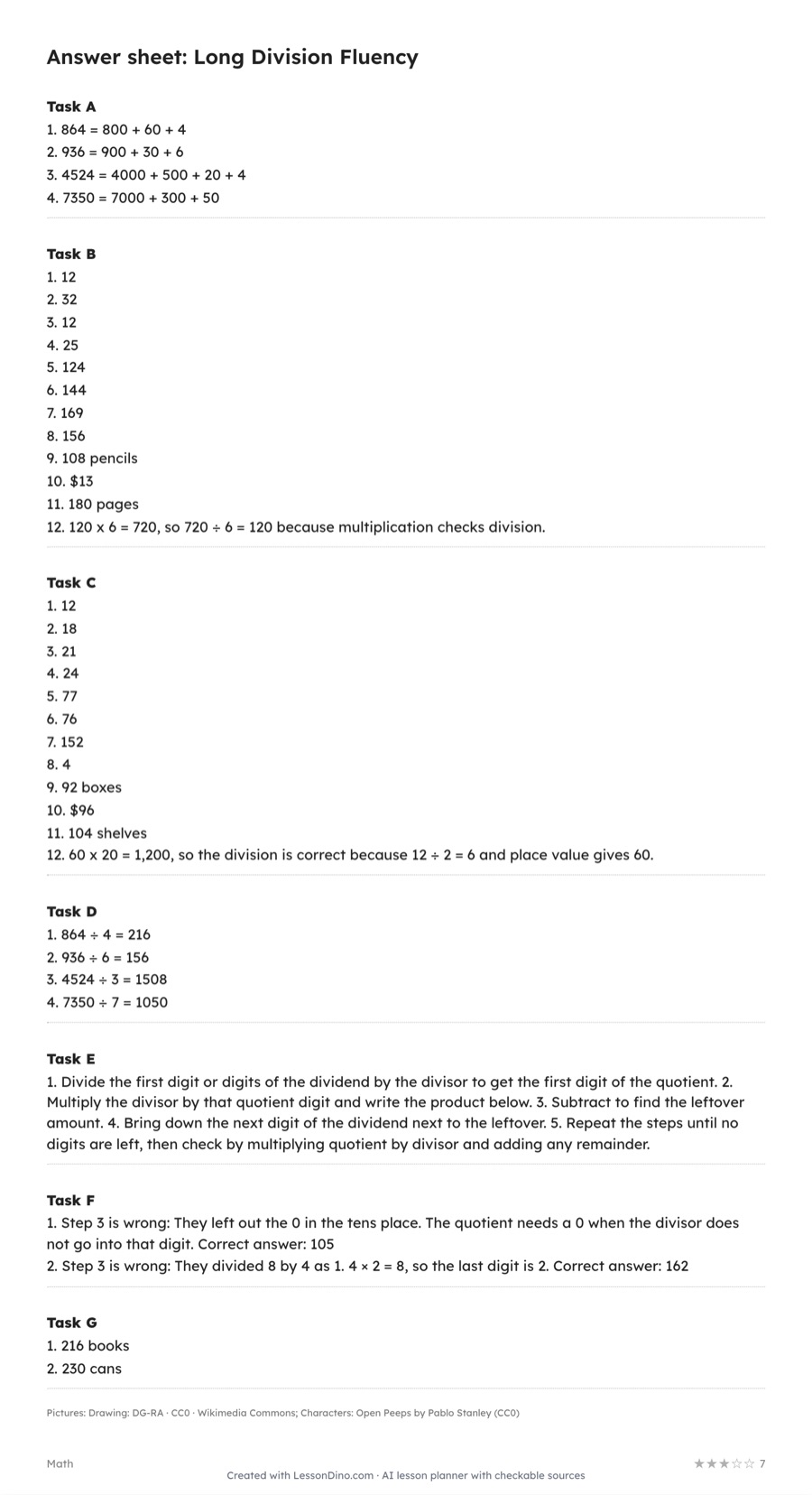
- The answer sheet is the last page, so you can print it on its own or let students check their own work.
Key vocabulary
- dividend: the large amount that gets split up
- divisor: the number you split by, or how many groups you make
- quotient: the answer that sits on top after splitting is done
- remainder: the small amount left over after sharing fairly
- estimate: a close guess that is near the right answer
- long division: a way of splitting large numbers by working in smaller groups
Mistakes to watch for
- Quotient digit written over the wrong place value. Estimate first and ask how many groups fit in the first two digits; long division records regrouping alongside the subtraction.
- Forgetting to bring down the next digit and stopping early. Repeat divide, multiply, subtract, and bring down until no digits are left.
- Remainder larger than the divisor. Check that remainder is an amount left after division and must fit a = b x q + r with r smaller than the divisor; choose a larger quotient digit.
What's on the worksheet
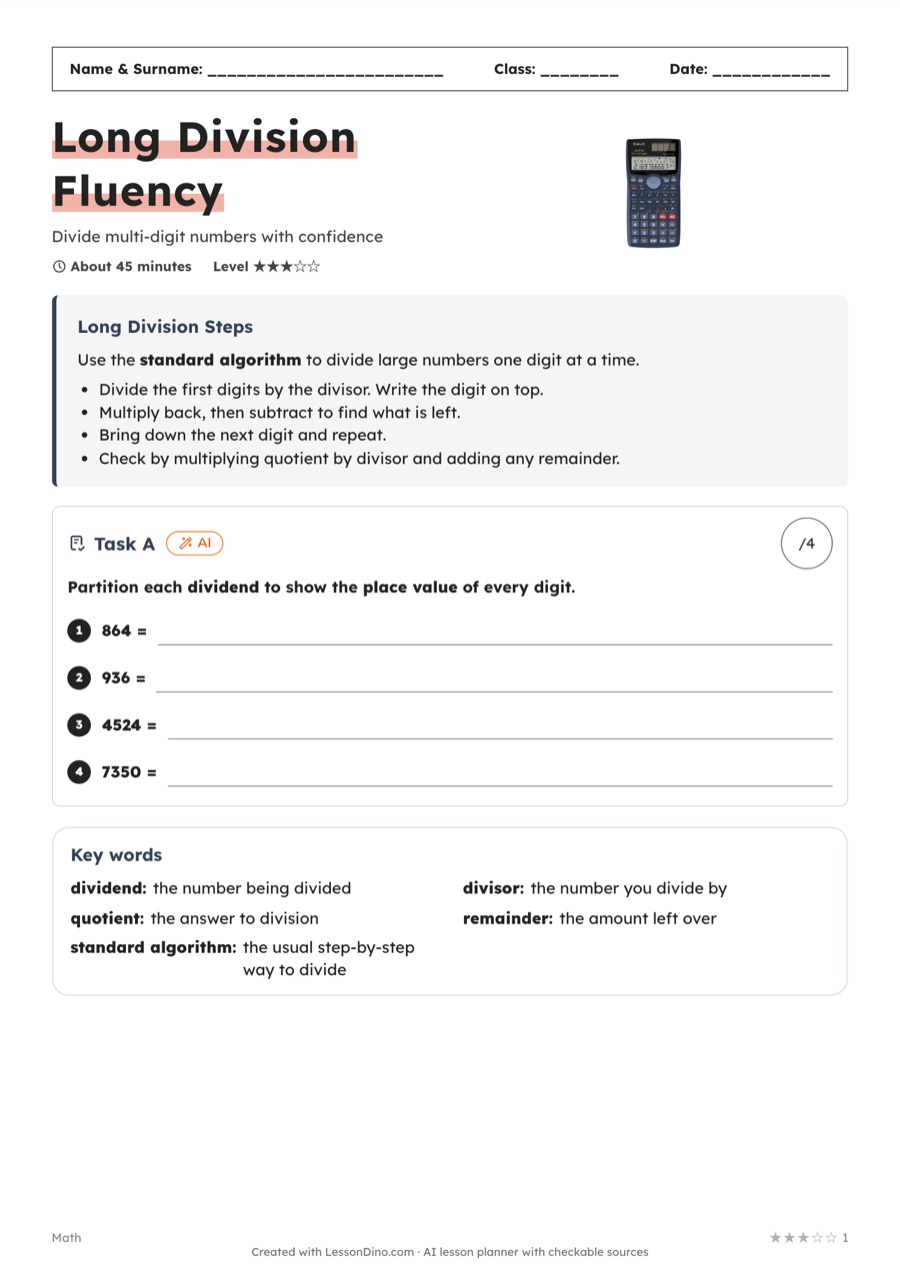
Divide With Confidence
Learn the long division steps and review place value.
Long Division Steps
- Use the standard algorithm to divide large numbers one digit at a time.
- Divide the first digits by the divisor. Write the digit on top.
- Multiply back, then subtract to find what is left.
- Bring down the next digit and repeat.
- Check by multiplying quotient by divisor and adding any remainder.
Partition each dividend to show the place value of every digit.
| Word | Meaning |
|---|---|
| dividend | the number being divided |
| divisor | the number you divide by |
| quotient | the answer to division |
| remainder | the amount left over |
| standard algorithm | the usual step-by-step way to divide |
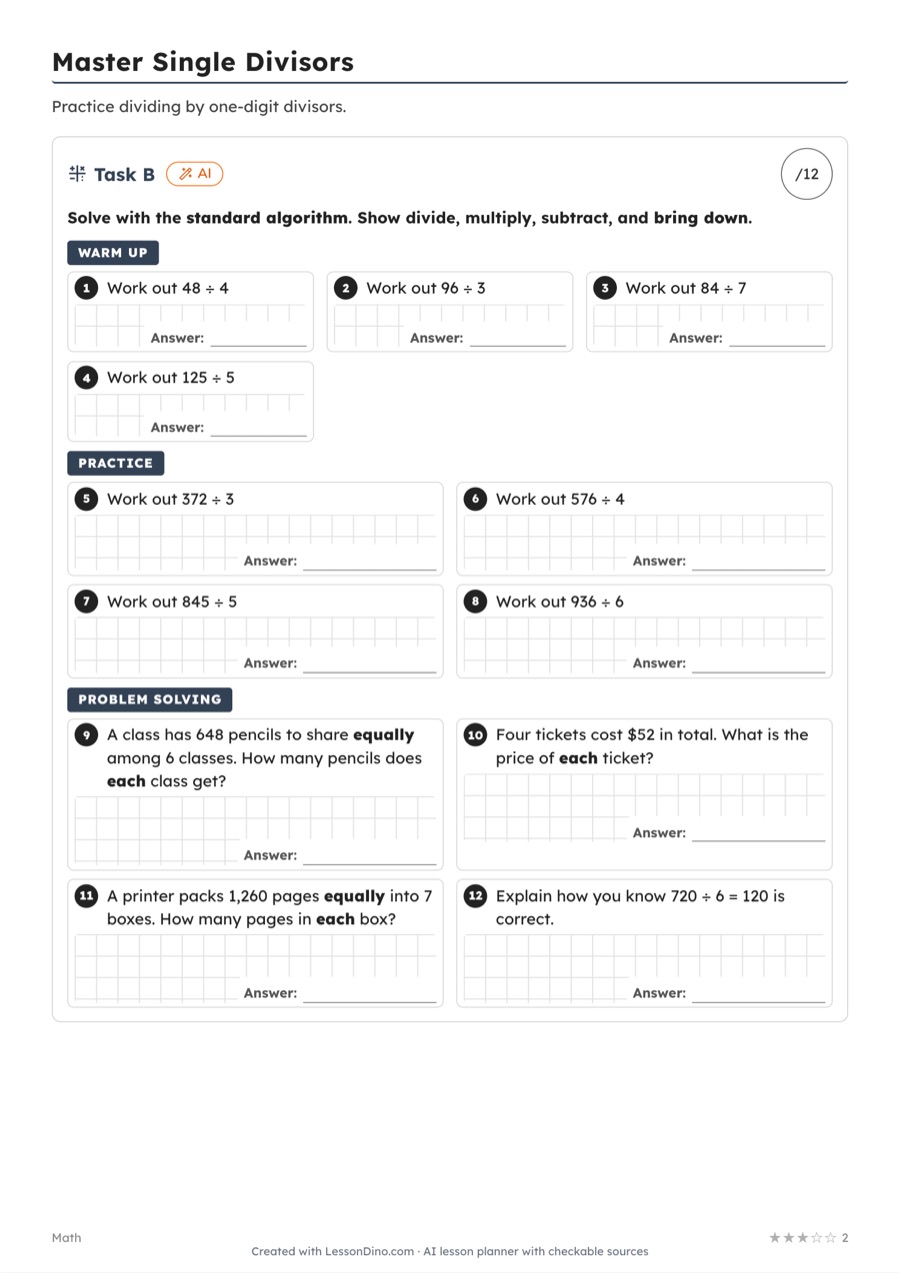
Master Single Divisors
Practice dividing by one-digit divisors.
Solve with the standard algorithm. Show divide, multiply, subtract, and bring down.
Warm up
- Work out 48 ÷ 4
- Work out 96 ÷ 3
- Work out 84 ÷ 7
- Work out 125 ÷ 5
Practice
- Work out 372 ÷ 3
- Work out 576 ÷ 4
- Work out 845 ÷ 5
- Work out 936 ÷ 6
Problem solving
- A class has 648 pencils to share equally among 6 classes. How many pencils does each class get?
- Four tickets cost $52 in total. What is the price of each ticket?
- A printer packs 1,260 pages equally into 7 boxes. How many pages in each box?
- Explain how you know 720 ÷ 6 = 120 is correct.
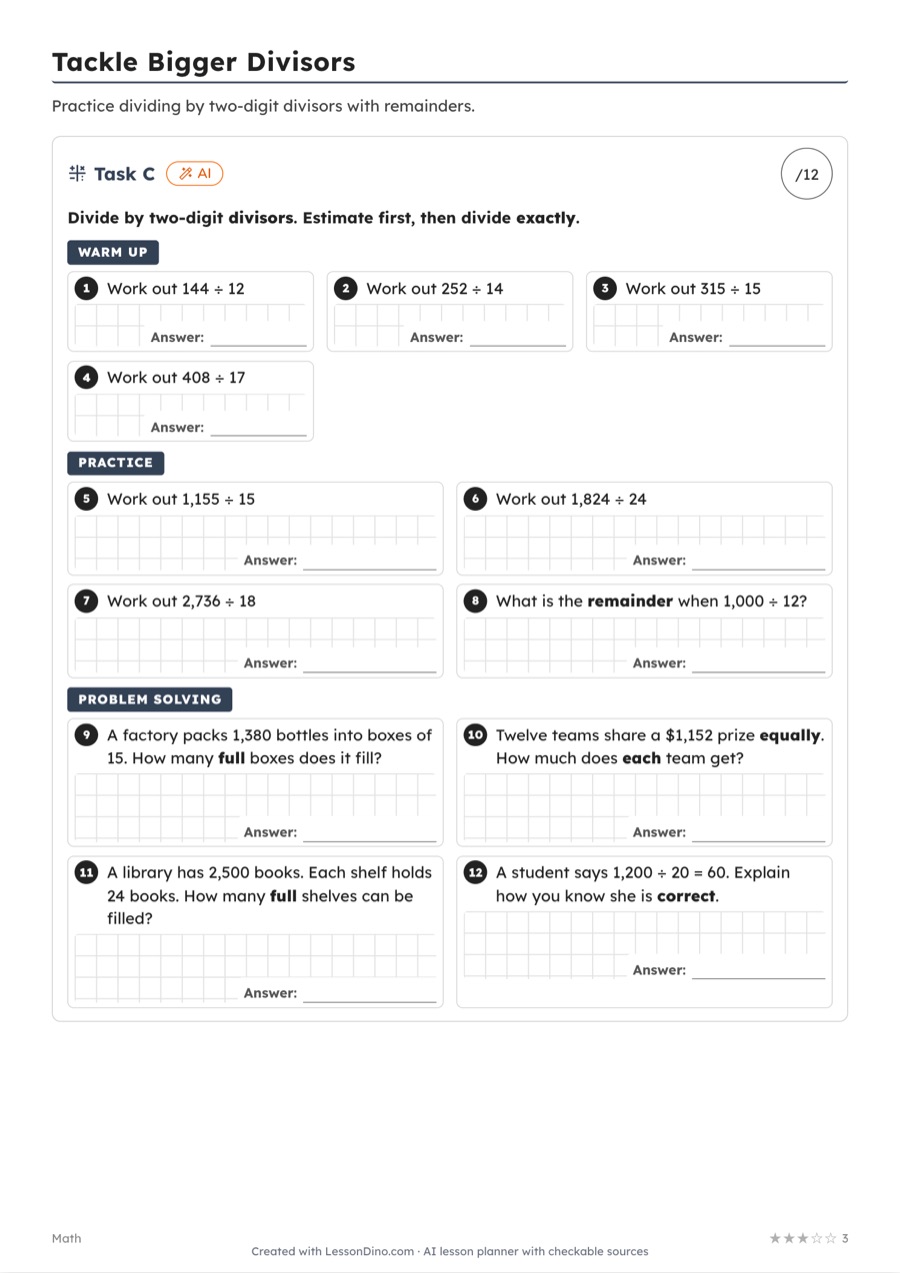
Tackle Bigger Divisors
Practice dividing by two-digit divisors with remainders.
Divide by two-digit divisors. Estimate first, then divide exactly.
Warm up
- Work out 144 ÷ 12
- Work out 252 ÷ 14
- Work out 315 ÷ 15
- Work out 408 ÷ 17
Practice
- Work out 1,155 ÷ 15
- Work out 1,824 ÷ 24
- Work out 2,736 ÷ 18
- What is the remainder when 1,000 ÷ 12?
Problem solving
- A factory packs 1,380 bottles into boxes of 15. How many full boxes does it fill?
- Twelve teams share a $1,152 prize equally. How much does each team get?
- A library has 2,500 books. Each shelf holds 24 books. How many full shelves can be filled?
- A student says 1,200 ÷ 20 = 60. Explain how you know she is correct.
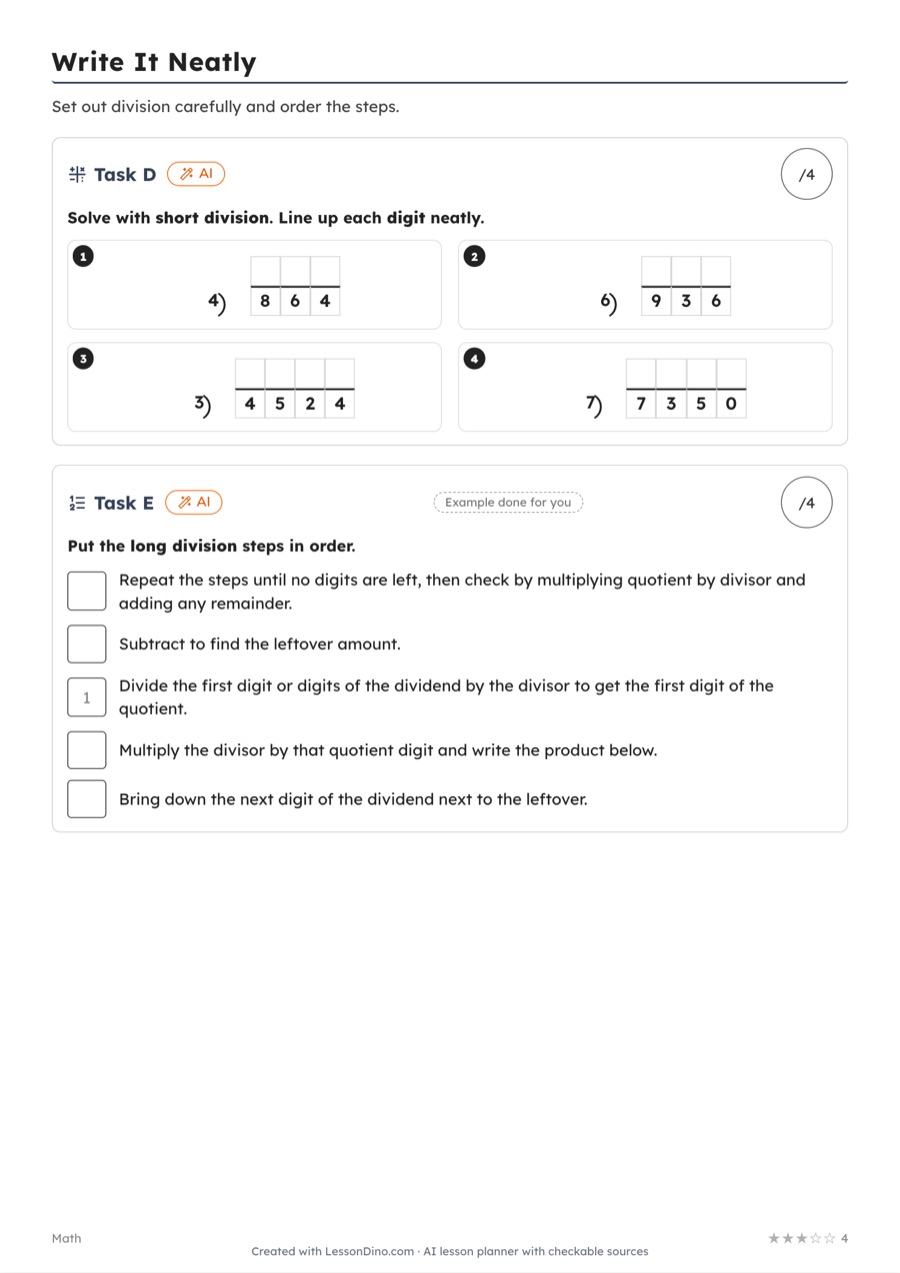
Write It Neatly
Set out division carefully and order the steps.
Solve with short division. Line up each digit neatly.
Put the long division steps in order.
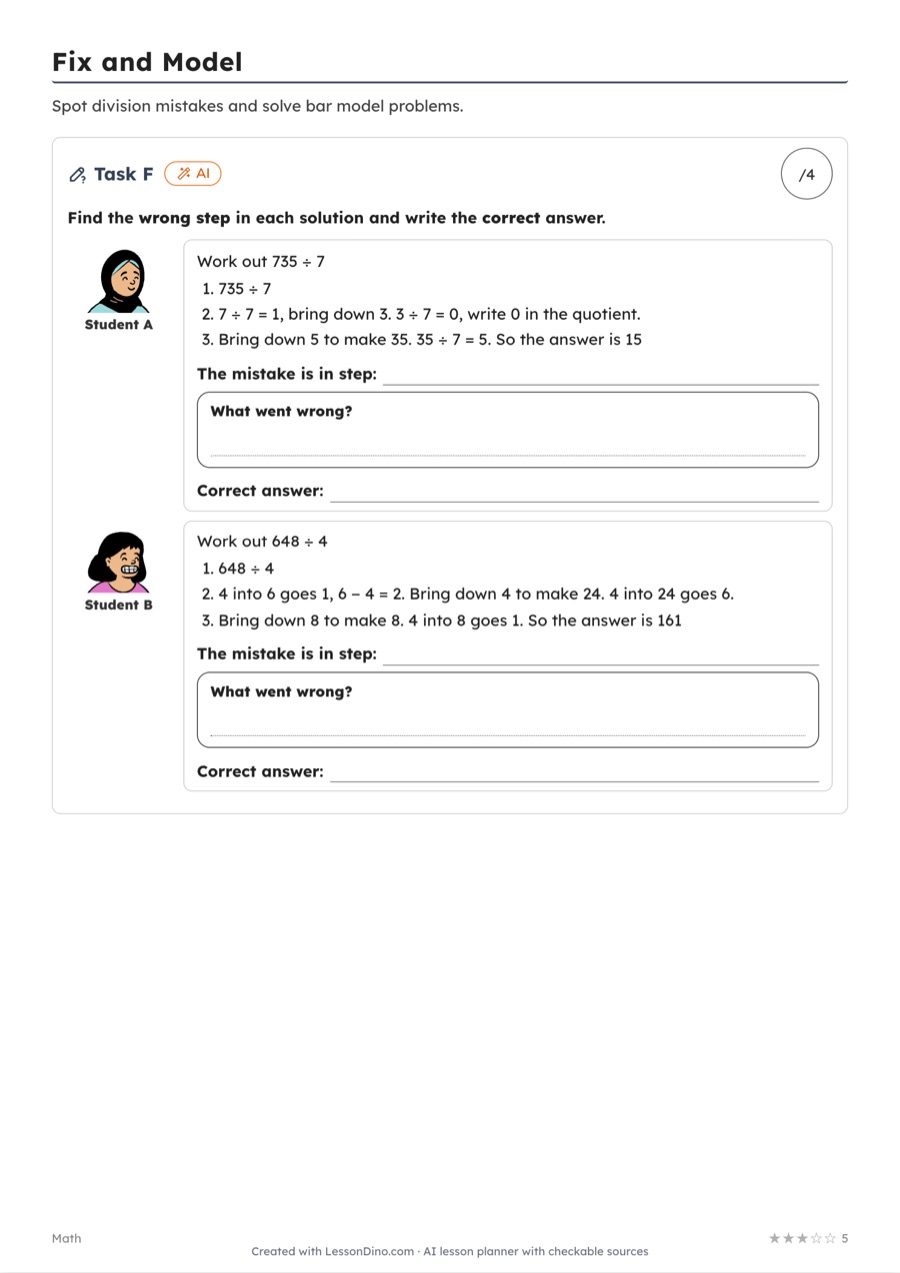
Fix and Model
Spot division mistakes and solve bar model problems.
Find the wrong step in each solution and write the correct answer.
Page 6
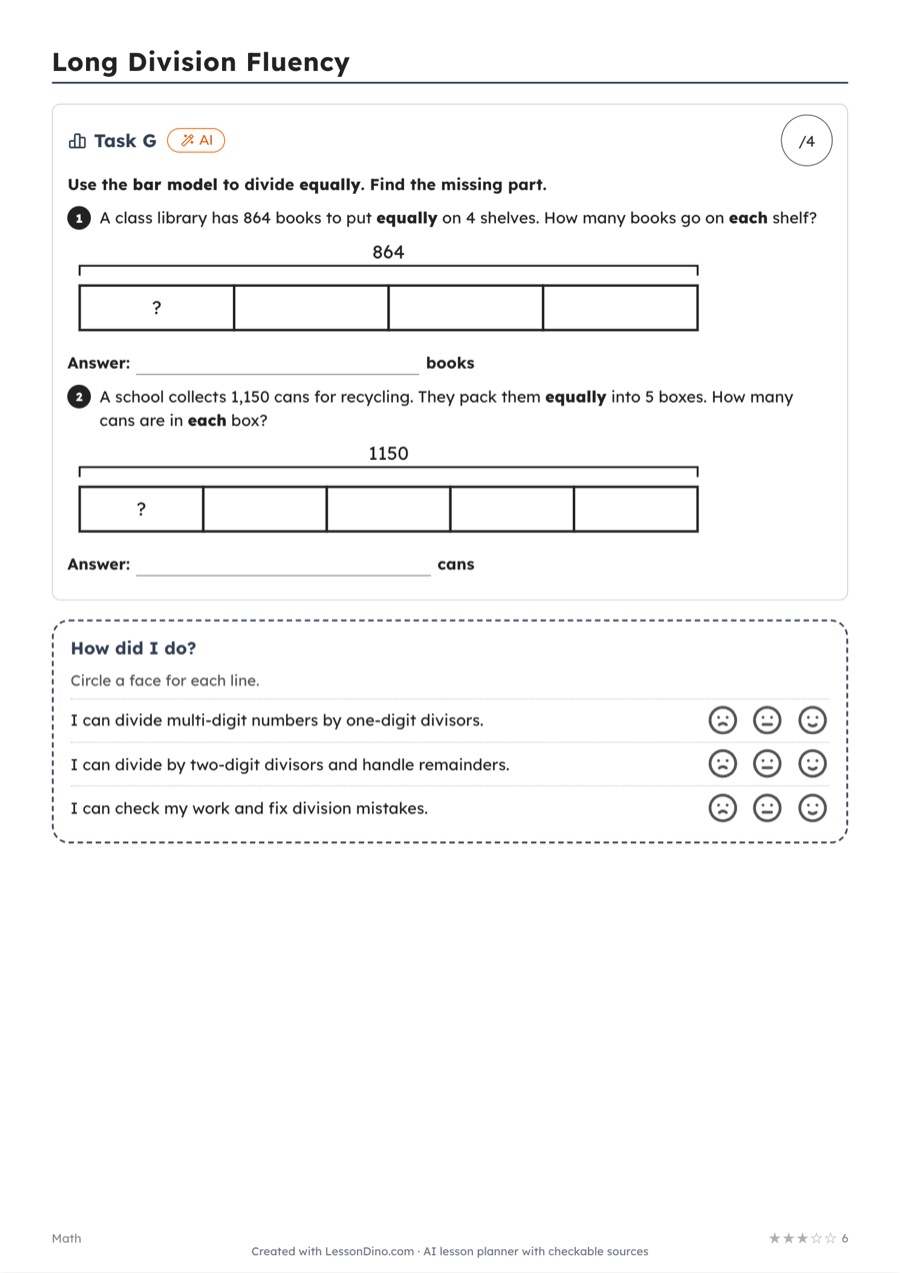
Use the bar model to divide equally. Find the missing part.
Answers
Show the answers
- Work out 48 ÷ 4 12
- Work out 96 ÷ 3 32
- Work out 84 ÷ 7 12
- Work out 125 ÷ 5 25
- Work out 372 ÷ 3 124
- Work out 576 ÷ 4 144
- Work out 845 ÷ 5 169
- Work out 936 ÷ 6 156
- A class has 648 pencils to share equally among 6 classes. How many pencils does each class get? 108 pencils
- Four tickets cost $52 in total. What is the price of each ticket? $13
- A printer packs 1,260 pages equally into 7 boxes. How many pages in each box? 180 pages
- Explain how you know 720 ÷ 6 = 120 is correct. 120 x 6 = 720, so 720 ÷ 6 = 120 because multiplication checks division.
- Work out 144 ÷ 12 12
- Work out 252 ÷ 14 18
- Work out 315 ÷ 15 21
- Work out 408 ÷ 17 24
- Work out 1,155 ÷ 15 77
- Work out 1,824 ÷ 24 76
- Work out 2,736 ÷ 18 152
- What is the remainder when 1,000 ÷ 12? 4
- A factory packs 1,380 bottles into boxes of 15. How many full boxes does it fill? 92 boxes
- Twelve teams share a $1,152 prize equally. How much does each team get? $96
- A library has 2,500 books. Each shelf holds 24 books. How many full shelves can be filled? 104 shelves
- A student says 1,200 ÷ 20 = 60. Explain how you know she is correct. 60 x 20 = 1,200, so the division is correct because 12 ÷ 2 = 6 and place value gives 60.
The answer sheet is the last picture above.
Curriculum
Fluently divide multi-digit numbers using the standard algorithm.
Made with Lesson Dino's AI on 16 October 2026. AI can make mistakes, so check the answers and facts against the sources before you teach.