The worksheet
About this worksheet
Students learn to interpret and compute fraction-by-fraction division. They draw models, use keep-change-flip, and solve story problems. This Grade 6 Math worksheet gives students (ages 11–12) seven pages of practice on dividing fractions, part of the the number system unit. It goes with our free Dividing fractions lesson, which has the slides and a timed lesson plan.
What it covers
By the end, students should be able to:
- Students will interpret fraction division as a fit question using models.
- Students will compute quotients of fractions by fractions using the reciprocal.
- Students will create a story context for dividing fractions and solve it.
How to use it
- Compute It (11 minutes): Do Worksheet Task B together, showing the reciprocal step and simplifying.
- Plenary (10 minutes): Link back to objectives and set Worksheet Task A for homework.
- Support: Provide a sentence frame with blanks for amount left and amount needed, plus two same-size bars to shade.
- Stretch: Students write a second story where the quotient is greater than 1 and show why it makes sense.
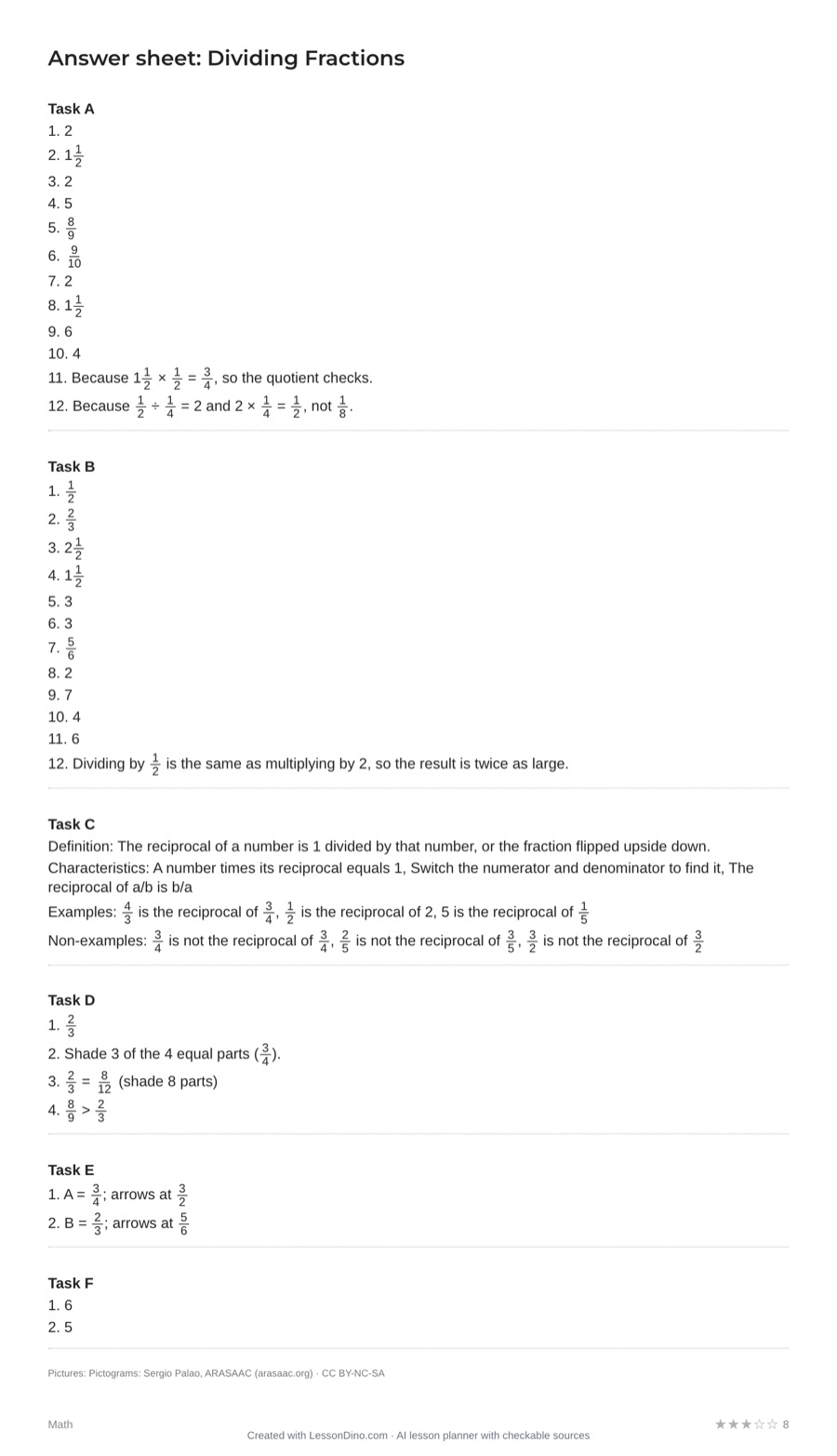
- The answer sheet is the last page, so you can print it on its own or let students check their own work.
Key vocabulary
- dividend: the starting amount that is split up
- divisor: the amount we fit in or split by
- quotient: the answer you get after a division
- reciprocal: the flipped fraction that makes 1 when multiplied
Mistakes to watch for
- Flipping the first fraction instead of the second. Restate keep the dividend, change ÷ to ×, and flip the divisor; turn only the second fraction upside down and multiply.
- Thinking division always makes a smaller answer. Ask how many halves fit in 6 using circles or a number line to show 10 halves in 5 and 12 halves in 6, so dividing by 1/2 doubles.
- Insisting on common denominators before dividing. Show the flip method does not require common denominators; only turn the second fraction over and multiply, then simplify.
What's on the worksheet
Keep Change Flip
Practice dividing fractions with the reciprocal method.
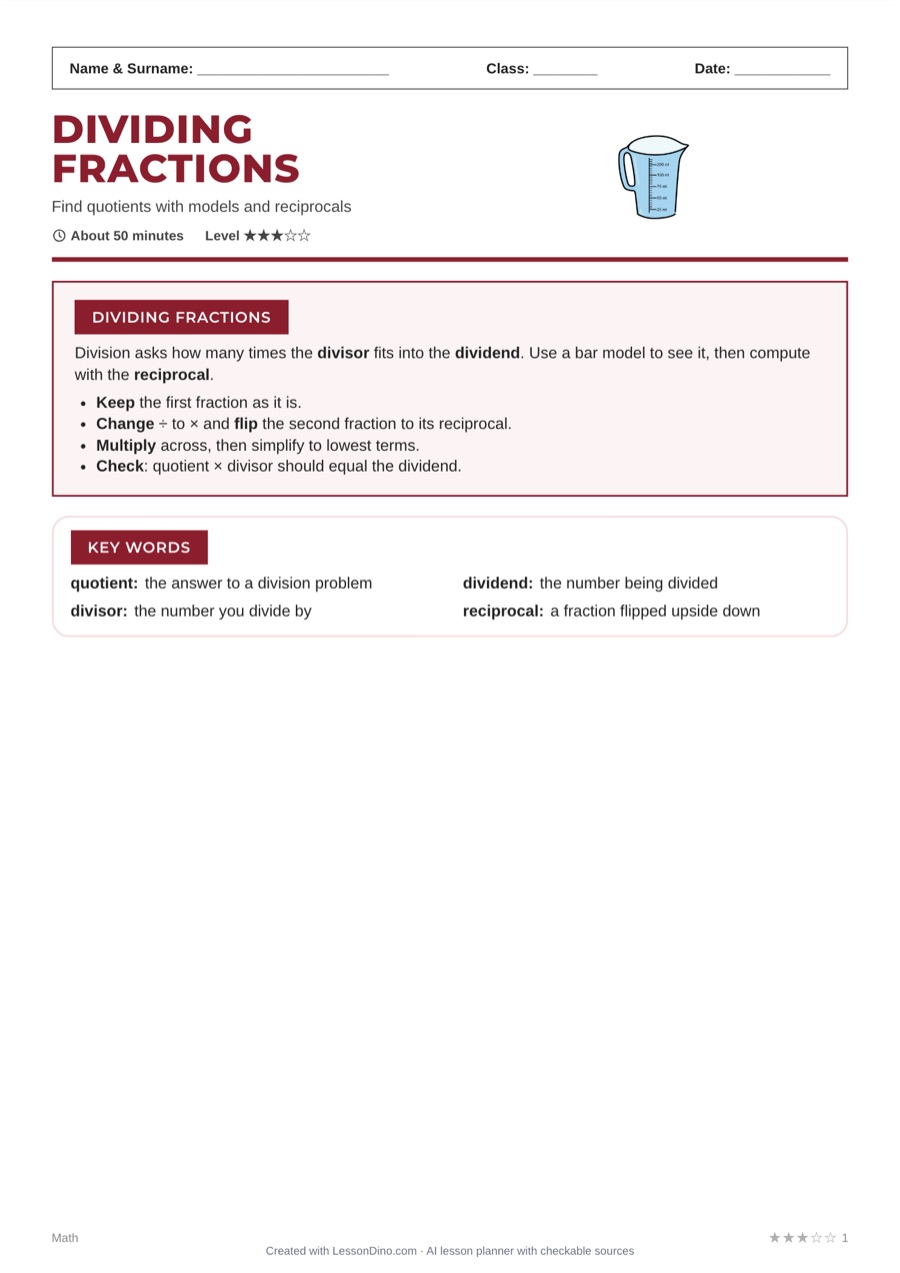
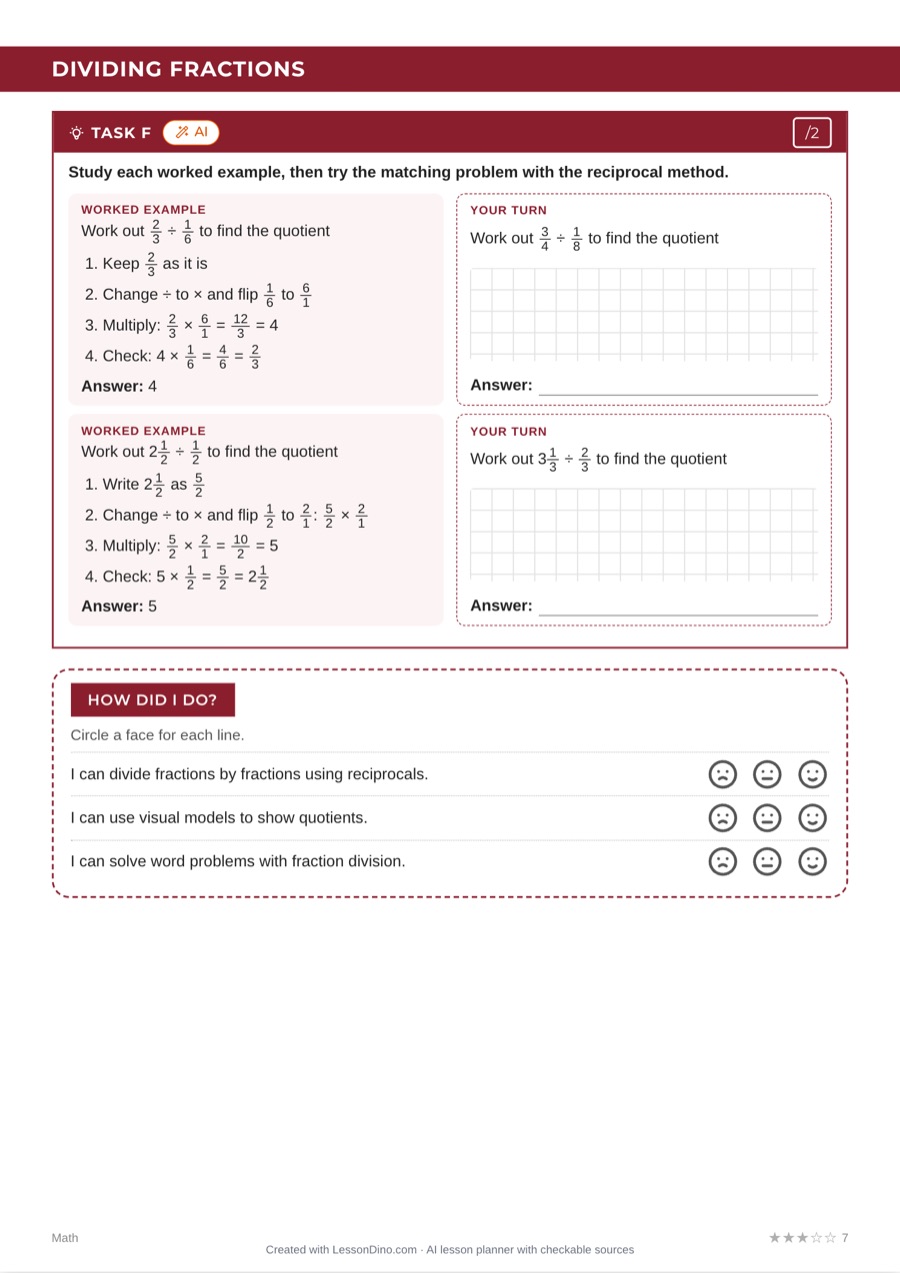
Dividing Fractions
- Division asks how many times the divisor fits into the dividend. Use a bar model to see it, then compute with the reciprocal.
- Keep the first fraction as it is.
- Change ÷ to × and flip the second fraction to its reciprocal.
- Multiply across, then simplify to lowest terms.
- Check: quotient × divisor should equal the dividend.
| Word | Meaning |
|---|---|
| quotient | the answer to a division problem |
| dividend | the number being divided |
| divisor | the number you divide by |
| reciprocal | a fraction flipped upside down |
Page 2
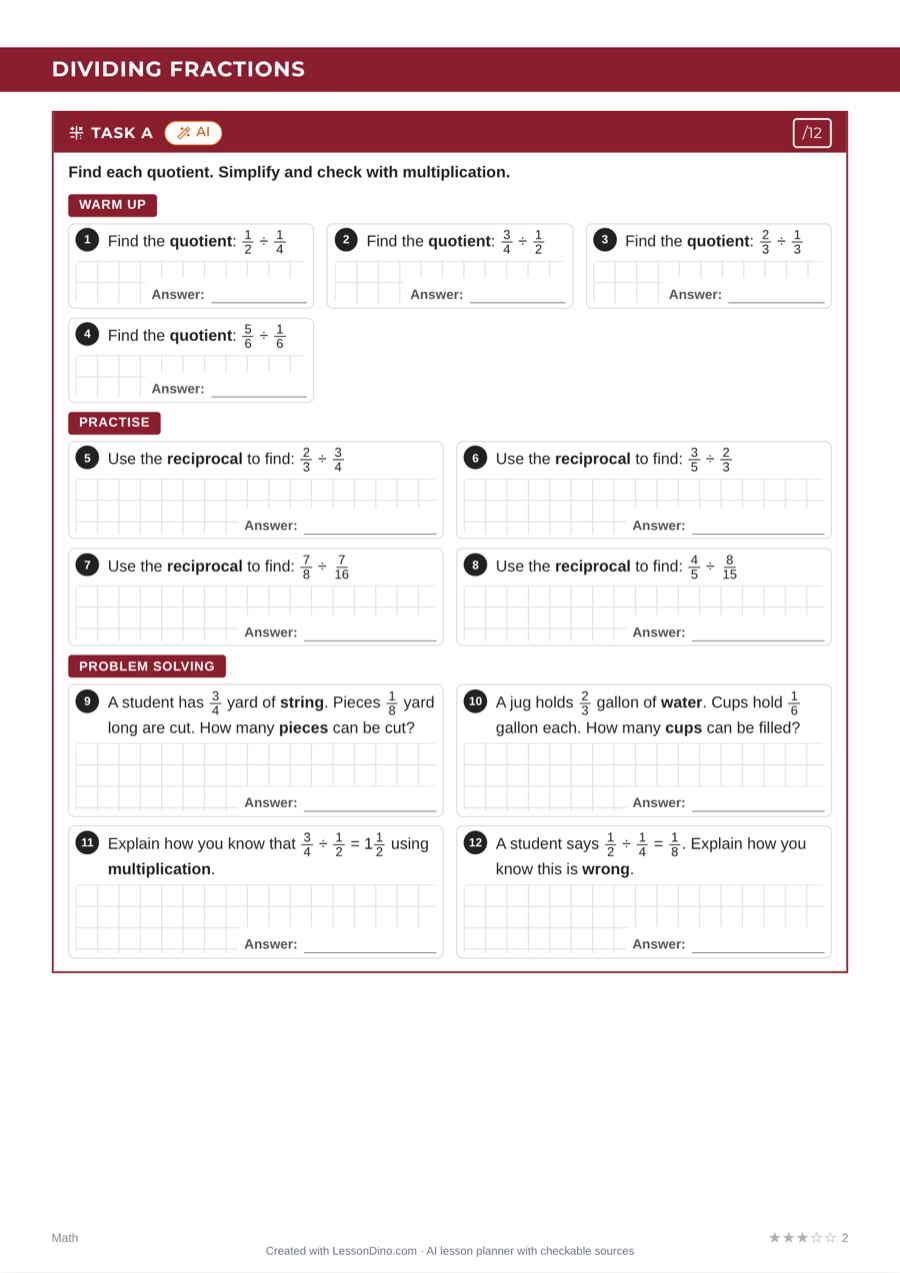
Find each quotient. Simplify and check with multiplication.
Warm up
- Find the quotient: 1/2 ÷ 1/4
- Find the quotient: 3/4 ÷ 1/2
- Find the quotient: 2/3 ÷ 1/3
- Find the quotient: 5/6 ÷ 1/6
Practise
- Use the reciprocal to find: 2/3 ÷ 3/4
- Use the reciprocal to find: 3/5 ÷ 2/3
- Use the reciprocal to find: 7/8 ÷ 7/16
- Use the reciprocal to find: 4/5 ÷ 8/15
Problem solving
- A student has 3/4 yard of string. Pieces 1/8 yard long are cut. How many pieces can be cut?
- A jug holds 2/3 gallon of water. Cups hold 1/6 gallon each. How many cups can be filled?
- Explain how you know that 3/4 ÷ 1/2 = 1 1/2 using multiplication.
- A student says 1/2 ÷ 1/4 = 1/8. Explain how you know this is wrong.
Divide With Confidence
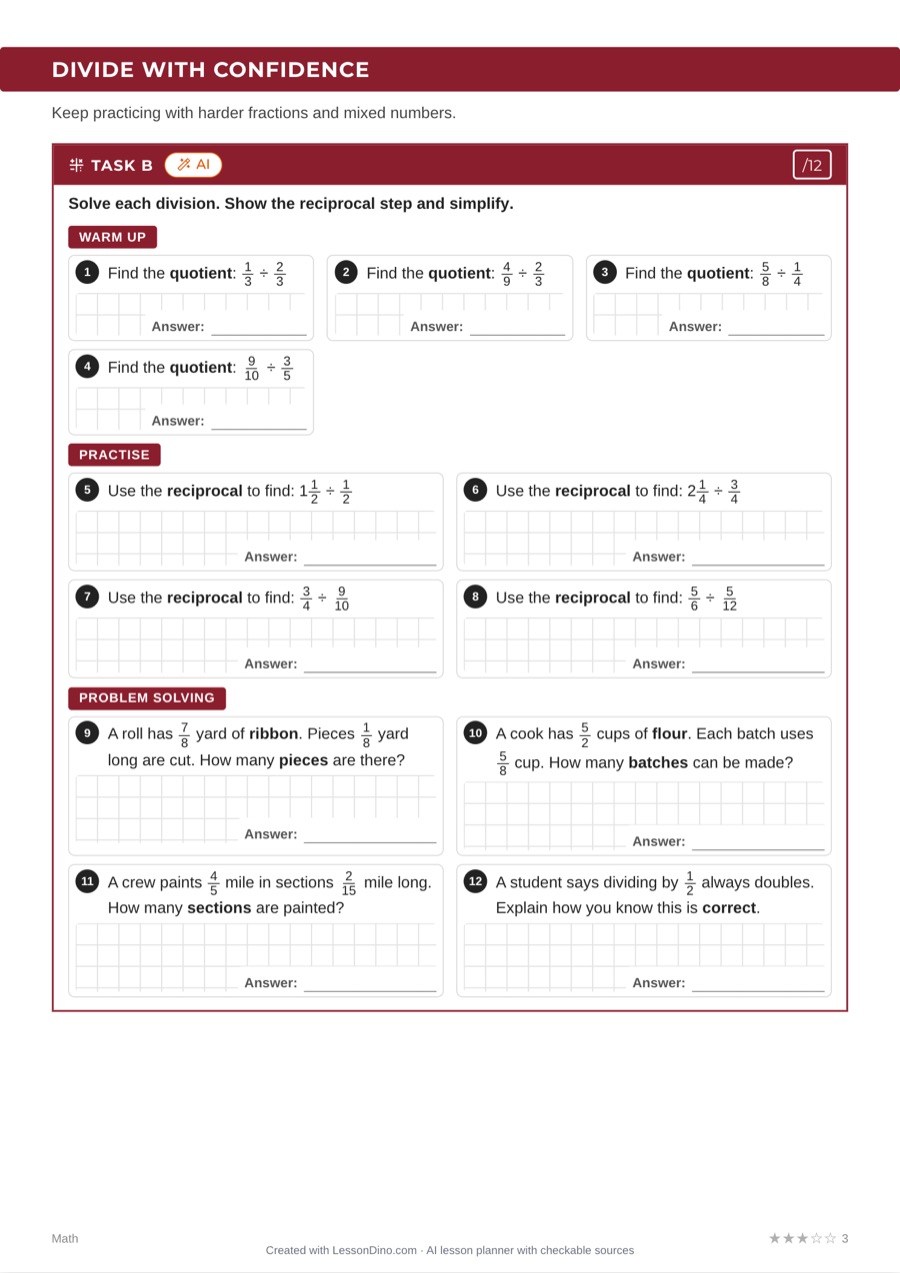
Keep practicing with harder fractions and mixed numbers.
Solve each division. Show the reciprocal step and simplify.
Warm up
- Find the quotient: 1/3 ÷ 2/3
- Find the quotient: 4/9 ÷ 2/3
- Find the quotient: 5/8 ÷ 1/4
- Find the quotient: 9/10 ÷ 3/5
Practise
- Use the reciprocal to find: 1 1/2 ÷ 1/2
- Use the reciprocal to find: 2 1/4 ÷ 3/4
- Use the reciprocal to find: 3/4 ÷ 9/10
- Use the reciprocal to find: 5/6 ÷ 5/12
Problem solving
- A roll has 7/8 yard of ribbon. Pieces 1/8 yard long are cut. How many pieces are there?
- A cook has 5/2 cups of flour. Each batch uses 5/8 cup. How many batches can be made?
- A crew paints 4/5 mile in sections 2/15 mile long. How many sections are painted?
- A student says dividing by 1/2 always doubles. Explain how you know this is correct.
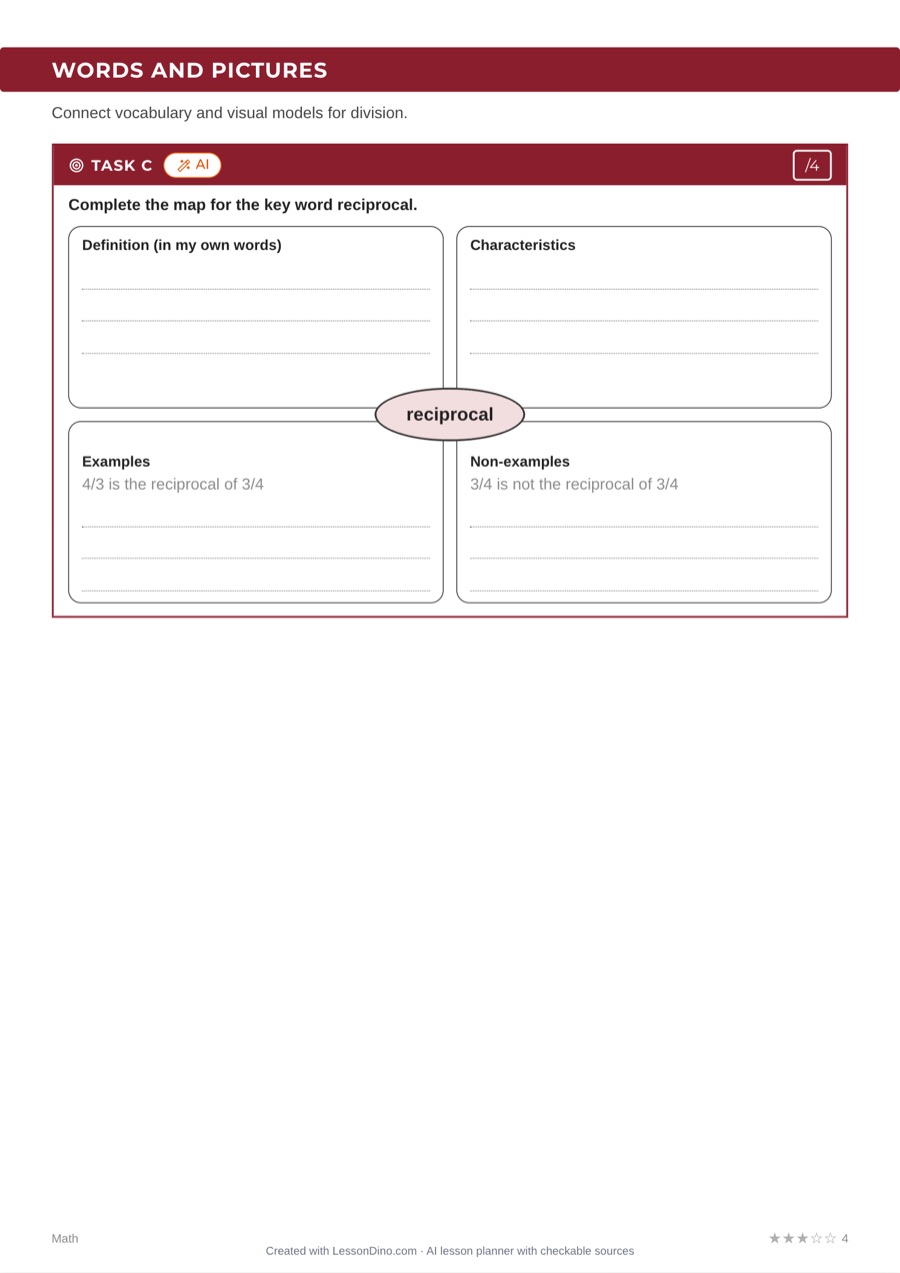
Words and Pictures
Connect vocabulary and visual models for division.
Complete the map for the key word reciprocal.
Page 5
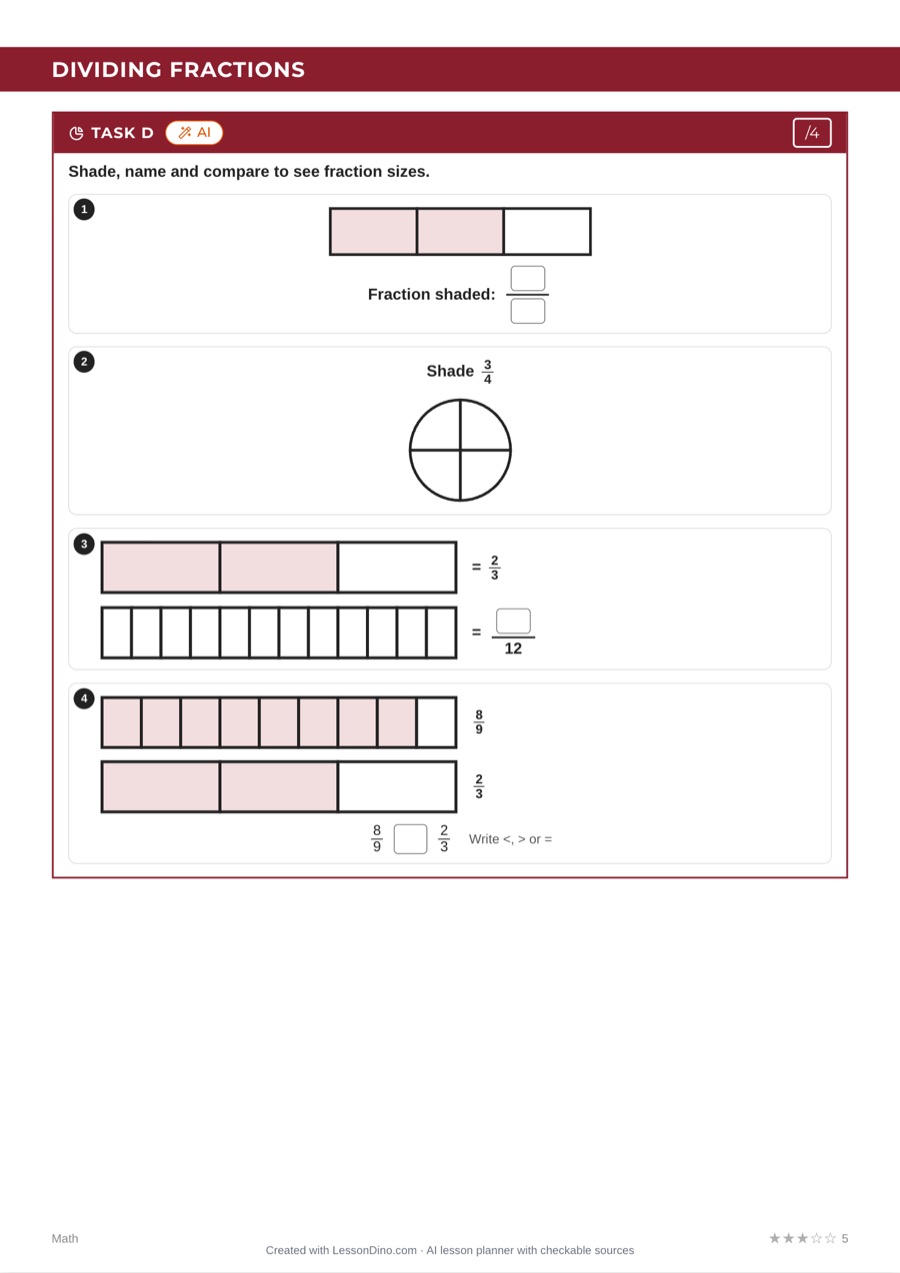
Shade, name and compare to see fraction sizes.
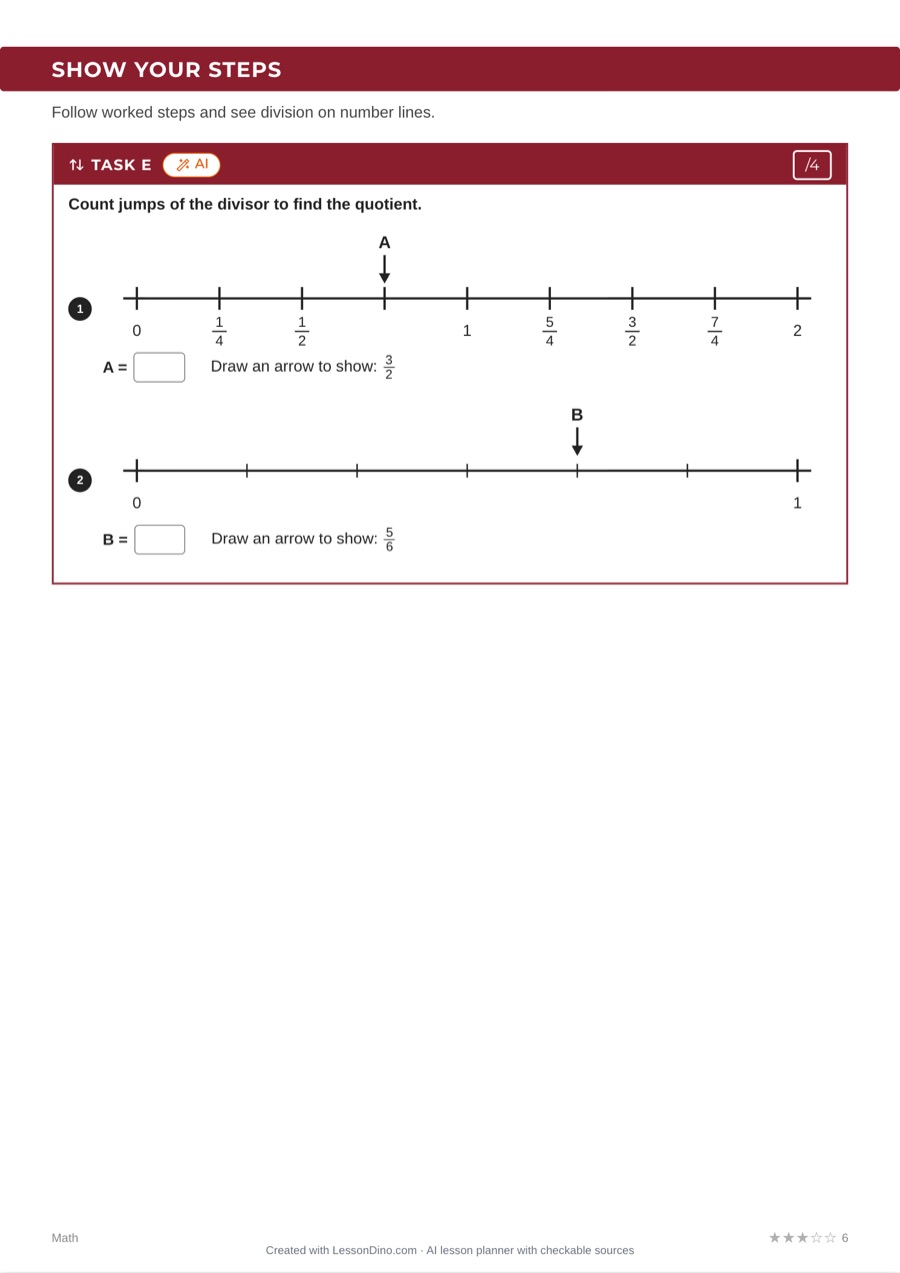
Show Your Steps
Follow worked steps and see division on number lines.
Count jumps of the divisor to find the quotient.
Page 7
Study each worked example, then try the matching problem with the reciprocal method.
Answers
Show the answers
- Find the quotient: 1/2 ÷ 1/4 2
- Find the quotient: 3/4 ÷ 1/2 1 1/2
- Find the quotient: 2/3 ÷ 1/3 2
- Find the quotient: 5/6 ÷ 1/6 5
- Use the reciprocal to find: 2/3 ÷ 3/4 8/9
- Use the reciprocal to find: 3/5 ÷ 2/3 9/10
- Use the reciprocal to find: 7/8 ÷ 7/16 2
- Use the reciprocal to find: 4/5 ÷ 8/15 1 1/2
- A student has 3/4 yard of string. Pieces 1/8 yard long are cut. How many pieces can be cut? 6
- A jug holds 2/3 gallon of water. Cups hold 1/6 gallon each. How many cups can be filled? 4
- Explain how you know that 3/4 ÷ 1/2 = 1 1/2 using multiplication. Because 1 1/2 × 1/2 = 3/4, so the quotient checks.
- A student says 1/2 ÷ 1/4 = 1/8. Explain how you know this is wrong. Because 1/2 ÷ 1/4 = 2 and 2 × 1/4 = 1/2, not 1/8.
- Find the quotient: 1/3 ÷ 2/3 1/2
- Find the quotient: 4/9 ÷ 2/3 2/3
- Find the quotient: 5/8 ÷ 1/4 2 1/2
- Find the quotient: 9/10 ÷ 3/5 1 1/2
- Use the reciprocal to find: 1 1/2 ÷ 1/2 3
- Use the reciprocal to find: 2 1/4 ÷ 3/4 3
- Use the reciprocal to find: 3/4 ÷ 9/10 5/6
- Use the reciprocal to find: 5/6 ÷ 5/12 2
- A roll has 7/8 yard of ribbon. Pieces 1/8 yard long are cut. How many pieces are there? 7
- A cook has 5/2 cups of flour. Each batch uses 5/8 cup. How many batches can be made? 4
- A crew paints 4/5 mile in sections 2/15 mile long. How many sections are painted? 6
- A student says dividing by 1/2 always doubles. Explain how you know this is correct. Dividing by 1/2 is the same as multiplying by 2, so the result is twice as large.
The answer sheet is the last picture above.
Curriculum
Interpret and compute quotients of fractions, and solve word problems involving division of fractions by fractions, e.g., by using visual fraction models and equations to represent the problem.
Made with Lesson Dino's AI on 17 October 2026. AI can make mistakes, so check the answers and facts against the sources before you teach.