Slides
Lesson plan
Who Eats Who? Simple Food Chains
Pupils learn how animals get food from plants and other animals. They order picture cards into a simple food chain.
Objectives
- Students will describe how animals get food from plants and other animals.
- Students will order three living things into a correct simple food chain.
- Students will identify and name foods that come from plants and animals.
Success criteria
- I can say what an animal eats from plants or animals.
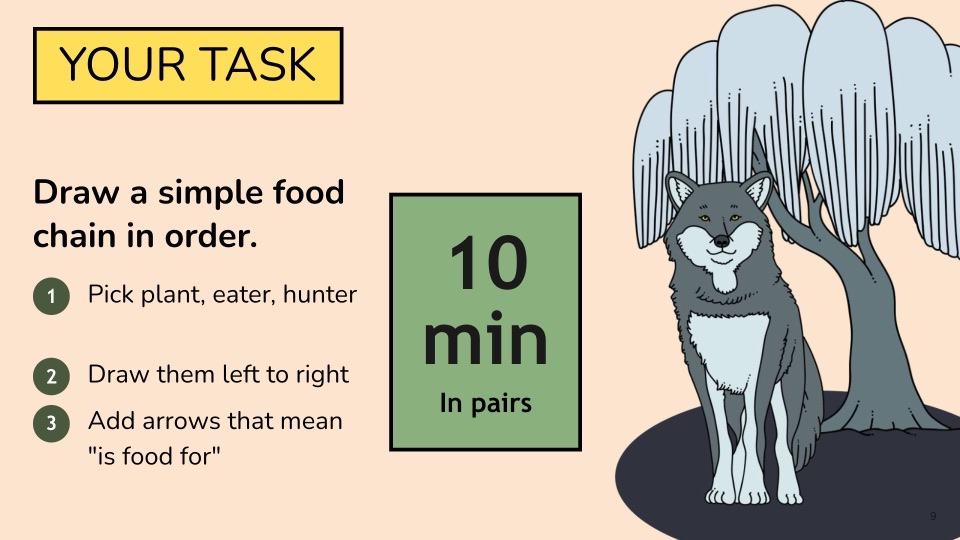
- I can put a plant, eater and hunter in chain order.
- I can show arrows mean is food for and point to eater.
Key words
| Word | Meaning |
|---|---|
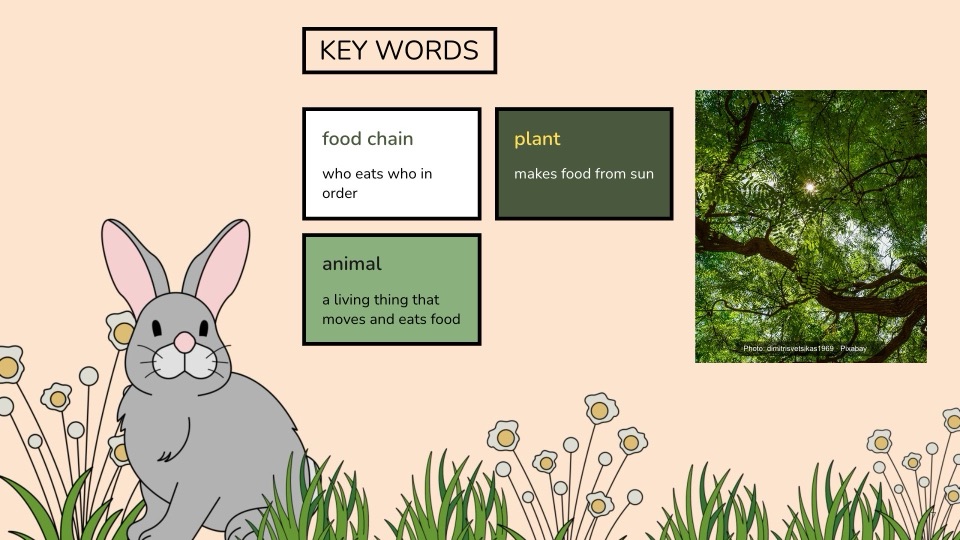
| food chain | who eats who in order |
| plant | living thing that makes food from sun, water and air |
| animal | a living thing that moves and eats food |
| arrow | a mark that points to the eater to show what is food for what |
Timed plan (60 minutes)
| Time | Stage | What happens |
|---|---|---|
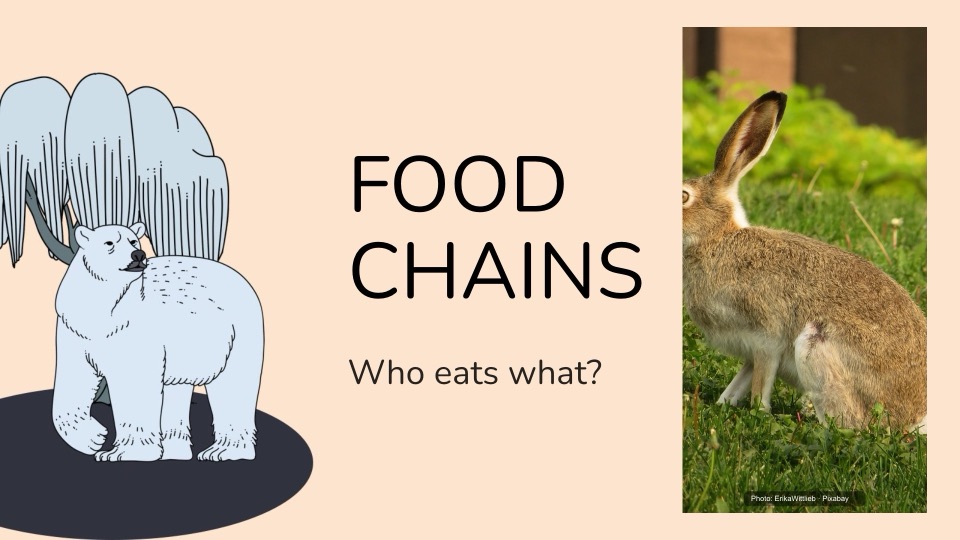
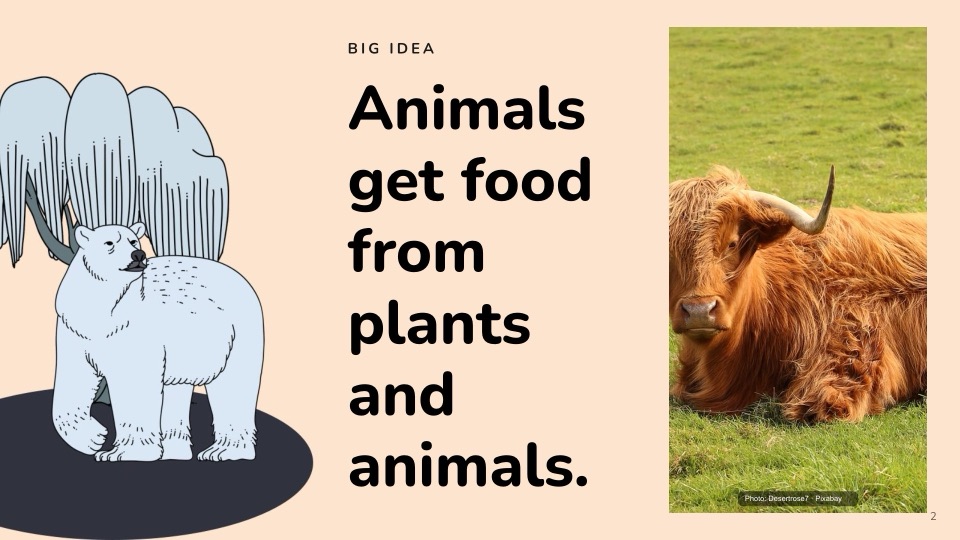
| 8 min | Starter | To hook interest and recall foods that come from plants and animals. Show Slide 1 Food Chains [title]: Who eats what? and Slide 2 Big idea [statement]: Animals get food from plants and animals. Hold up mixed-up pictures of grass, a cow and a person eating and say the hook. Ask pairs to name one food from a plant and one food from an animal. Take 3-4 ideas and sort them on the whiteboard into plant foods and animal foods. |
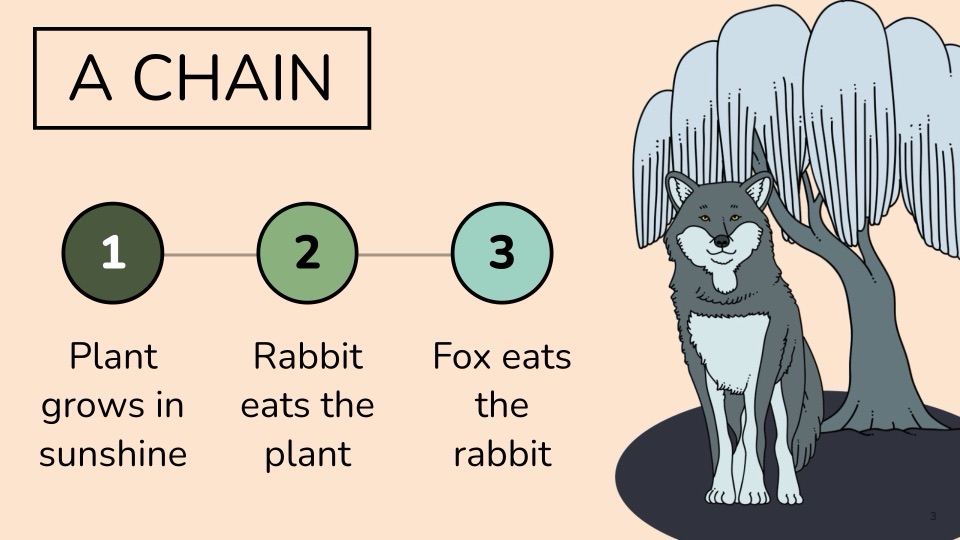
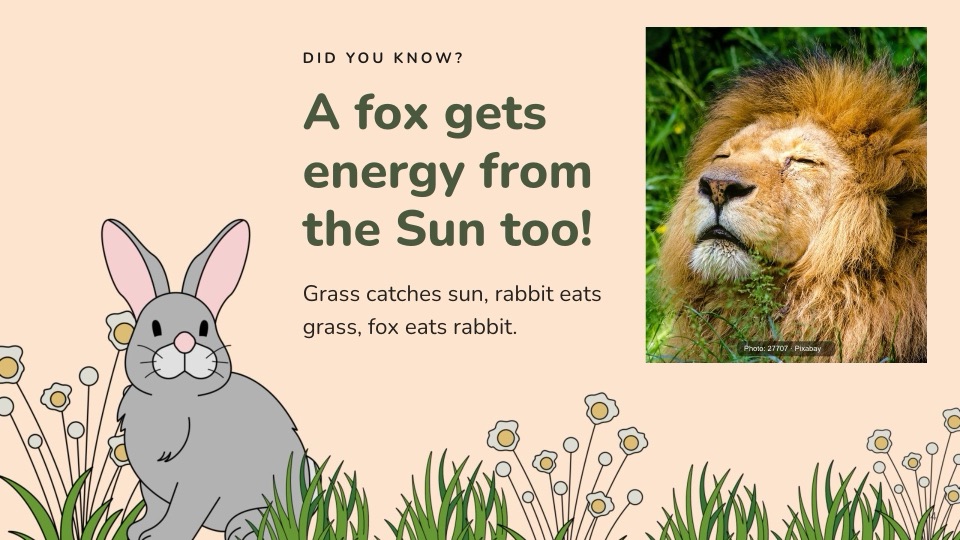
| 10 min | Teaching | To explain how food moves along a chain that starts with a plant. Show Slide 3 A chain [steps]: Plant grows in sunshine · Rabbit eats the plant · Fox eats the rabbit. Model reading left to right with finger, saying the arrow means ‘is eaten by’. Show Slide 4 Did you know? [fact]: A fox gets energy from the Sun too! · Grass catches sun, rabbit eats grass, fox eats rabbit. Explain that a food chain shows how plants and animals get their energy and starts with a green plant that makes its own food from sunlight. |
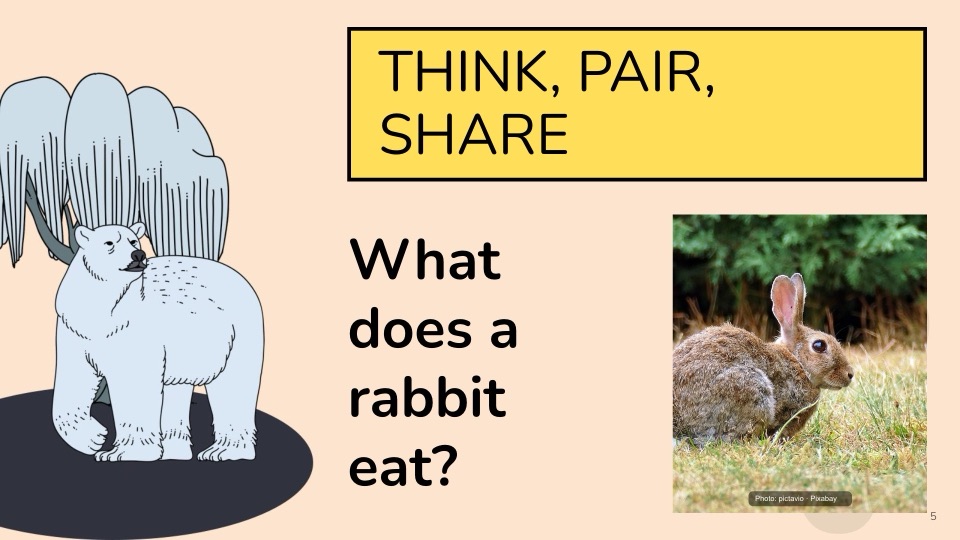
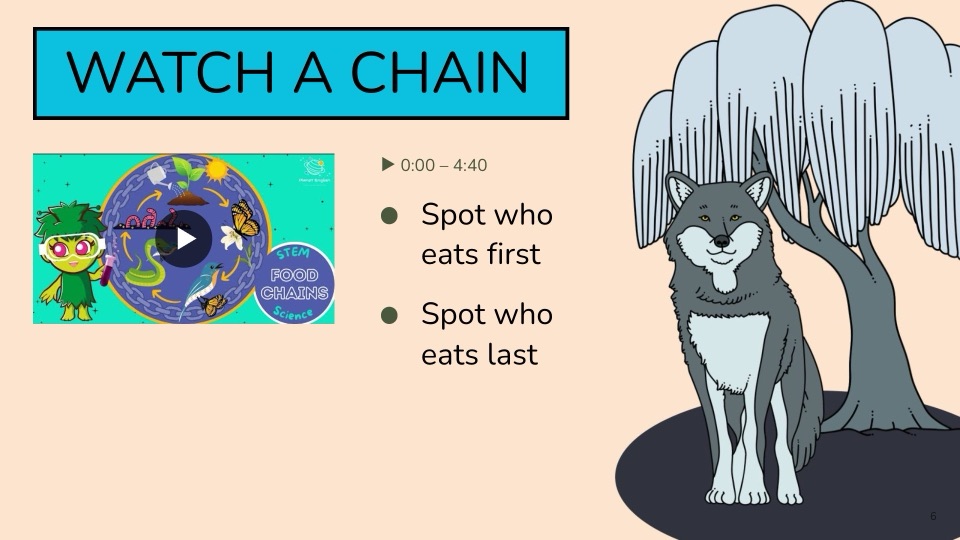
| 12 min | Watch together | To practise spotting who eats first and last and learning key words. Show Slide 5 Think, pair, share [question]: What does a rabbit eat? and take quick pair answers. Play Video clip 1 (0:00–4:40) on Slide 6 Watch a chain [video]: Spot who eats first · Spot who eats last, pausing to ask who eats who. Teach Slide 7 Key words [words]: food chain · who eats who in order · plant · makes food from sun · animal · a living thing that moves and eats food. |
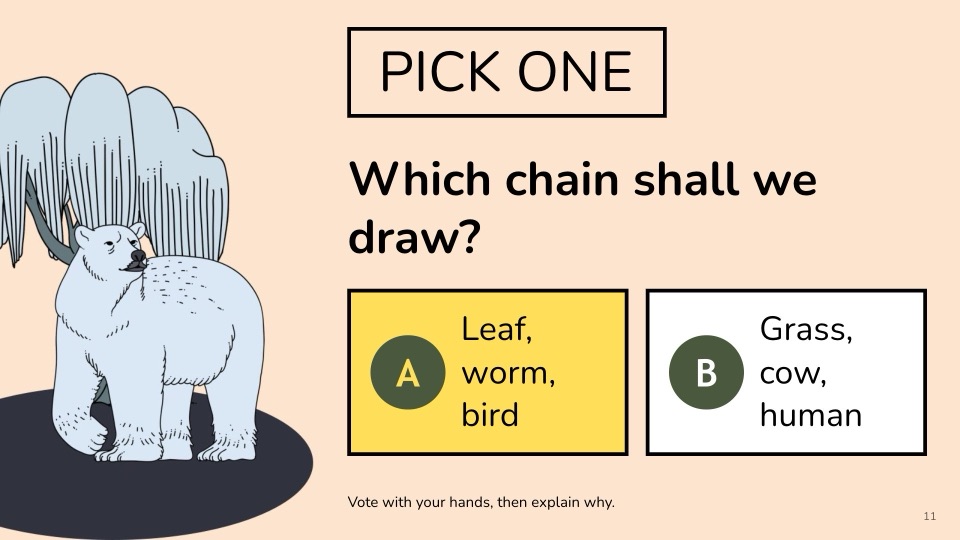
| 20 min | Main activity | To order three living things into a simple food chain. Show Slide 11 Pick one [vote]: Which chain shall we draw? · Leaf, worm, bird · Grass, cow, human and vote as a class. Give each pair a tray with the three picture cards out of order and two arrow cards. Model organising cards for grass, cow, human into the right order and placing arrows to show the flow. Remind pairs to read their chain aloud as grass is food for cow, cow is food for human, using language that arrows mean ‘is food for’. |
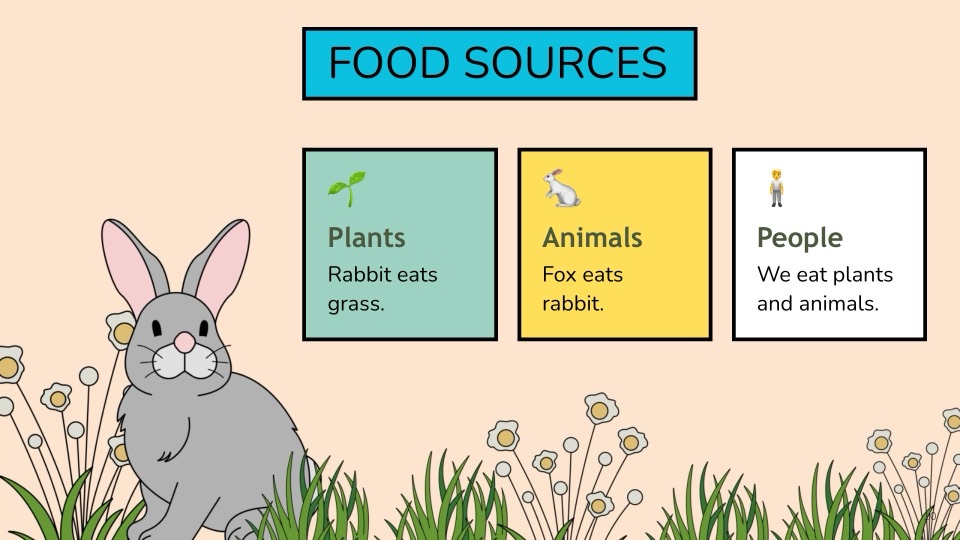
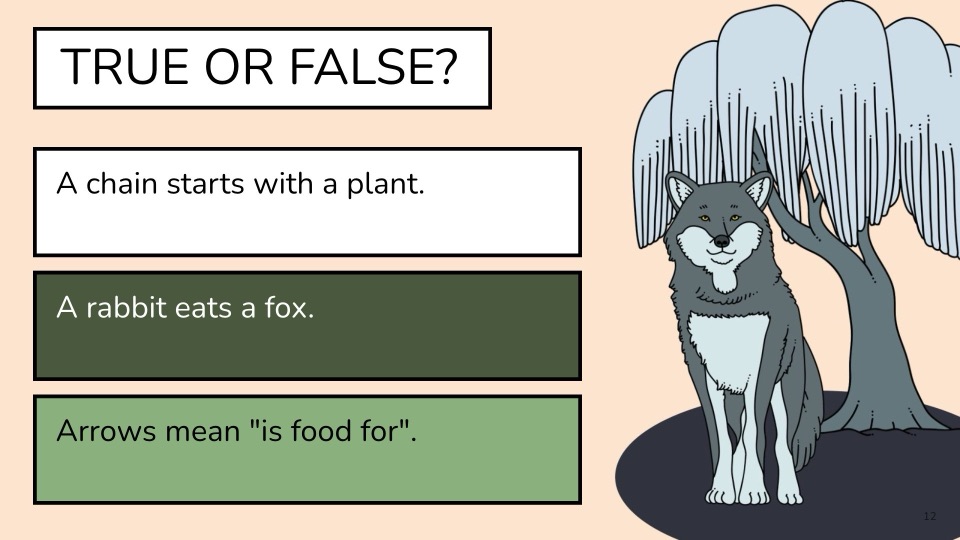
| 10 min | Plenary | To name food sources and check chain order and arrows. Show Slide 10 Food sources [cards]: Plants · Rabbit eats grass. · Animals · Fox eats rabbit. · People · We eat plants and animals. Ask pairs to explain one card in each group: Rabbit eats grass, Fox eats rabbit. Show Slide 12 True or false? [truefalse]: A chain starts with a plant. · Plants make first food. · A rabbit eats a fox. · Fox eats rabbit. · Arrows mean is food for. · Arrow points to eater. Vote true or false and correct any muddle together. |
Common mistakes
- Arrows point to the food instead of the eater
How to spot it: Chain reads backwards, like cow to grass
Practise saying is food for and sliding finger from food to eater, as arrows mean ‘is eaten by’. - Putting an animal first instead of a plant
How to spot it: Bird or fox placed at the start of the line
Remind that a food chain always starts with a producer, usually a green plant, because plants make their own food from sunlight. - Thinking arrows mean eats
How to spot it: Reading leaf arrow worm as leaf eats worm
Use is food for each time, so leaf is food for worm, worm is food for bird.
Support
- Use large cards with a coloured dot for first and sentence stems is food for.
- Pre-order one chain to copy before sorting alone.
Stretch
- Order a second chain and add arrows and is food for labels.
- Explain what would happen if the middle animal had no food.
Check questions
- Put grass, cow, human in food chain order.
Answer: Grass, cow, human. - Name one food that comes from a plant and one from an animal.
Answer: Plant e.g. grass/leaves; animal e.g. worm/rabbit. - What do arrows in a food chain mean and where do they point?
Answer: Arrows mean is food for and point to the eater.
Curriculum
describe how animals obtain their food from plants and other animals, using the idea of a simple food chain, and identify and name different sources of food
Video clips
Clips on YouTube, from the start and end times we chose. Check each one before you show it.
-
KS1 Food Chains from 0:00 to 4:40
Explore Planet English: Food Chains | KS1 Science | STEM and Beyond
Made for KS1 ages 5-7 and shows simple plant-to-animal chains exactly matching the Year 2 goal.
-
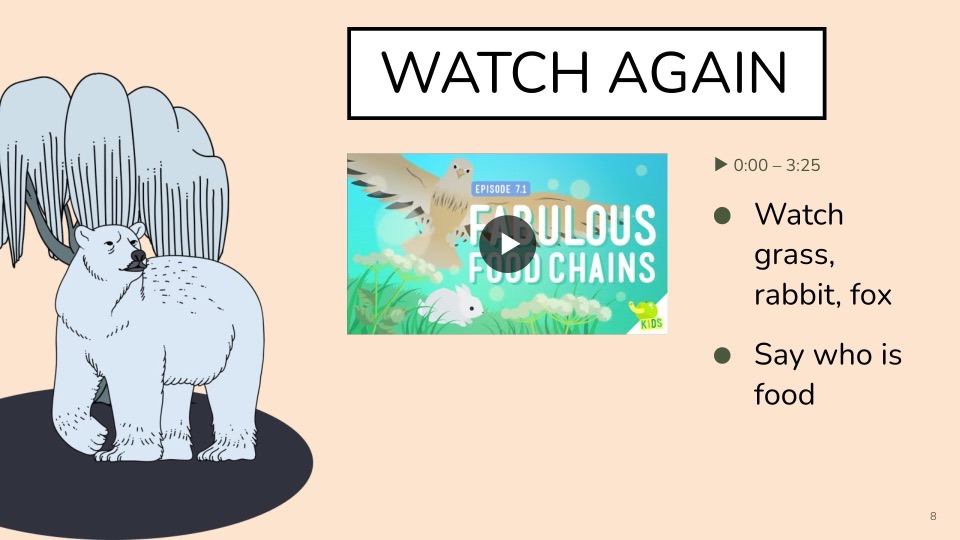
Fabulous Food Chains from 0:00 to 3:25
Crash Course Kids: Fabulous Food Chains: Crash Course Kids #7.1
Short, lively example of grass-rabbit-fox that suits 6-7 and makes the idea of a simple food chain very clear.
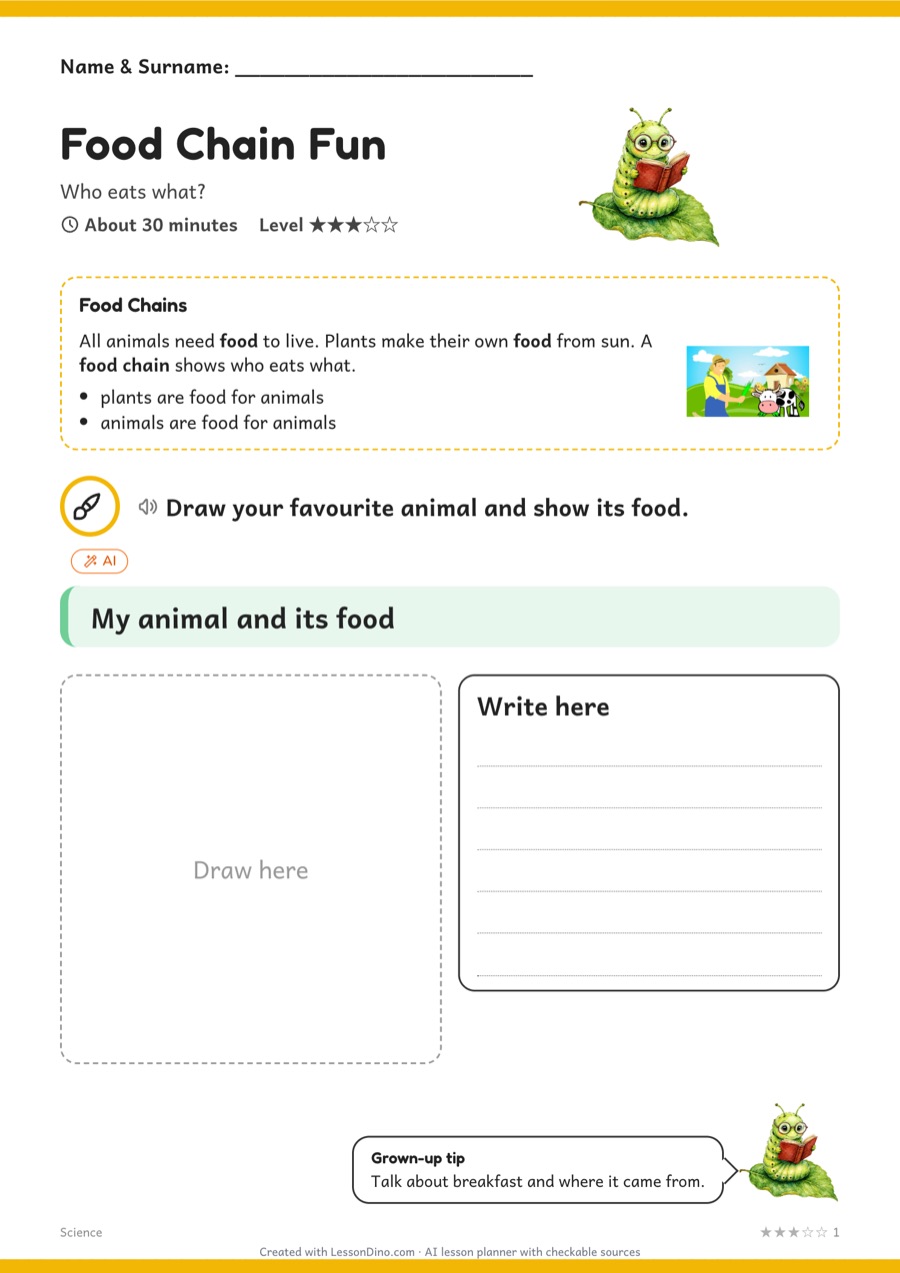
Worksheet
Sources
- National curriculum in England: science programmes of study gov.uk
- Linking to the National curriculum qmc.ac.uk
- What is a food chain? - BBC Bitesize bbc.co.uk
- Food Chains - BBC Bitesize bbc.co.uk
- Food chains (KS1 - KS2) Lessons and Resources | Cornerstones cornerstoneseducation.co.uk
- Food chains - abpischools.org.uk abpischools.org.uk
- Year 7 Biology: Food Chains And Webs: Producers, Consumers ... keystagelearning.co.uk
- What is a food chain? – KS2 Science curriculum - BBC Bitesize bbc.co.uk
- Science for Kids: Food Chain and Web - Ducksters ducksters.com
- Food Chains - Science Games & Activities for Kids sciencekids.co.nz
- Food chain Facts for Kids kids.kiddle.co
- food chain - Kids | Britannica Kids | Homework Help kids.britannica.com
- food chain - Students | Britannica Kids | Homework Help kids.britannica.com
- The food chain - Primary teaching resources - BBC Teach bbc.co.uk
- Introduction to food chains KS1 | Y2 Science | Lesson ... thenational.academy
- Flexi answers - Define food chain. | CK-12 Foundation ck12.org
- Food Chains and Food Webs - GeeksforGeeks geeksforgeeks.org
- How the Food Chain Works: A Kid-Friendly Guide - The Kids Point thekidspoint.com
- Food chain Explained for Kids: Story, Facts & Activities ... mystorypie.com
- Complete Guide of Food Chain for Kids, Food Web, Energy Flow ... smartclass4kids.com
- Explaining Food Chains to Kids: A Comprehensive Guide for ... panflavor.com
- Food Chains for Kids - Science for Kids - Science Sparks science-sparks.com
- Food Chain Lesson for Kids: Definition & Examples - Study.com study.com
- The Food Chain and the Food Web | Kids Discover Online online.kidsdiscover.com
Picture credits
- Photo: ErikaWittlieb · Pixabay
- Photo: Desertrose7 · Pixabay
- Photo: 27707 · Pixabay
- Photo: pictavio · Pixabay
- Photo: dimitrisvetsikas1969 · Pixabay
- Illustration: Mohamed_hassan · Pixabay
- Illustration: Andrey_and_Olesya · Pixabay
- Drawing: Courtesy of NIAID Ryan Kissinger · Public domain · Wikimedia Commons
- Picture: unknown · CC0 · rawpixel via Openverse
- Picture: unknown · CC0 · rawpixel via Openverse
- Microsoft Fluent Emoji (MIT)
- Pictograms: Sergio Palao, ARASAAC (arasaac.org) · CC BY-NC-SA
- Illustration: brenjbeecrafts · Pixabay
Made with Lesson Dino's AI on 17 October 2026. AI can make mistakes, so check facts against the sources before you teach.