Slides

Lesson plan
Mow More, Pay Less, Drive Steady
Students learn to find a unit rate and use it to solve problems. They solve lawn, price, and speed problems in pairs.
Objectives
- Students will find unit rates for lawn work, unit pricing, and constant speed.
- Students will use unit rates to predict larger amounts and compare buys.
Success criteria
- I can find the amount for 1 unit with correct units.
- I can use that amount for 1 to solve price and speed problems.
Key words
| Word | Meaning |
|---|---|
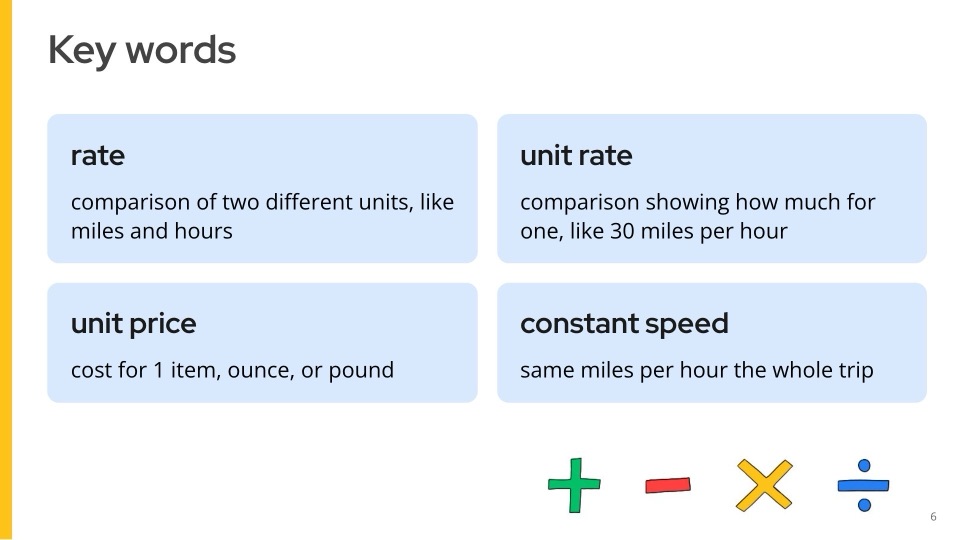
| rate | comparison of two different measures, like miles and hours |
| unit rate | amount for one of something, like 30 miles for 1 hour |
| unit price | cost for one item, ounce, or pound |
| constant speed | staying at the same pace the whole trip with no slowing down |
Timed plan (60 minutes)
| Time | Stage | What happens |
|---|---|---|
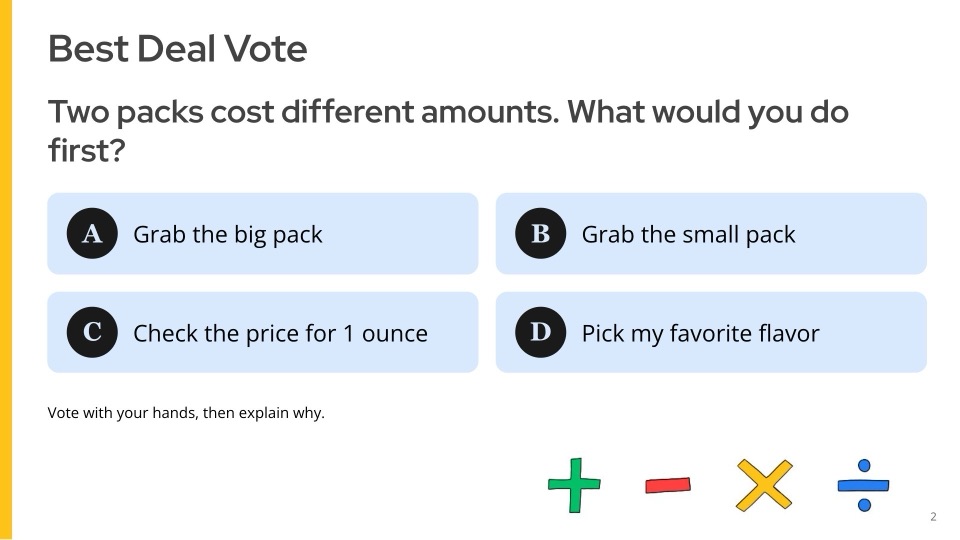
| 5 min | Starter | Hook interest in unit rates and recall that bigger packs are not always cheaper. Show Slide 1 and read the goal about unit prices and steady speeds. Say the hook: If it took 7 hours to mow 4 lawns, how many could you mow in 35 hours if you never slowed down? Show Slide 2 Best Deal Vote and take a quick vote on big pack, small pack, check price for 1 ounce, or favorite flavor. Tell class that checking the price for 1 unit lets us compare fairly. |
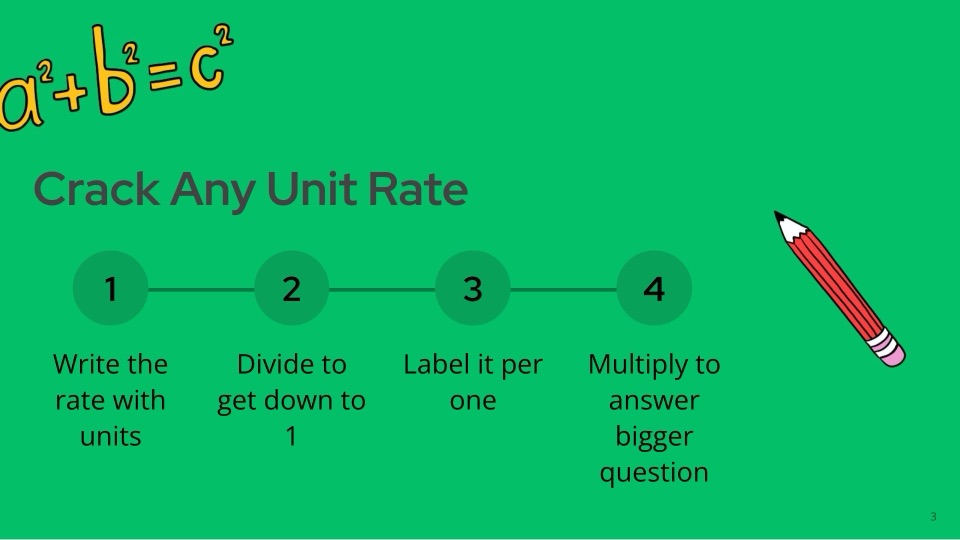
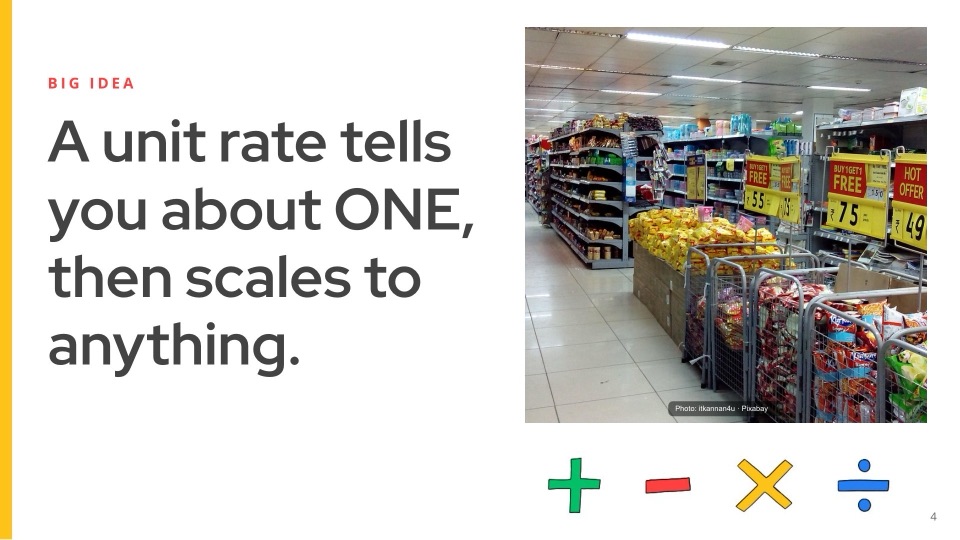
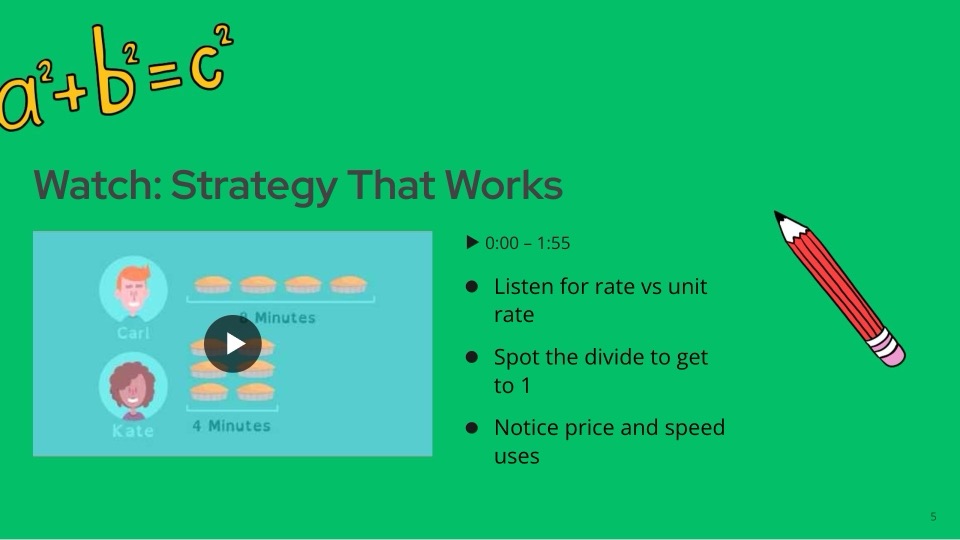
| 12 min | Teaching | Model how to write a rate, divide to 1, label it, and multiply to solve. Show Slides 3-4 steps and big idea that a unit rate tells you about ONE, then scales to anything. Play Slide 5 Video clip 1 and ask students to listen for rate vs unit rate and dividing to get to 1. Model two cases on the whiteboard with units: speed and price. Show Slide 6 key words and have class repeat each with its example. |
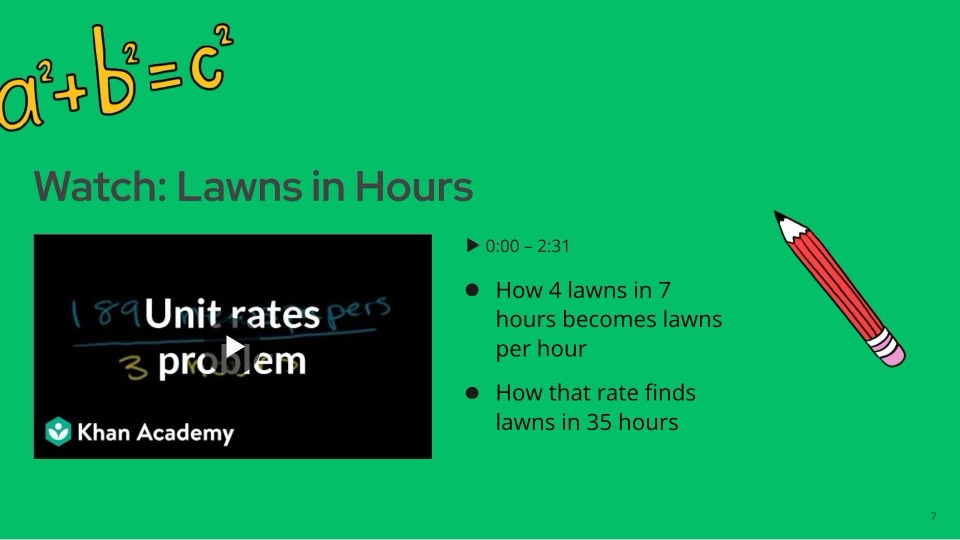
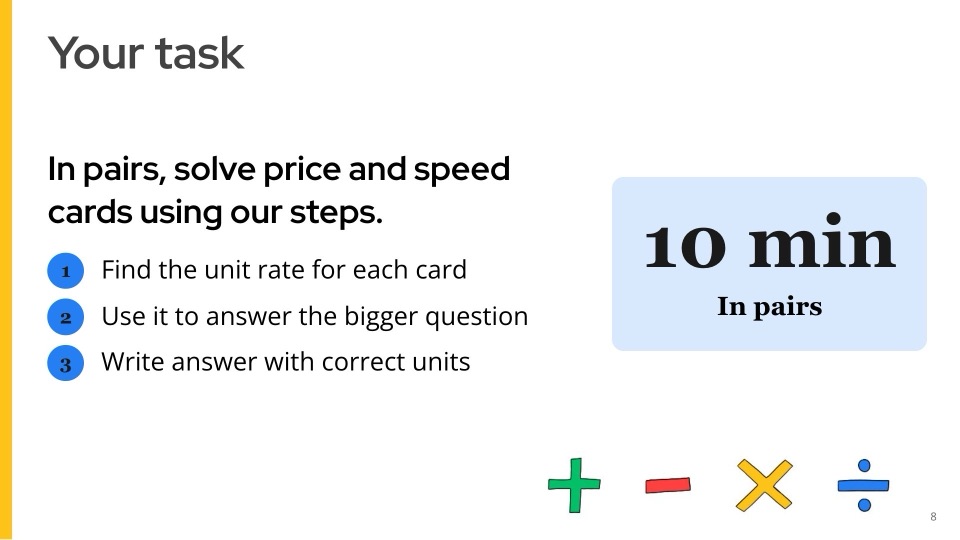
| 25 min | Main activity | Find the lawn unit rate and use it to predict lawns in 35 hours. Play Slide 7 Video clip 2 about 4 lawns in 7 hours becoming per 1 hour. Hand out printed ratio tables and model the lawn division on Slide 8. Send pairs to solve: find unit rate, then multiply to find lawns in 35 hours with units shown. Circulate, check tables of equivalent ratios, and push finishers to decimals. |
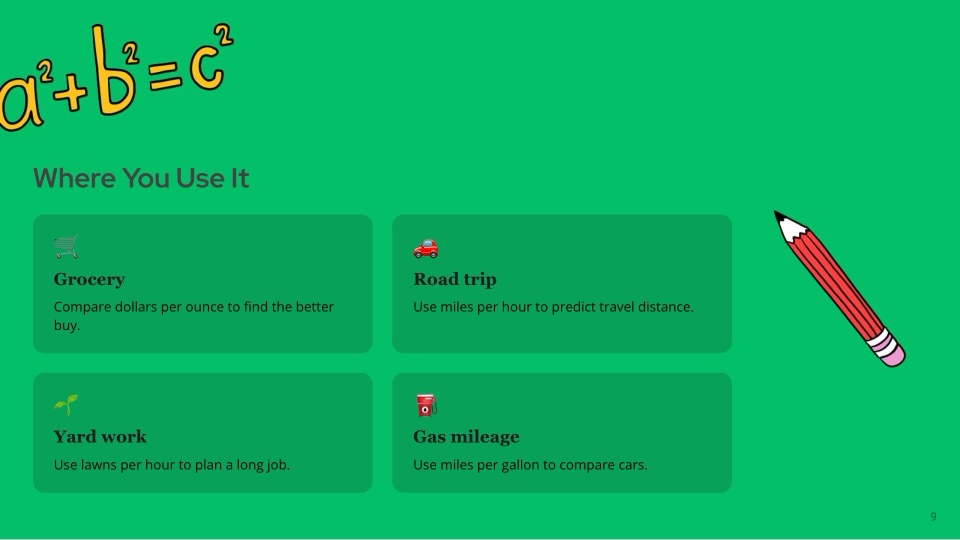
| 8 min | Application | Apply the same divide-to-1 then multiply method to unit pricing and constant speed. Show Slide 9 grocery, road trip, and yard work cards. Hand out Worksheet Task C and direct pairs to first find the unit rate, then multiply to solve Have one pair report dollars per ounce and one report miles per hour to predict distance. Remind class that speed is usually in miles per hour or mph. |
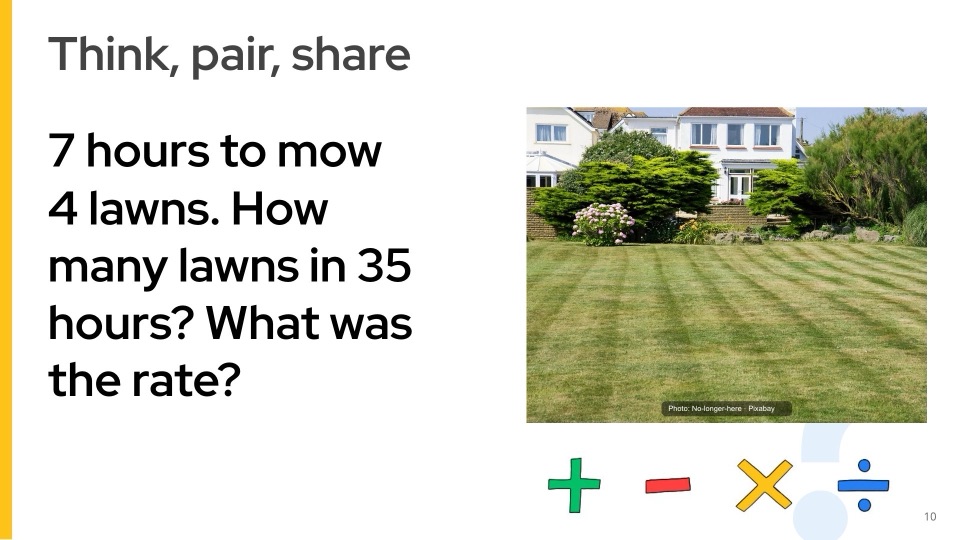
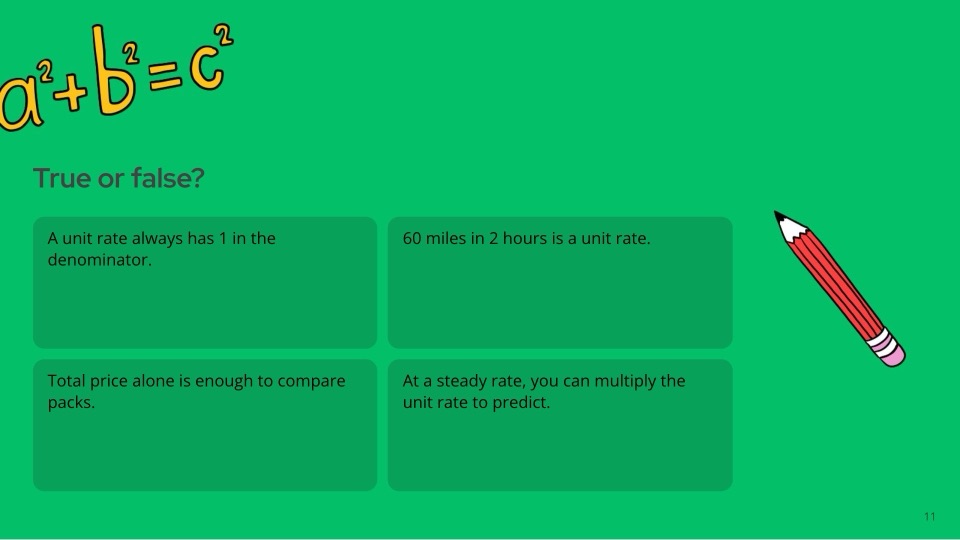
| 10 min | Plenary | Return to the lawn problem and confirm what counts as a unit rate. Show Slide 10 and have pairs restate lawns in 35 hours and the rate. Show Slide 11 true or false and vote on each claim about denominator 1. Correct the false claim that 60 miles in 2 hours is a unit rate, stressing 30 miles in 1 hour is. Link back to success criteria and give exit ticket. |
Common mistakes
- Flipping the division, like dividing weight by price for unit price
How to spot it: Units read ounces per dollar instead of dollars per ounce
Reset with units first: price ÷ weight gives cost for 1 unit, check with $5.50 for 5 pounds is $1.10 per pound. - Calling any rate a unit rate, like 60 miles in 2 hours
How to spot it: Denominator is not 1 but student labels it per hour
Remind a unit rate has 1 in the denominator; show 60 miles in 2 hours is a rate but 30 miles in 1 hour is the unit rate. - Leaving the answer without units or with wrong units
How to spot it: Writes 0.57 or 20 with no lawns, hours, or per
Require label it per one; practice dividing top number by bottom number to make bottom 1 and keep units.
Support
- Give a partly filled table with the 7 to 4 pair and the 35-hour row already labeled so students only fill in multiplies.
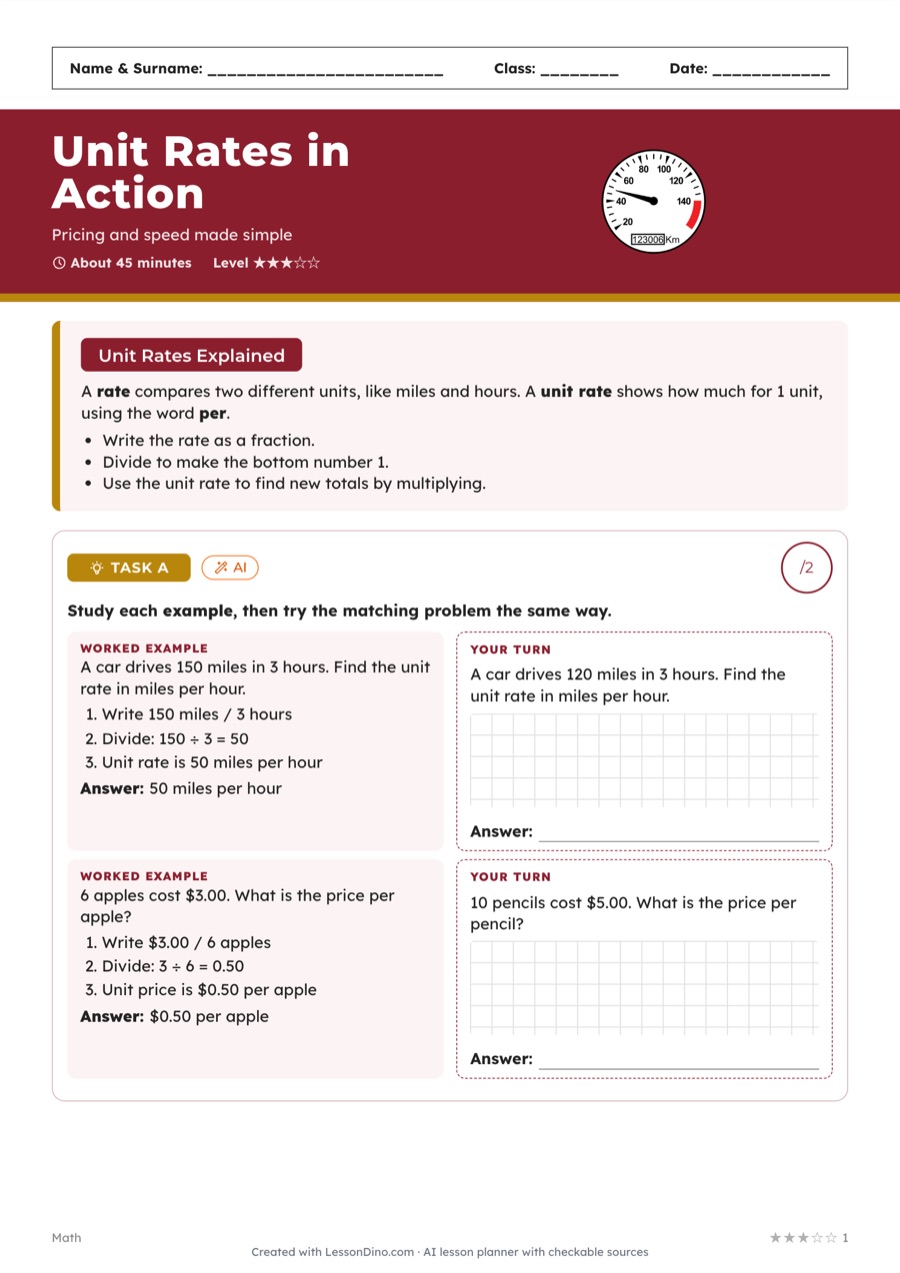
- Provide worked model of 150 miles in 3 hours equals 50 miles in 1 hour to copy.
- Allow calculator for decimal division while focusing on what per one means.
Stretch
- Ask what changes if the time is 36.5 hours and students must multiply a decimal by their unit rate.
- Ask teams to predict miles for 25 gallons using miles per gallon and check with a proportion.
- Ask students to explain why faster speed gives more miles per 1 hour but fewer minutes per mile.
Check questions
- 7 hours to mow 4 lawns. What is lawns per 1 hour?
Answer: 4/7 lawn per hour, about 0.57 - $5.50 for 5 pounds of potatoes. What is the unit price?
Answer: $1.10 per pound - Car goes 120 miles in 3 hours at constant speed. How far in 5 hours?
Answer: 40 miles per hour, so 200 miles
Curriculum
Solve unit rate problems including those involving unit pricing and constant speed. For example, if it took 7 hours to mow 4 lawns, then at that rate, how many lawns could be mowed in 35 hours? At what rate were lawns being mowed?
Video clips
Clips on YouTube, from the start and end times we chose. Check each one before you show it.
-
Solving Unit Rate Problems Strategy from 0:00 to 1:55
Planet Nutshell: Math Shorts Episode 17 - Solving Unit Rate Problems
Made for Grade 6 and exactly about unit pricing and constant speed, with slow clear pace perfect for ages 11-12.
-
Lawns in Hours Example from 0:00 to 2:31
Khan Academy: Solving unit rates problem | Ratios, proportions, units, and rates | Pre-Algebra | Khan Academy
Shows the same lawn-mowing rate problem as the lesson at the right vocabulary and pace for ages 11-12.
Worksheet
Sources
- Grade 6 Advanced Math Curriculum What is taught in grade 6 Advanced Mathematics? fcps.edu
- SST Grade 6 Mathematics TEKS - Texas Education Agency tea.texas.gov
- Math In Society: Rates and Proportions - spot.pcc.edu spot.pcc.edu
- Rate And Unit Rate - Online Lesson articulate.strayer.edu
- Lesson Objective - mechatronics.engineering.nyu.edu mechatronics.engineering.nyu.edu
- Interactive Unit Rate Lesson | WISELearn Resources wlresources.dpi.wi.gov
- Unit rates (practice) | Intro to rates | Khan Academy khanacademy.org
- Unit rates (practice) | Comparing quantities | Khan Academy en.khanacademy.org
- Rates | Lesson (article) | Lessons | Khan Academy en.khanacademy.org
- Comparing Unit Rates - PhET-bidrag phet.colorado.edu
- Unit rates - Khan Academy khanacademy.org
- Unit Rates - learnmath.org learnmath.org
- Unit Rate Worksheets superteacherworksheets.com
- How to Introduce Unit Rate and Engage Students - Math Geek Mama mathgeekmama.com
- Unit Rates & Tables - Math Worksheets imathworksheets.com
- Unit Rate Calculator calculatorsoup.com
- Unit Rate - Math Help mathhelp.com
- Unit Rate Definition (Illustrated Mathematics Dictionary) mathsisfun.com
- How to Find Unit Rate Formula - Definition, Examples, Facts splashlearn.com
- Rates and Unit Rates Worksheets with Word Problems mathworksheets4kids.com
- Unit Rate and Rate (Video & Practice Questions) mometrix.com
- Scaffolded Math and Science: Activities for Teaching Unit Rate scaffoldedmath.com
- Teaching Ratios & Unit Rates in Math | Houghton Mifflin Harcourt eduplace.com
- How to Teach Unit Rates in Middle School - Flip4Math flip4math.com
- Unit Rates Worksheets easyteacherworksheets.com
Picture credits
- Photo: itkannan4u · Pixabay
- Photo: No-longer-here · Pixabay
- Pictograms: Sergio Palao, ARASAAC (arasaac.org) · CC BY-NC-SA
- Illustration: geralt · Pixabay
Made with Lesson Dino's AI on 19 October 2026. AI can make mistakes, so check facts against the sources before you teach.