Slides
Lesson plan
Opposites Around Zero
Students learn how positives and negatives show opposite values around zero. They match real cases and write signed numbers with zero explained.
Objectives
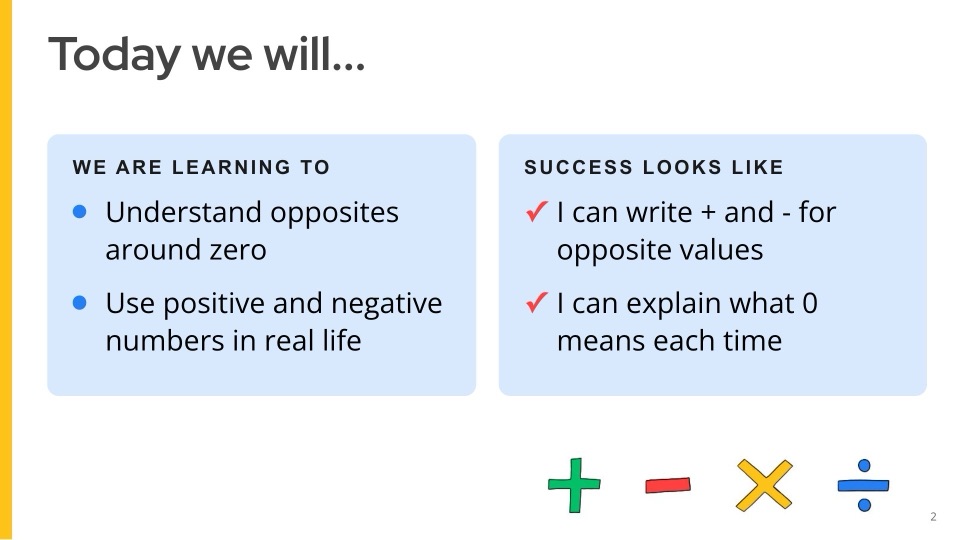
- Students will pair positive and negative numbers for opposite real-world quantities.
- Students will write signed numbers for temperature, elevation, money and charge.
- Students will explain what zero means in each real-world situation.
Success criteria
- I can write + and - to show opposite values in context.
- I can show where positive, negative and zero sit.
- I can explain what 0 means each time in words.
Key words
| Word | Meaning |
|---|---|
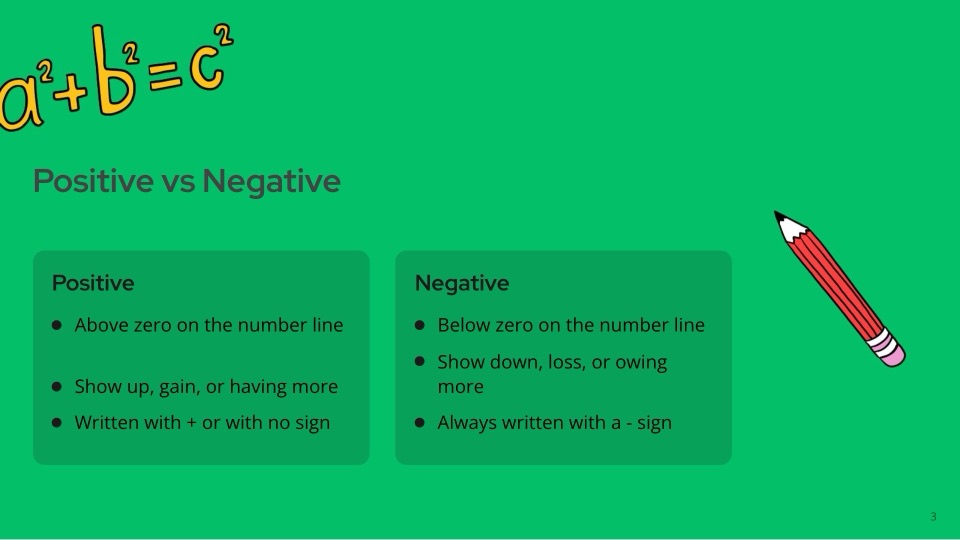
| positive | greater than zero, shown to the right of zero on a number line |
| negative | less than zero, shown to the left of zero on a number line |
| zero | the middle mark used as a starting point, neither above nor below |
| opposite | two values facing different ways from the middle, like up and down |
| credit | money put into an account, written with + |
| debit | money taken out or owed, written with - |
Timed plan (60 minutes)
| Time | Stage | What happens |
|---|---|---|
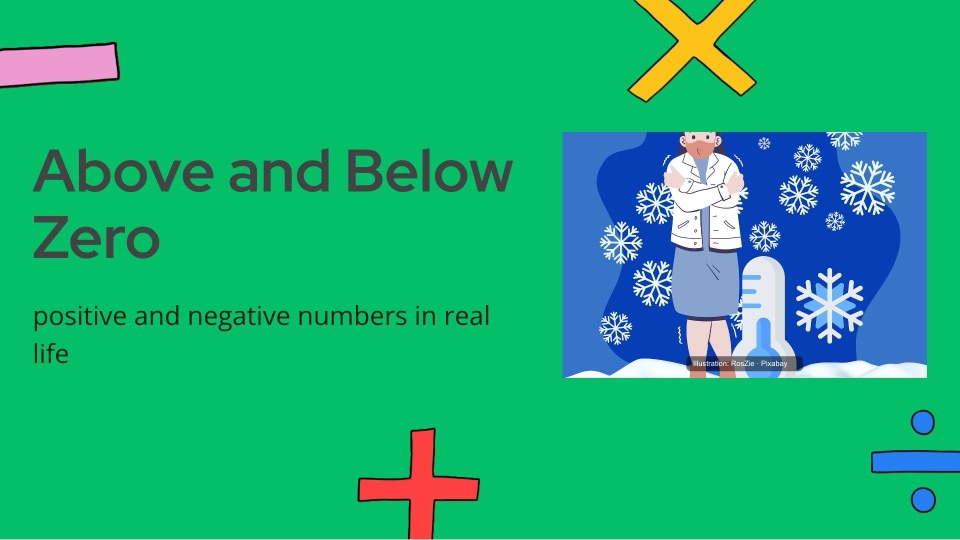
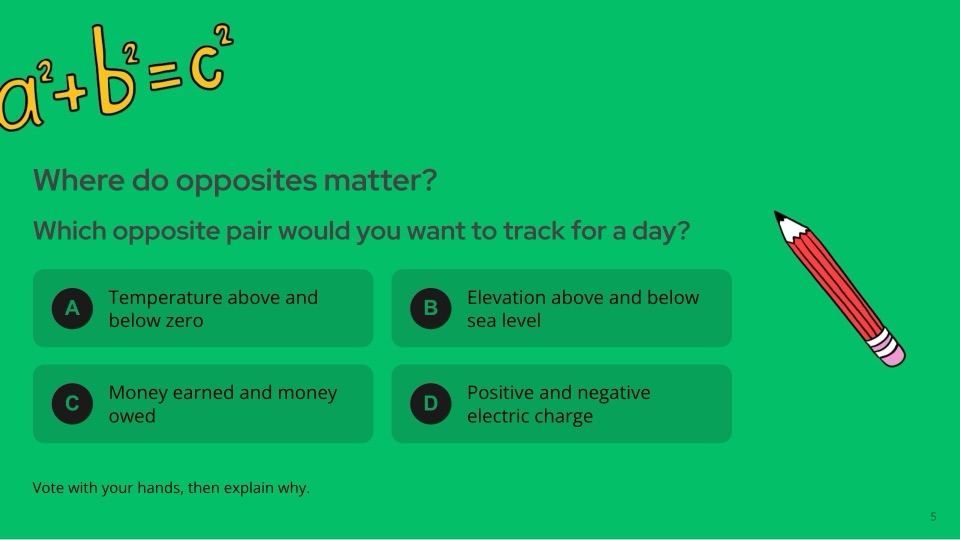
| 8 min | Starter | Spark curiosity about zero and share what we will learn today. Display Slide 1 and say the hook to the class. Ask students to turn and talk with a partner for 1 minute about the hook. Show Slide 2 objectives and read them in student words. Run Slide 5 vote on which opposite pair to track for a day and tally hands. |
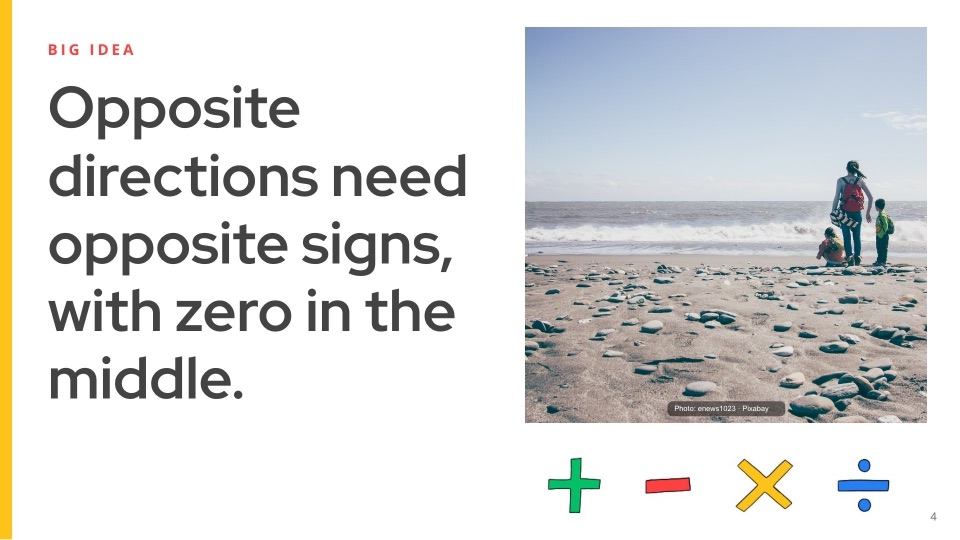
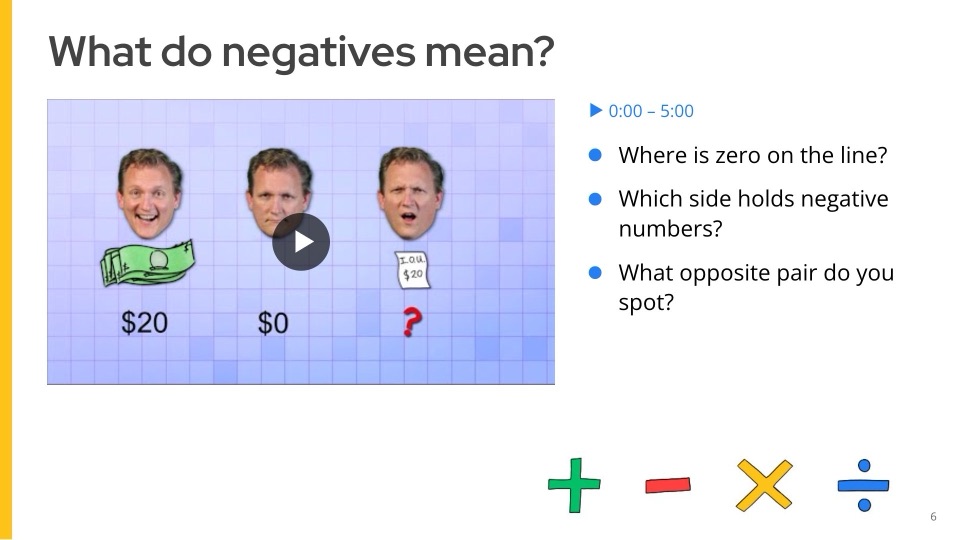
| 12 min | Teaching | Explain how positives, negatives and zero sit on a line. Show Slides 3-4 and model right for positive and left for negative with hand moves. Play Slide 6 Video clip 1 (0:00–5:00) and pause for the three questions on the slide. Show Slide 7 fact about history and connect to why signs matter now. Model two temperature examples on a drawn line with 0°F marked. |
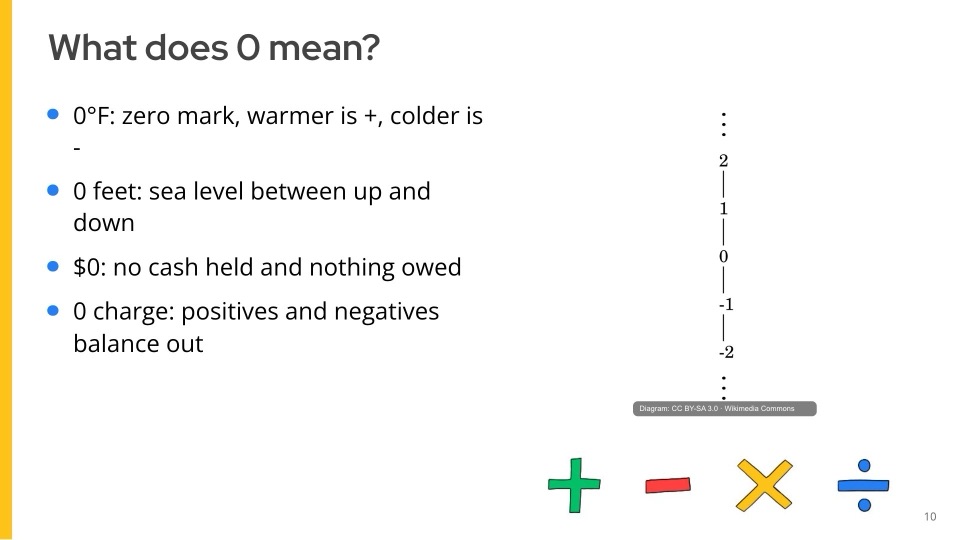
| 20 min | Main Activity | Match opposite pairs and explain what zero means each time. Give each small group the 4 cards and show Slide 10 as a reference. Ask groups to decide for each card what counts as 0, what counts as positive one way, and what as negative the other way. Press for the idea that 0 marks a reference point, not nothing. Have each group write one sentence for two cards to share. |
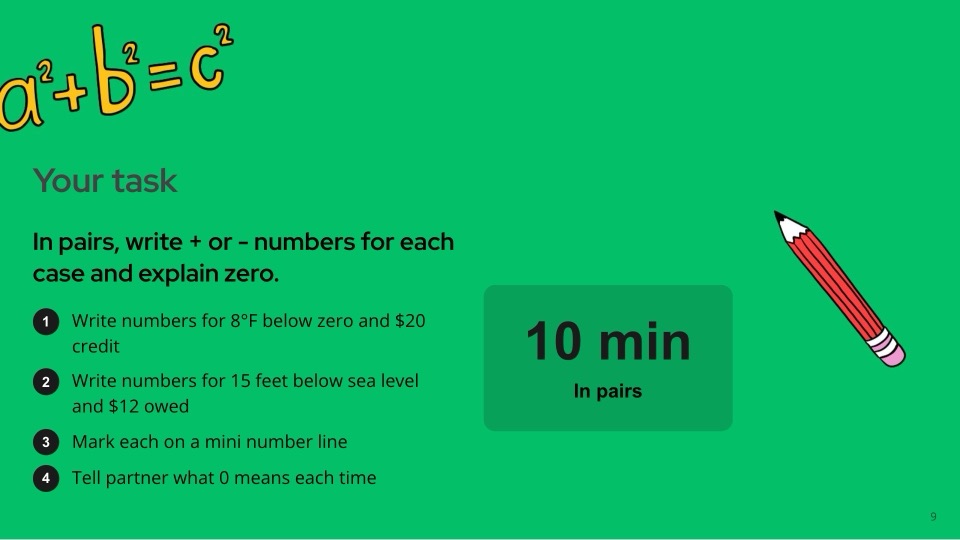
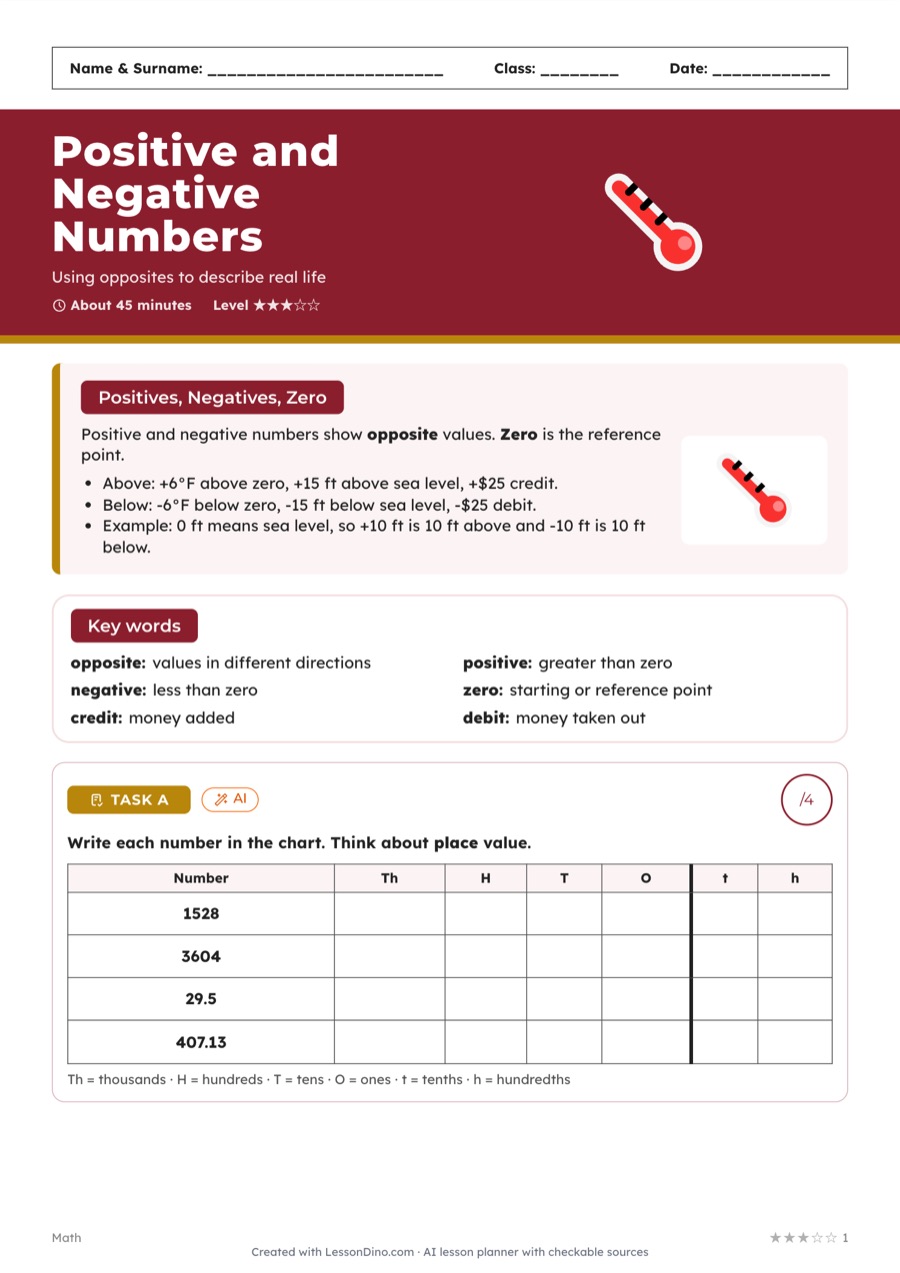
| 12 min | Practice | Practice writing signed numbers and marking them on a line. Display Slide 9 task and model the first two numbers on a mini number line. Hand out Worksheet Tasks B-C and set 10 minutes for pairs to complete. Circulate, check signs and zero labels, and prompt partners to say what 0 means. Stop class and confirm answers for the four Slide 9 numbers. |
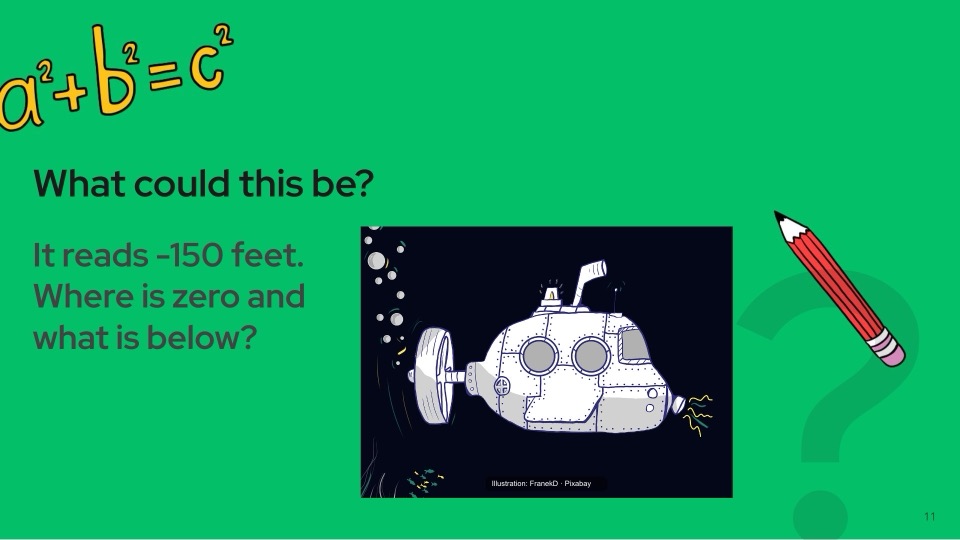
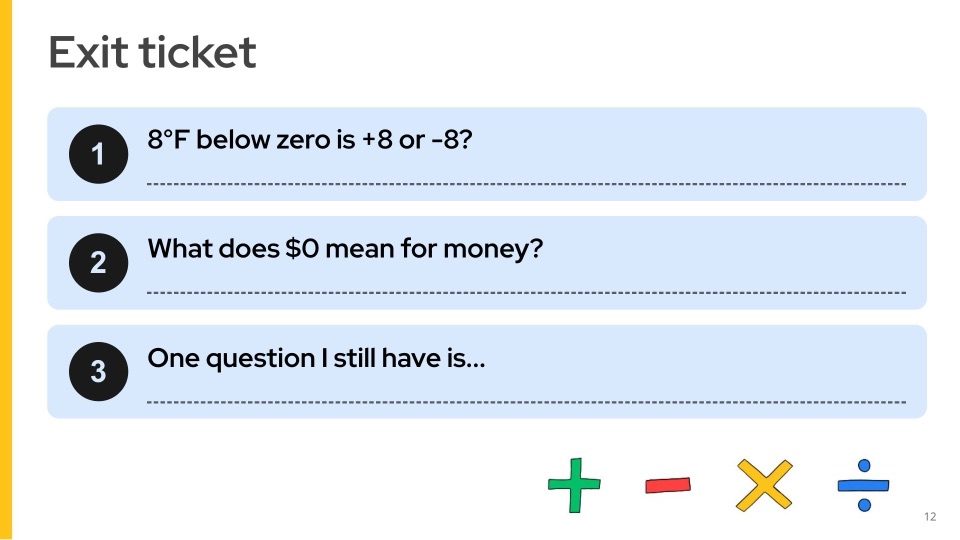
| 8 min | Plenary | Check what zero means and what + and - show. Show Slide 11 mystery and ask where zero is and what is below. Confirm with the slide answer and link back to sea level as 0. Show Slide 12 exit ticket and have all write answers on paper. Collect tickets and restate the big idea in one line. |
Common mistakes
- Saying -5 is greater than -2 because 5 is greater than 2.
How to spot it: Orders negatives backwards on lines or worksheets.
Greater means more to the right on the line, so -2 is greater than -5. - Saying zero means nothing, no temperature or empty.
How to spot it: Writes 0 = nothing for all contexts.
Treat 0 as the reference mark: 0°F allows colder negatives and water freezes at 32°F; 0 feet is sea level; $0 is no debt or savings. - Writing 8 for 8 below zero without a minus sign.
How to spot it: Missing - on temperatures, depths or amounts owed.
Numbers without a sign are taken as positive; below zero and owed need -.
Support
- Use sentence frames and pre-marked 0 on lines and cards.
- Limit to whole numbers -5 to +5 before decimals.
Stretch
- Use decimals like +2.5 and -2.5 and explain distance from 0.
- Explain why 0°F is not freezing or empty using 32°F freezing point.
Check questions
- 8°F below zero is +8 or -8?
Answer: -8°F - What does $0 mean for money?
Answer: No cash held and nothing owed. - What does 0 feet mean for elevation?
Answer: Sea level, between above (+) and below (-).
Curriculum
Understand that positive and negative numbers are used together to describe quantities having opposite directions or values (e.g., temperature above/below zero, elevation above/below sea level, credits/debits, positive/negative electric charge); use positive and negative numbers to represent quantities in real-world contexts, explaining the meaning of 0 in each situation.
Video clips
Clips on YouTube, from the start and end times we chose. Check each one before you show it.
-
What negative numbers mean from 0:00 to 5:00
mathantics: Math Antics - Negative Numbers
Introduces positive and negative numbers with a number line and real-world opposites at the perfect pace and vocabulary for ages 11-12.
-
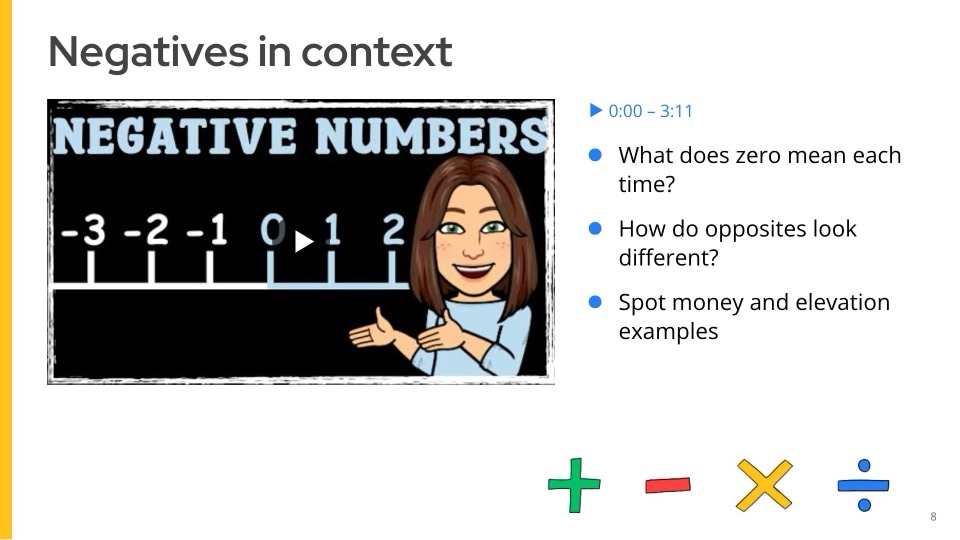
Understanding negatives in context from 0:00 to 3:11
Maths with Mrs B.: Understanding Negative Numbers | Maths with Mrs B.
Gives a clear conceptual intro to opposite values and zero with simple visuals that suits ages 11-12.
Worksheet
Sources
- Grade 6 » The Number System | Common Core State Standards ... thecorestandards.org
- Grade 6 Advanced Math Curriculum What is taught in grade 6 Advanced Mathematics? fcps.edu
- Introduction to Positive and Negative Numbers - ResourceCenter resourcecenter.byupathway.edu
- POSITIVE AND NEGATIVE NUMBERS - Clovis clovis.edu
- Math Resources: Numbers & Place Value - National University resources.nu.edu
- Addition and Subtraction with Positive and Negative Numbers resourcecenter.byupathway.edu
- What are positive and negative numbers - BBC Bitesize bbc.co.uk
- Lesson: Solve problems involving positive and negative numbers in a ... thenational.academy
- Positive and negative numbers - KS3 Maths - BBC Bitesize bbc.co.uk
- Number Line For Negative And Positive Numbers — Elearning elearning.asc.edu.ag
- BBC Two - The Maths Channel, Negative Numbers, Positive and nega… bbc.co.uk
- Addition of positive and negative integers - thenational.academy thenational.academy
- Adding and Subtracting Positive and Negative Numbers nrich.maths.org
- Add and subtract negative numbers - Math | Khan Academy khanacademy.org
- Understanding Positive and Negative Numbers Worksheets mathworksheetsland.com
- Rules for Positive and Negative Numbers sciencenotes.org
- Integers Worksheets | Positive and Negative Numbers mathfunworksheets.com
- Printable Number Line - Positive and Negative numbers math-salamanders.com
- Positive and Negative Numbers | SkillsYouNeed skillsyouneed.com
- How to Teach Integers With Positive and Negative Numbers brainninjas.ca
- Teaching positive and negative numbers math4teaching.com
- Positive and Negative Numbers Teaching Resources - Teach Starter teachstarter.com
- Natural number en.wikipedia.org
- Free Printable Positive and Negative Numbers worksheets wayground.com
- Positive and Negative Numbers | Junior High Notes thinka.ai
Picture credits
Made with Lesson Dino's AI on 16 October 2026. AI can make mistakes, so check facts against the sources before you teach.