Slides
Lesson plan
Over or Under: Writing and Graphing x > c and x < c
Students learn to write x > c or x < c for real limits. They test values and graph all solutions on number lines.
Objectives
- Students will write x > c or x < c to show a real-world limit.
- Students will explain why x > c or x < c has infinitely many solutions.
- Students will graph x > c or x < c with open circle and arrow.
Success criteria
- I can write x < c or x > c for a limit in words.
- I can test numbers and explain why solutions never end.
- I can draw an open circle at c with the correct arrow.
Key words
| Word | Meaning |
|---|---|
| inequality | a math statement that says two amounts are not equal |
| greater than (>) | bigger in amount; wide end points to the bigger value |
| less than (<) | smaller in amount; point faces the smaller value |
| solution | a number that makes the statement true |
| number line | a picture with values in order that shows all answers at once |
| open circle | an empty ring on a diagram that means the end value is not counted |
Timed plan (60 minutes)
| Time | Stage | What happens |
|---|---|---|
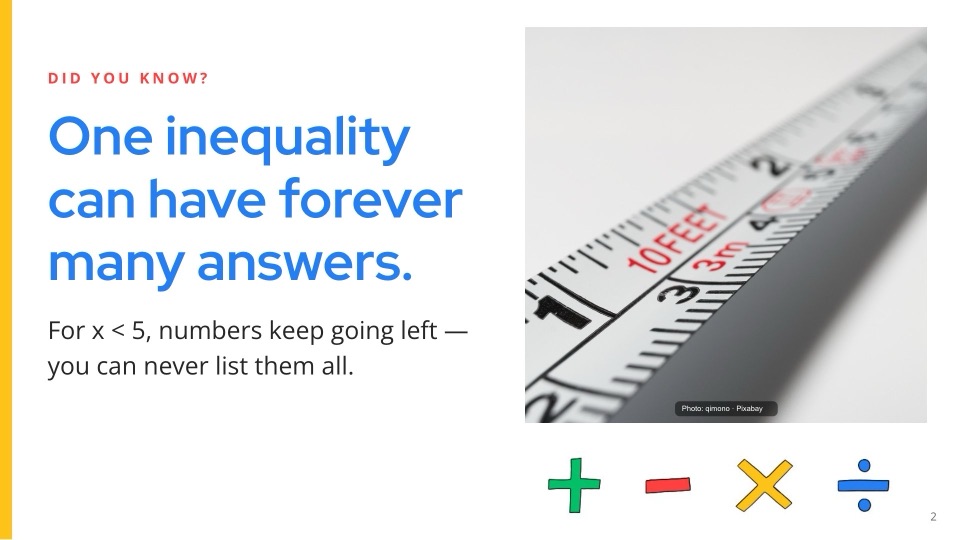
| 7 min | Starter | Activate > and < meanings and spark curiosity about the boundary number. Show Slide 1 and read the hook about the backpack sign. Ask for vote: if the bag weighs exactly 15 pounds, can it go. Quick check of prior symbols with 2 < 4 and -2 > -4. Introduce w for weight and preview that one rule can have forever many answers. |
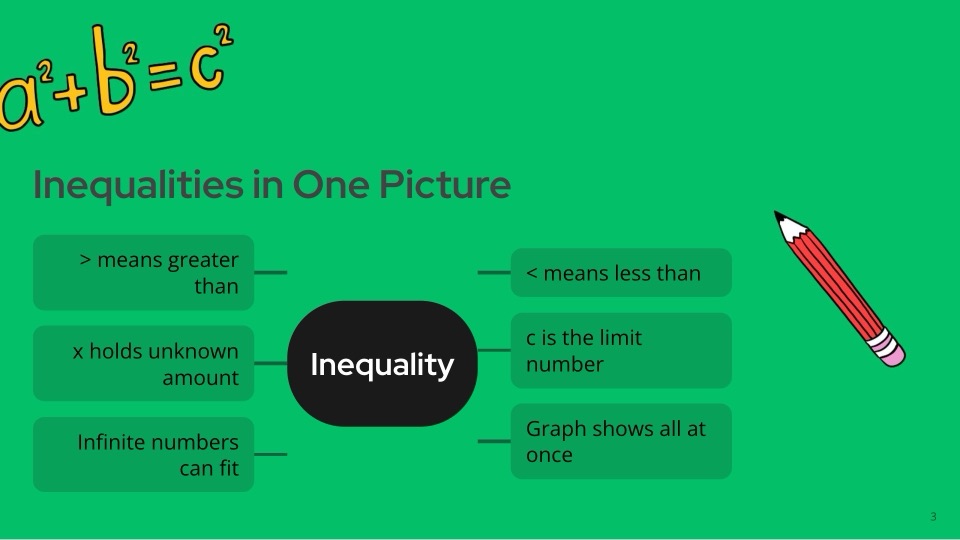
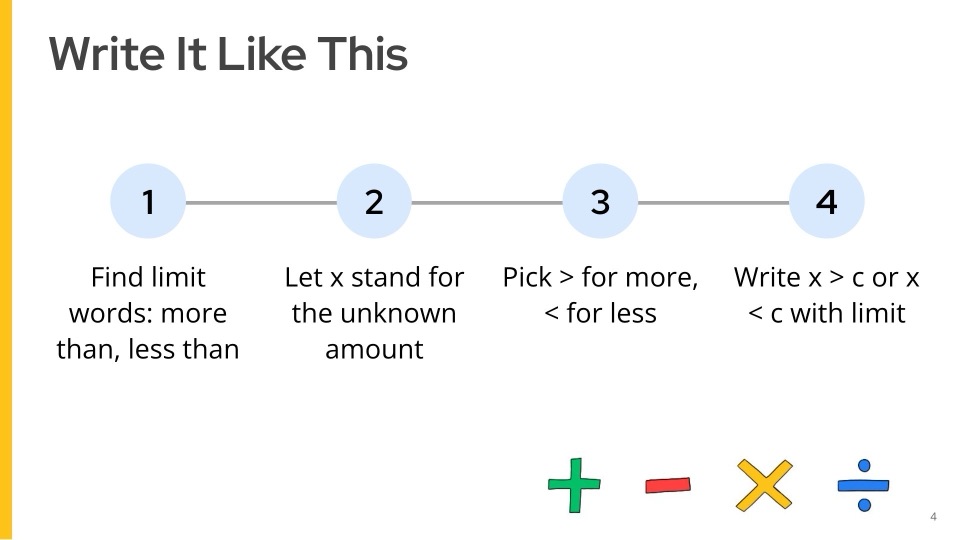
| 10 min | Teaching | Model the steps for writing x > c or x < c from limit words. Show Slide 3 mindmap: x holds unknown amount, c is the limit number. Teach Slide 4 steps: find limit words, name the variable, pick > or <. Model w < 15 for weight w step by step on the whiteboard. Stress the boundary: open empty ring means 15 is not counted. |
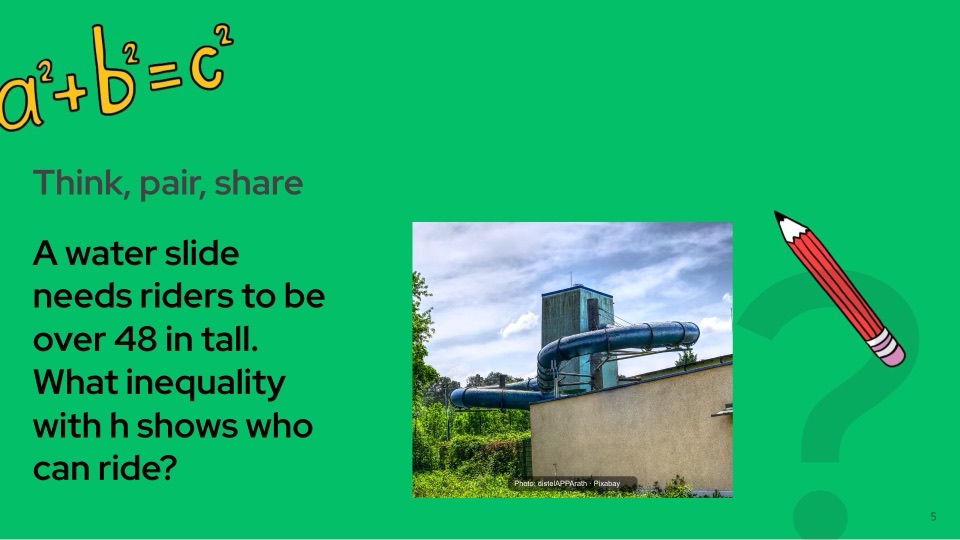
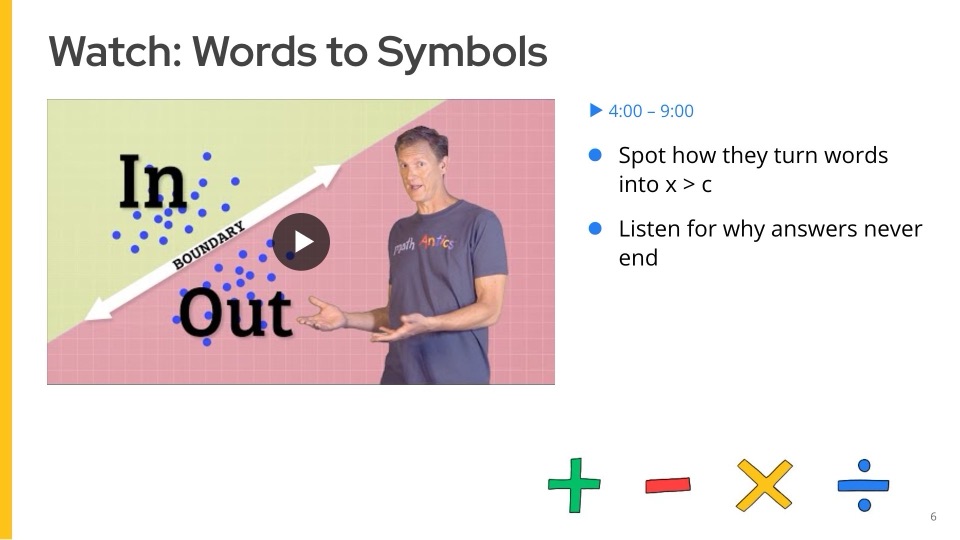
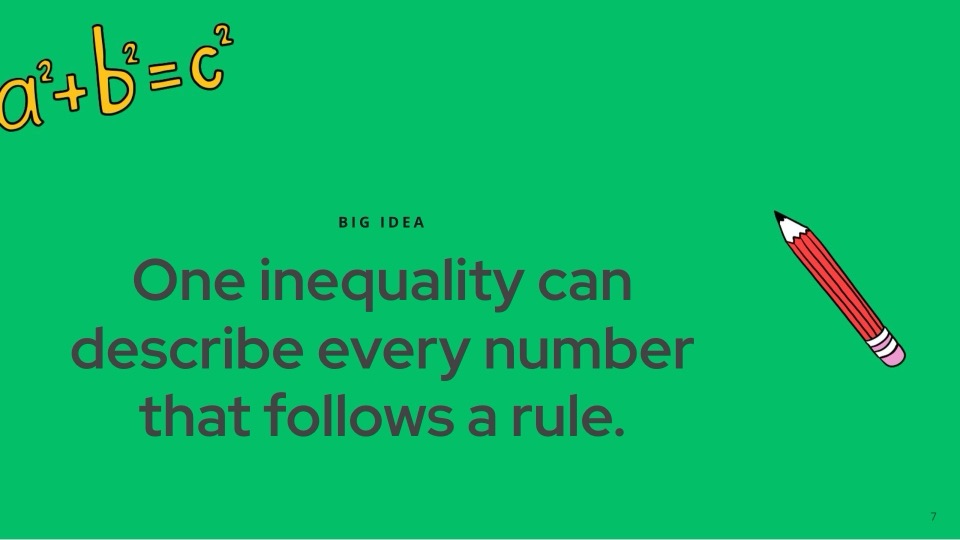
| 13 min | Guided practice | Connect words to symbols and see why answers never end. Show Slide 5 question: water slide needs riders over 48 in tall with h. Play Video clip 1 (4:00-9:00) on Slide 6; students spot words to symbols. Pause to list solutions: 49, 50, 60, 48.5, and note the list keeps going. Show Slide 7 statement that one rule can cover every number that fits. |
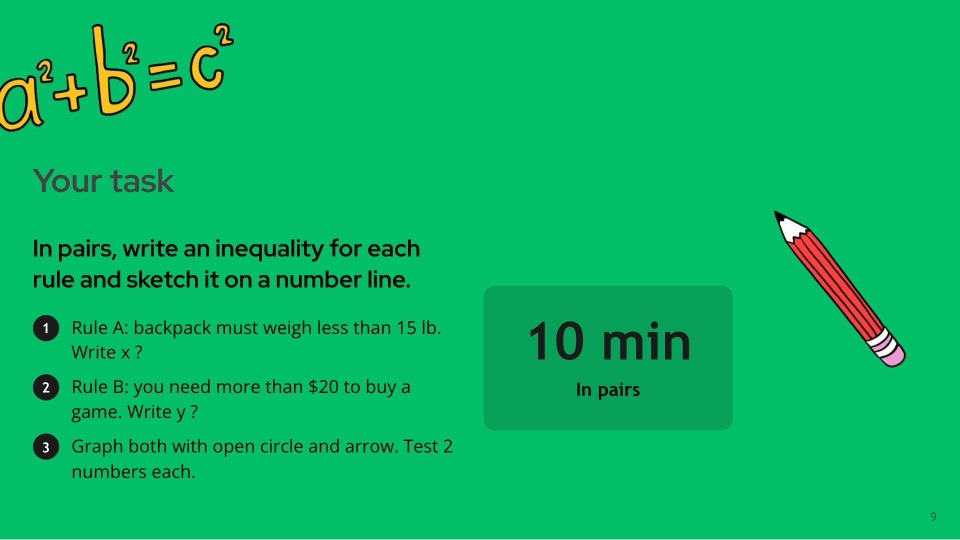
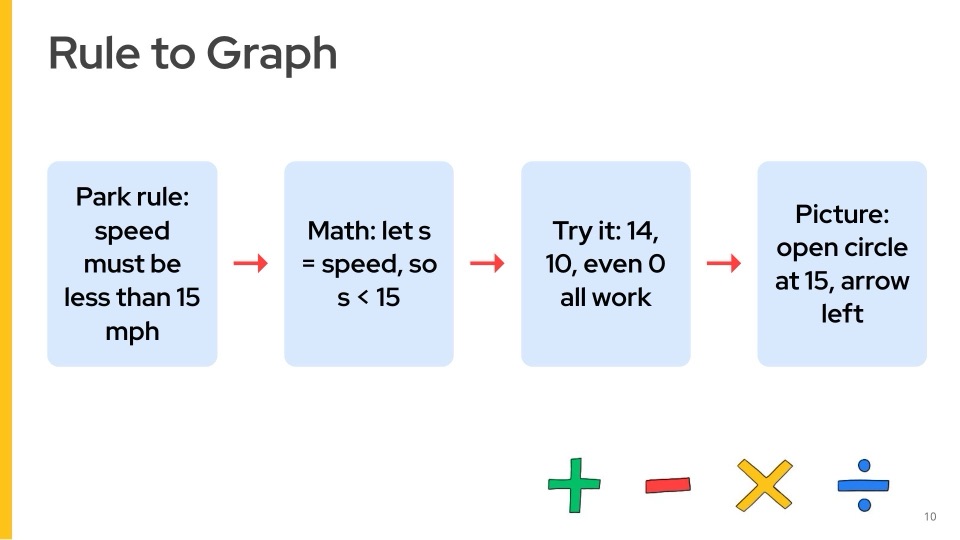
| 20 min | Main activity | Write real-world limits as x > c or x < c and graph all solutions. Present Slide 9: Rule A backpack less than 15 lb, Rule B more than $20.00 for a game. Model Slide 10 chain with s < 15 for speed: try 14, 10, even 0, then open circle at 15 arrow left. Hand out Worksheet Tasks B and E; pairs write inequalities then graph with open circle and arrow. Circulate to check symbol choice, boundary dot, and arrow direction; have each student add one class-life rule. |
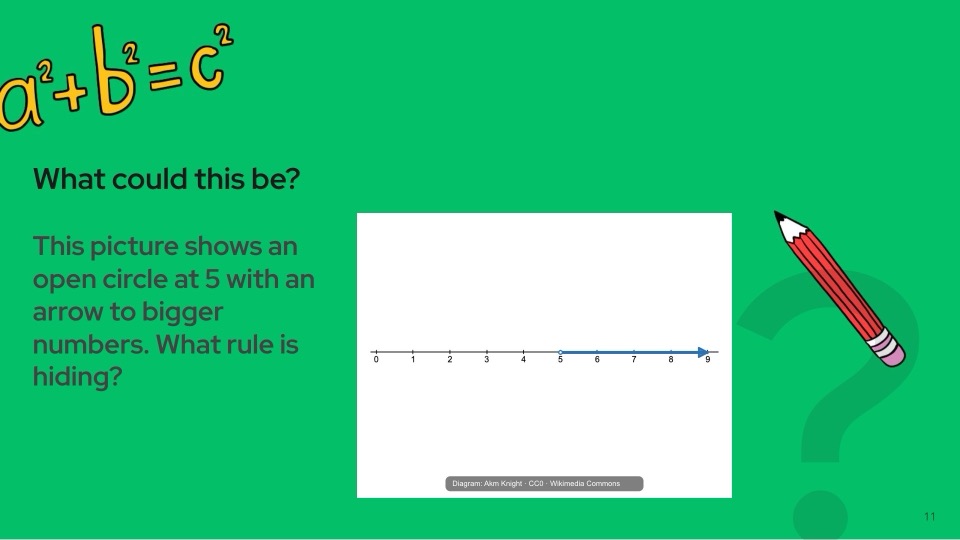
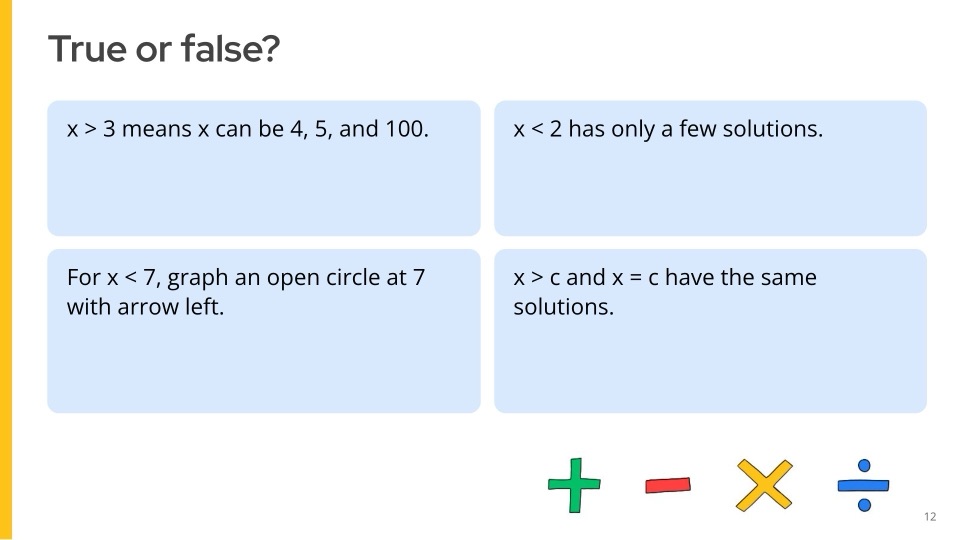
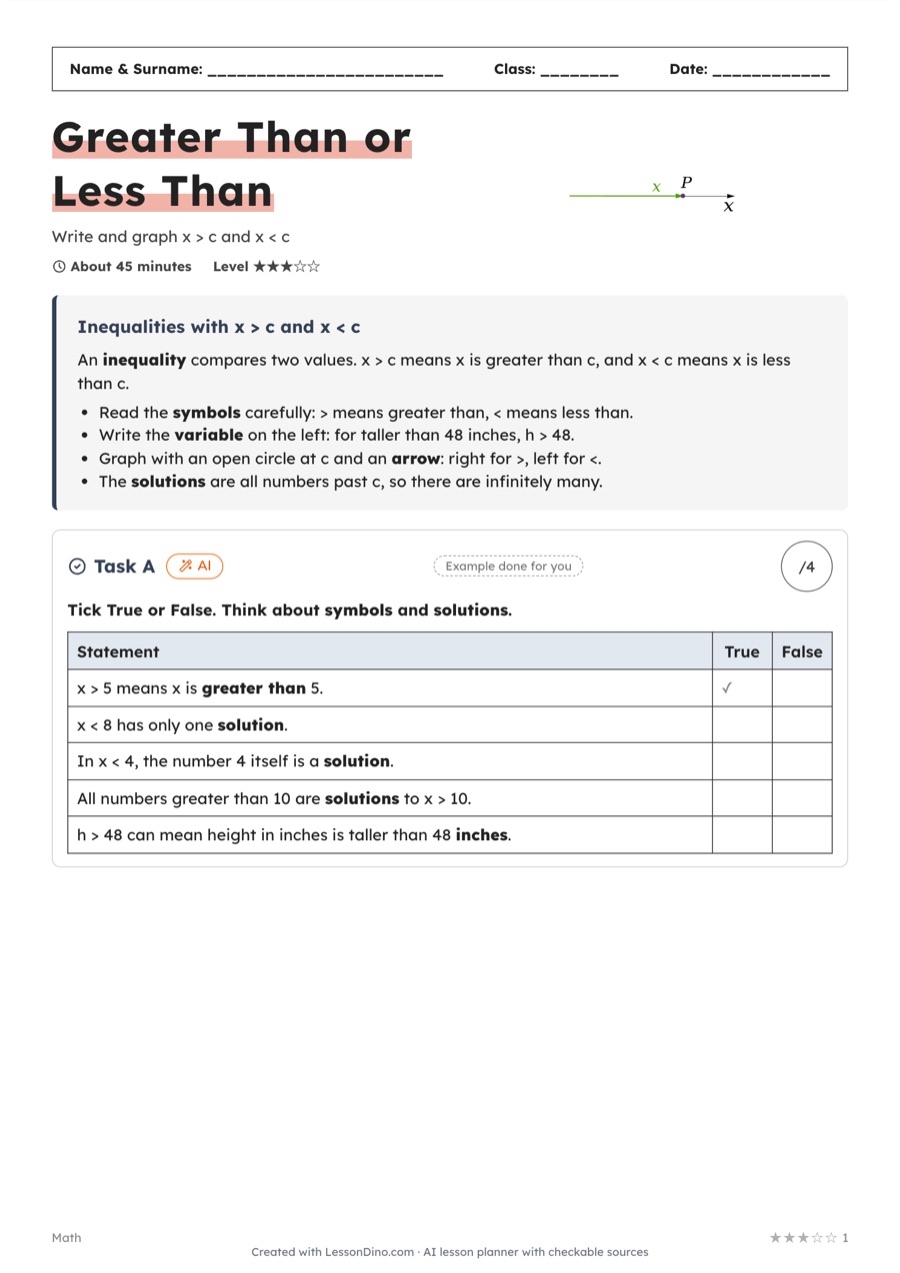
| 10 min | Plenary | Confirm infinite solutions and correct reading of graphs and symbols. Show Slide 11 mystery: open circle at 5, arrow to bigger numbers. Elicit x > 5: every number greater than 5, but not 5. Run Slide 12 true-or-false with Worksheet Task A: True or false: Tick True or False. Think about symbols and solutions. Close by restating objectives and previewing exit check. |
Common mistakes
- Thinking the boundary c is included, so x < 15 includes 15
How to spot it: Student lists 15 as working or fills in the dot at 15
Test the boundary: 15 < 15 is false. Keep the circle empty to show c itself is not counted. - Drawing the arrow the wrong way, such as right for x < 8
How to spot it: Graph for x < 8 points right, or x > 3 points left
Test a number on each side. For x > 8, 13 is greater than 8 and works, while 6 does not. Point arrow to the working side. - Believing there are only a few whole-number answers
How to spot it: List stops at 14, 13, 12 and misses decimals like 14.5
Add decimals between wholes and stress infinite solutions that cannot be listed one by one.
Support
- Give the sentence frame x is less than __, fill c first, then write > or <.
- Start with whole dollars and whole numbers, then add cents and decimals.
- Provide half-drawn number lines with open circles already at c.
Stretch
- Have students explain why 15 itself does not work and what makes the boundary special.
- Ask for three whole-number and three decimal solutions to prove solutions do not stop.
- Add cards with decimals like x > 4.5 to force careful placement.
Check questions
- Game costs more than $20.00. Let y = price in dollars. Write the inequality.
Answer: y > 20 - Name two solutions and one non-solution for x < 8.
Answer: Solutions e.g., 7 and 0; non-solution 8 or any number 8 or above - Draw x > 3. Where is the circle and which way is the arrow?
Answer: Open circle at 3, arrow right; 3 not included, all bigger numbers included
Curriculum
Write an inequality of the form x > c or x < c to represent a constraint or condition in a real-world or mathematical problem. Recognize that inequalities of the form x > c or x < c have infinitely many solutions; represent solutions of such inequalities on number line diagrams.
Video clips
Clips on YouTube, from the start and end times we chose. Check each one before you show it.
-
Inequalities with variables and number lines from 4:00 to 9:00
mathantics: Algebra Basics: Inequalities In Algebra - Math Antics
Teaches exactly writing x > c or x < c with infinitely many solutions on a number line in a Math Antics style made for ages 11-12.
-
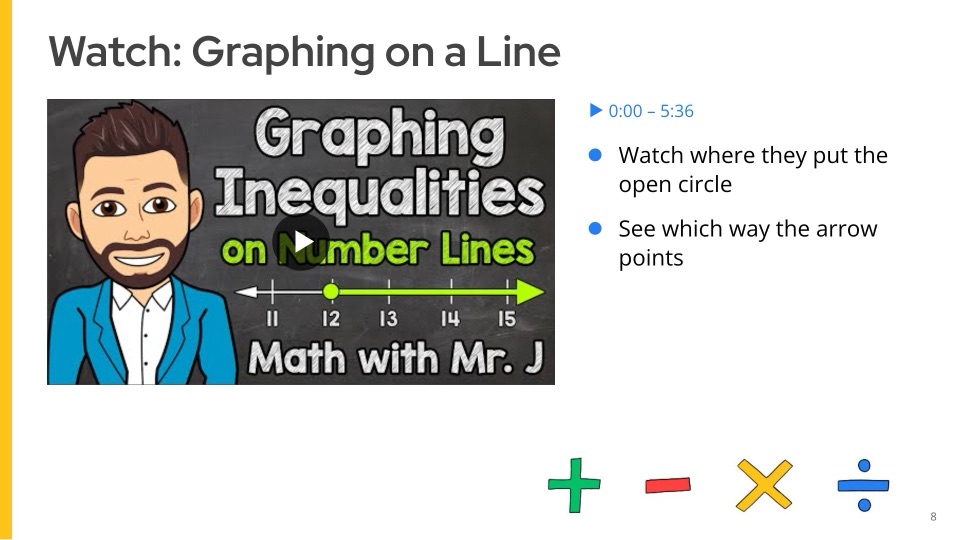
Graphing inequalities on number lines from 0:00 to 5:36
Math with Mr. J: Graphing Inequalities on Number Lines | Math with Mr. J
Models exactly how to graph x > c and x < c for Grade 6 with slow, clear steps ideal for ages 11-12.
Worksheet
Sources
- Grade 6 | Common Core State Standards Initiative thecorestandards.org
- Grade 6 » Introduction | Common Core State Standards Initiative thecorestandards.org
- Inequalities - Emory University mathcenter.oxford.emory.edu
- What are Inequalities? - Ximera - University of Florida xronos.clas.ufl.edu
- A Primer on Inequalities - UC Santa Barbara web.math.ucsb.edu
- Inequalities - mathweb.ucsd.edu mathweb.ucsd.edu
- The History of Inequality | ReVista revista.drclas.harvard.edu
- Real Numbers:Inequalities - Department of Mathematics at UTSA mathresearch.utsa.edu
- Inequalities - GCSE Maths Revision - BBC Bitesize bbc.co.uk
- Inequalities - KS3 Maths - BBC Bitesize bbc.co.uk
- Inequalities GCSE | KS4 | Y11 Maths Foundation | Lesson ... thenational.academy
- Inequalities (systems & graphs) | Algebra 1 | Math | Khan Academy khanacademy.org
- Solving equations & inequalities | Algebra 1 | Math | Khan ... khanacademy.org
- Inequalities (graphs & systems) | Algebra 1 (FL B.E.S.T ... en.khanacademy.org
- Kids Math: Inequalities - Ducksters ducksters.com
- Inequalities Explained with Real-Life Scenarios learnwithexamples.org
- Teaching One- and Two-Step Inequalities - Maneuvering the Middle maneuveringthemiddle.com
- Inequality Math for Kids | Definition, Facts, Examples & Quiz workybooks.com
- Inequalities Worksheets - Math Worksheets 4 Kids mathworksheets4kids.com
- Inequalities Worksheets superteacherworksheets.com
- Inequalities Games - Interactive Learning | MathWorksheet... mathworksheetsfun.com
- Inequalities Worksheets - Tutoring Hour tutoringhour.com
- Inequalities Worksheets - Math Worksheets imathworksheets.com
- Solving Inequalities – Explanation & Examples storyofmathematics.com
- Inequalities in Math Lesson for Kids: Definition & Examples study.com
Picture credits
Made with Lesson Dino's AI on 17 October 2026. AI can make mistakes, so check facts against the sources before you teach.