Slides
Lesson plan
First, Next, Last: My True Story
Students learn to tell events in order with details and an ending. They act, draw, and write their own three-part true story.
Objectives
- Students will retell two or more events in order using first, then, last.
- Students will add one small detail about what happened in each event.
- Students will end the narrative with a closing feeling or sentence.
Success criteria
- I can tell what happened first, next, and last in order.
- I can add one small detail to show what happened.
- I can write an ending that shows how it felt or finished.
Key words
| Word | Meaning |
|---|---|
| first | at the very start of what happened |
| next | what comes right after one thing |
| last | at the very end of what happened |
| detail | a small bit that tells more, like color, sound, or feeling |
| ending | how a story feels finished and closed |
Timed plan (60 minutes)
| Time | Stage | What happens |
|---|---|---|
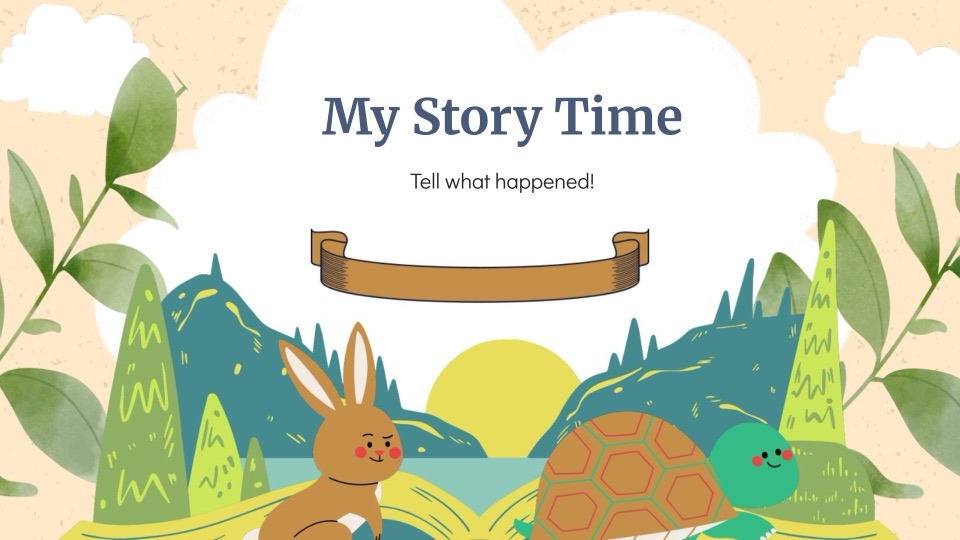
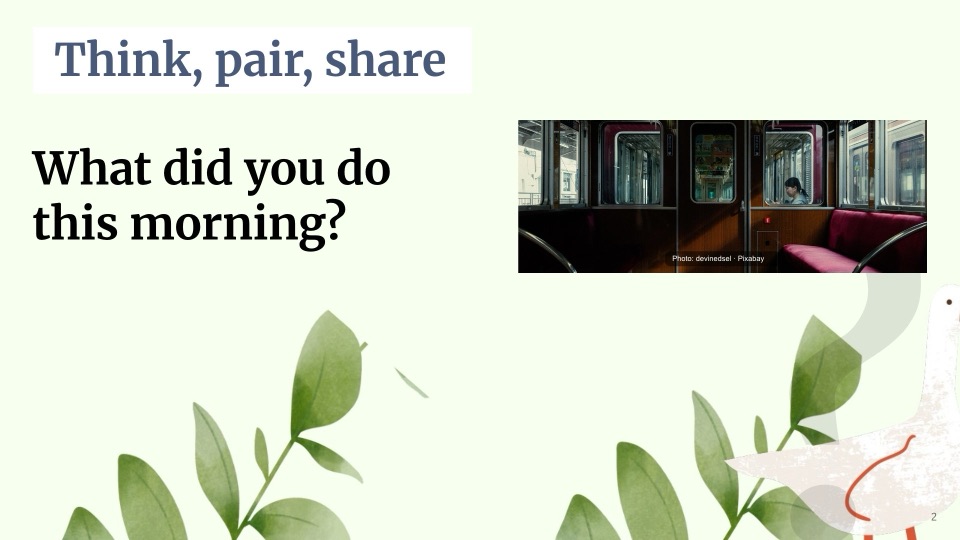
| 5 min | Starter | To hook students and recall telling morning events in order. Welcome class and say the hook: You be the actors — then you be the authors and finish your story! Show Slide 1 My Story Time and read title line: Tell what happened! Show Slide 2 Think, pair, share and read question: What did you do this morning? Have partners tell each other two things from this morning in order. |
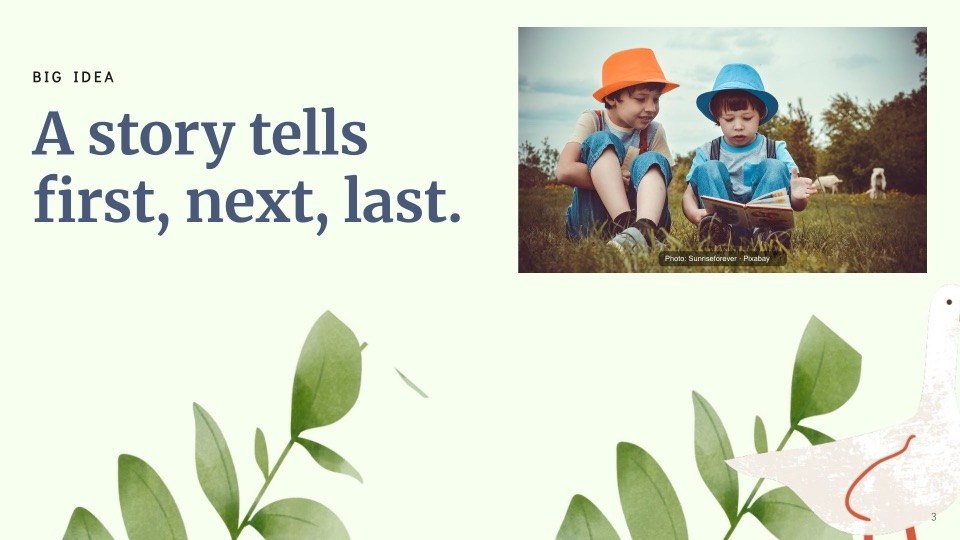
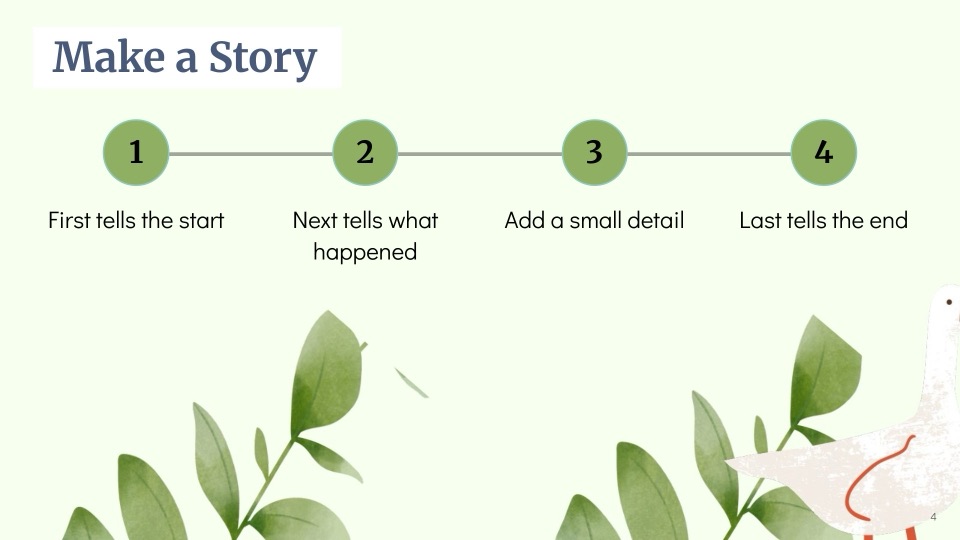
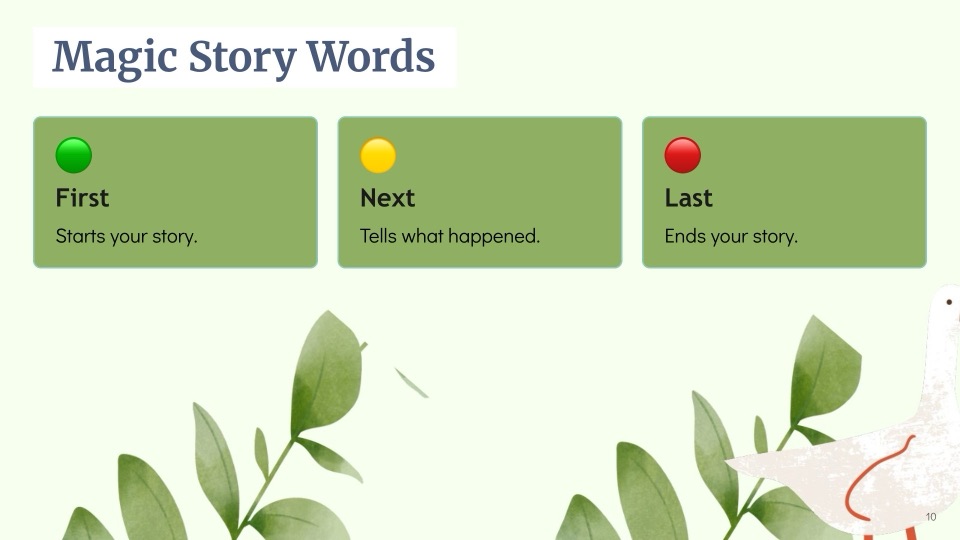
| 10 min | Teaching | To model a sequenced narrative with time words, details, and closure. Show Slide 3 Big idea and read: A story tells first, next, last. Show Slide 4 Make a Story steps and Slide 10 Magic Story Words with First, Next, Last. Explain that narrative writing tells a story, presenting readers with a sequence of events. Model drawing three quick boxes and writing one sentence per box with a detail and a happy finish. |
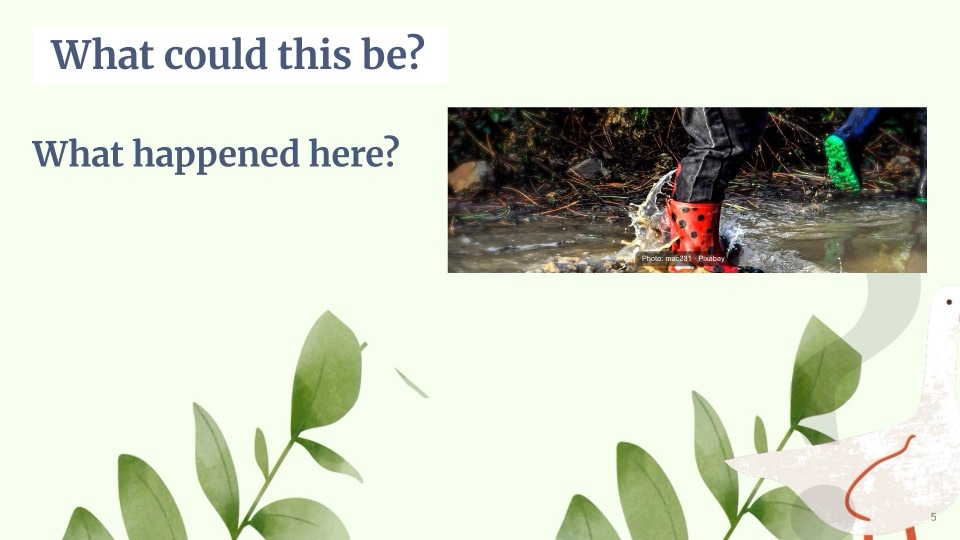
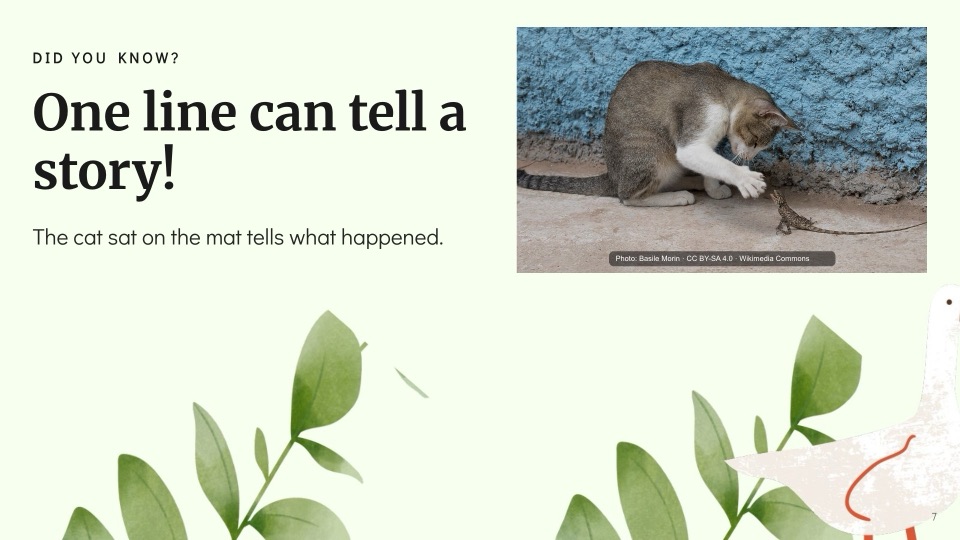
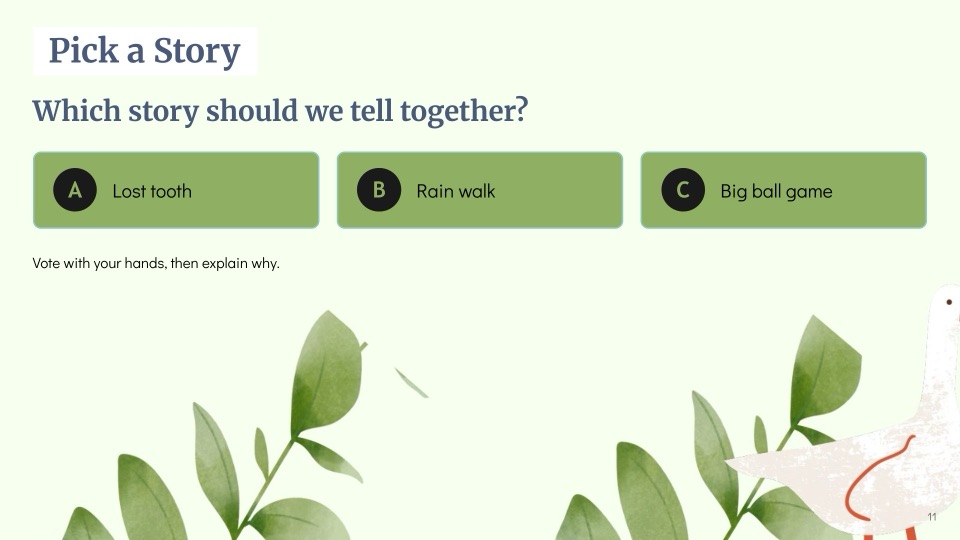
| 10 min | Act Together | To practice telling two events plus an ending in order before writing. Show Slide 5 What could this be? and read: What happened here? Walked in a rain puddle! Show Slide 11 Pick a Story and read: Which story should we tell together? Lost tooth, Rain walk, Big ball game. Take a quick vote and assign groups to act the start, what happened, and the finish. Remind students that a narrative organizes thoughts to make sense of things that happen. |
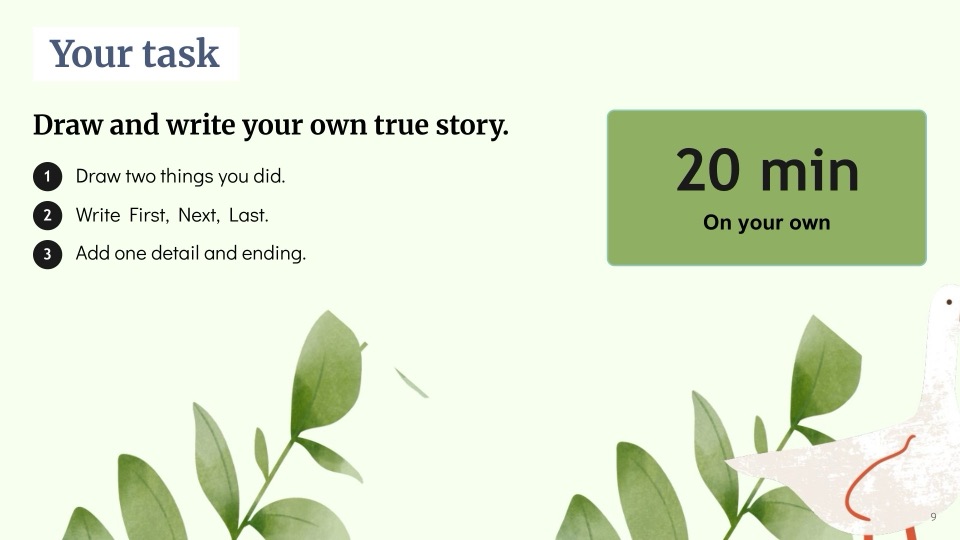
| 25 min | Draw It, Write It | To draw and write a sequenced narrative with details and closure. Show Slide 9 Your task and read steps: Draw two things you did. Write First, Next, Last. Add one detail and ending. Hand out paper folded in thirds, pencils, and crayons for students to draw and write their own true story. Remind students narratives present connected events in order to an audience. Circulate, help with spelling, and prompt for one detail and a last-box feeling. |
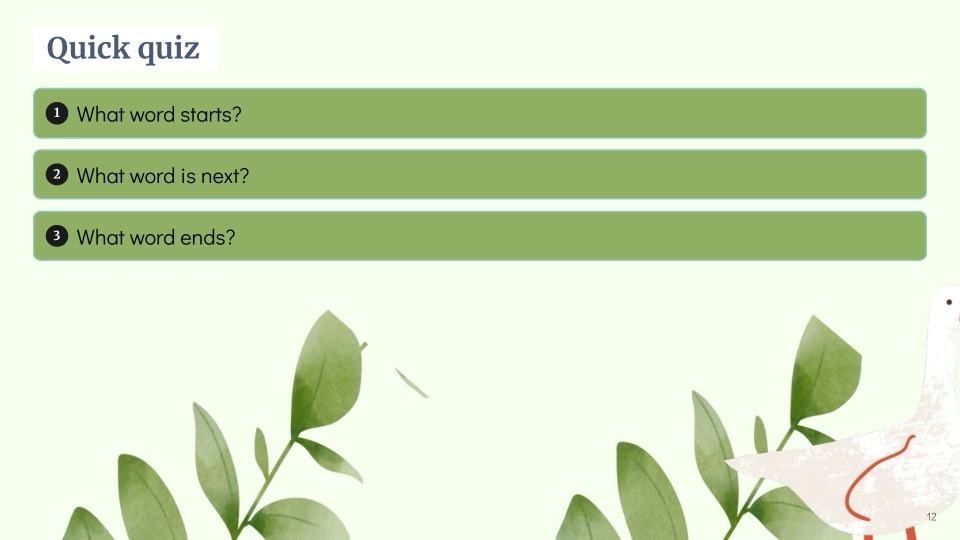
| 10 min | Plenary | To review time words, details, and endings and check the objectives. Invite two students to read their three sentences and point to First, Next, Last. Show Slide 12 Quick quiz and ask: What word starts? First. What word is next? Next. What word ends? Last. Restate that stories need two or more events in order, a small detail, and a finish. |
Common mistakes
- Events told out of order or only one event
How to spot it: Pictures or sentences do not match first, then, last sequence
Have student touch each box in order and retell with First, Then, Last before writing. - Missing time words
How to spot it: Sentences tell what happened but do not start with a time word
Point to word wall and have student add First, Next or Then, Last to start each sentence. - No detail or no sense of closure
How to spot it: Plain We played with no color, size, sound, or feeling and a sudden stop
Ask what, where, or how it felt and add one detail and a last-box feeling.
Support
- Provide a three-box template with First, Then, Last printed and sentence starters like First I___.
Stretch
- Have students add dialogue, a sound word, or a second detail sentence to the middle event.
Check questions
- What word starts your story?
Answer: First - What small detail can you add to show what happened?
Answer: A color, size, sound, or feeling word - What does the last part tell?
Answer: How the story ended or felt
Curriculum
Write narratives in which they recount two or more appropriately sequenced events, include some details regarding what happened, use temporal words to signal event order, and provide some sense of closure.
Video clips
Clips on YouTube, from the start and end times we chose. Check each one before you show it.
-
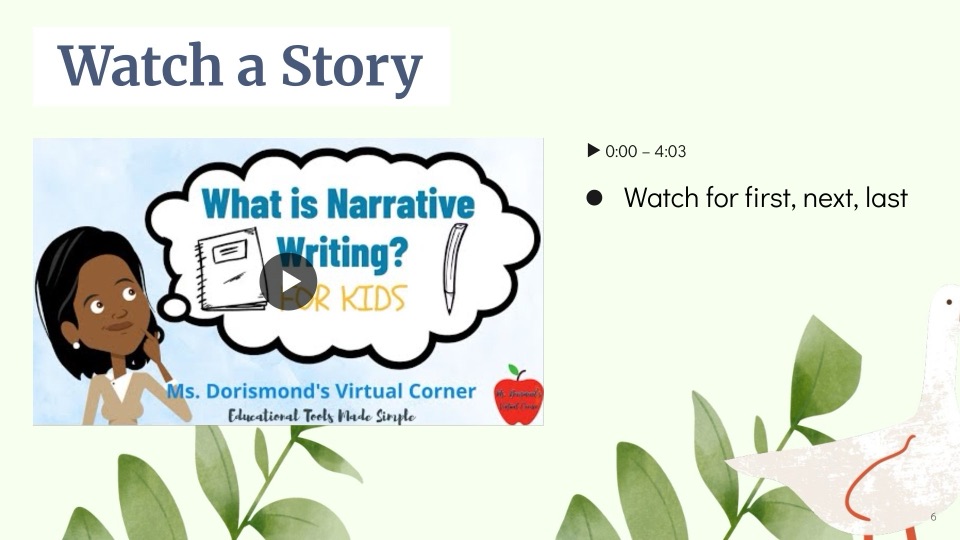
What Is Narrative Writing? from 0:00 to 4:03
Ms. Dorismond's Virtual Corner: ✏️ What is Narrative Writing? | Narrative Writing for Kids 1st & 2nd Grade
Made specifically for 1st and 2nd grade so vocabulary and pace fit 6-7-year-olds learning to recount sequenced events.
-
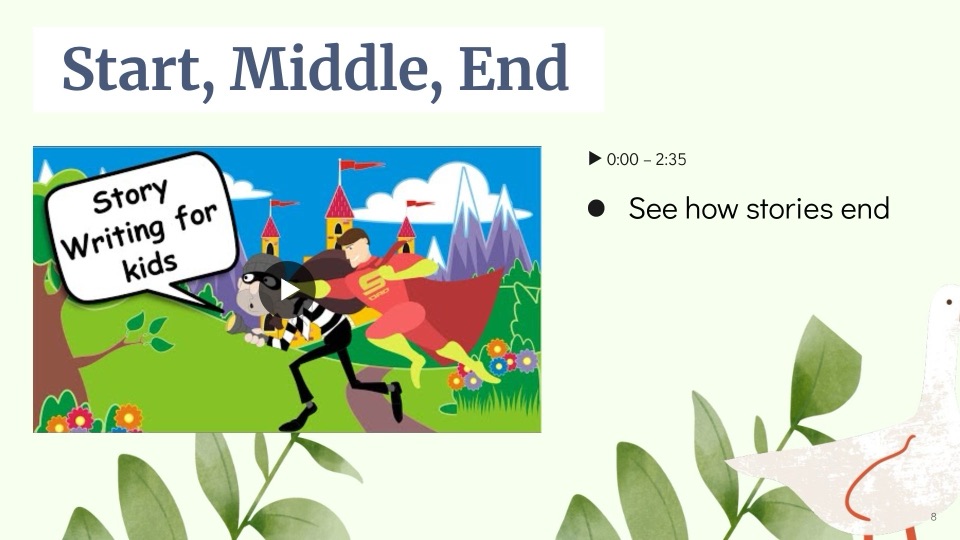
Beginning, Middle, End Story from 0:00 to 2:35
The Evelyn Winters Adventure: Writing a story with beginning, middle, end - tutorial for kids
Teaches beginning-middle-end in simple kid language, perfect for 6-7-year-olds to sequence two events and add closure.
Worksheet
Sources
- How to Read the Standards thecorestandards.org
- CCSS for ELA - Content Standards (CA Dept of Education) cde.ca.gov
- Beginning Creative Writing - Harvard Division of Continuing ... coursebrowser.dce.harvard.edu
- Fundamentals in Creative Writing: The Grammar of Narrative creativewriting.uchicago.edu
- THE EFFECTS OF CREATIVE WRITING ACTIVITIES ON NARRATIVE TEXT ... files.eric.ed.gov
- Introduction - Creative Writing - LibGuides at Malone University libraryguides.malone.edu
- What is Creative Writing? | SNHU snhu.edu
- Narrative and Creative Writing for Nonfiction - eCornell ecornell.cornell.edu
- Writing Skills - Creative and narrative writing - BBC Bitesize bbc.co.uk
- Narrative - Wikipedia en.wikipedia.org
- Narrative - NSW Department of Education education.nsw.gov.au
- UNIVERSITY WRITING CENTER calbaptist.edu
- Modes of Writing - Eastern easternct.edu
Picture credits
- Photo: TungArt7 · Pixabay
- Photo: devinedsel · Pixabay
- Photo: Sunriseforever · Pixabay
- Photo: mac231 · Pixabay
- Photo: Basile Morin · CC BY-SA 4.0 · Wikimedia Commons
- Pictograms: Sergio Palao, ARASAAC (arasaac.org) · CC BY-NC-SA
- Illustration: Haninabz · Pixabay
- Illustration: Animation_Studio · Pixabay
- Microsoft Fluent Emoji (MIT)
Made with Lesson Dino's AI on 17 October 2026. AI can make mistakes, so check facts against the sources before you teach.