Slides
Lesson plan
Fair Halves and Fourths
Students learn to split circles and rectangles into two and four fair shares. They fold paper shapes and use half of, fourth of, and quarter of.
Objectives
- Students will split circles and rectangles into 2 and 4 equal shares.
- Students will name shares with halves, fourths, quarters, half of, fourth of.
- Students will show the whole as two or four shares and compare sizes.
Success criteria
- I can make 2 fair shares called halves and 4 called fourths.
- I can say half of, fourth of, and quarter of for my shares.
- I can show 2 halves or 4 fourths make the whole.
Key words
| Word | Meaning |
|---|---|
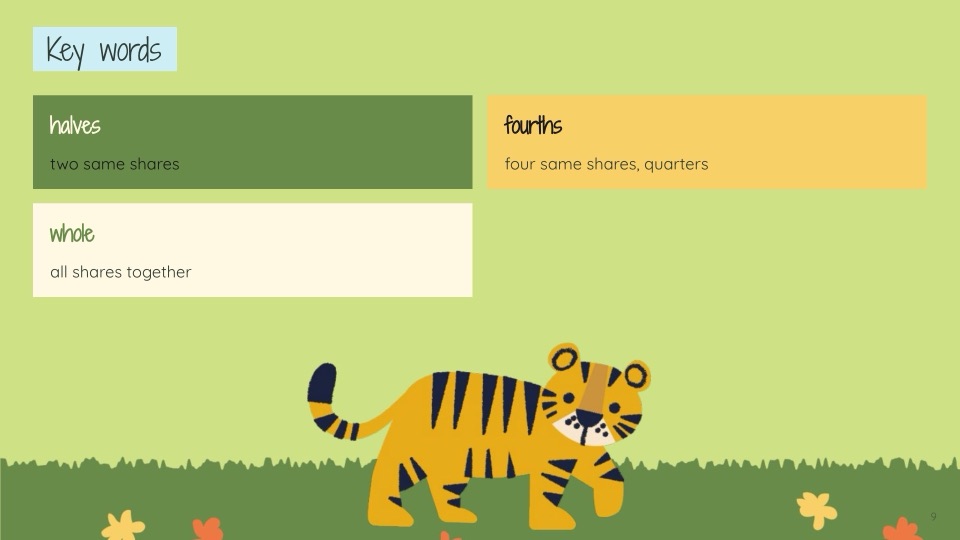
| halves | two fair parts of one shape that are the same size |
| fourths | four fair parts of one shape that are the same size |
| quarters | another name for four fair parts that are the same size |
| whole | all the parts together as one shape |
| equal shares | fair parts that are all the same size |
Timed plan (60 minutes)
| Time | Stage | What happens |
|---|---|---|
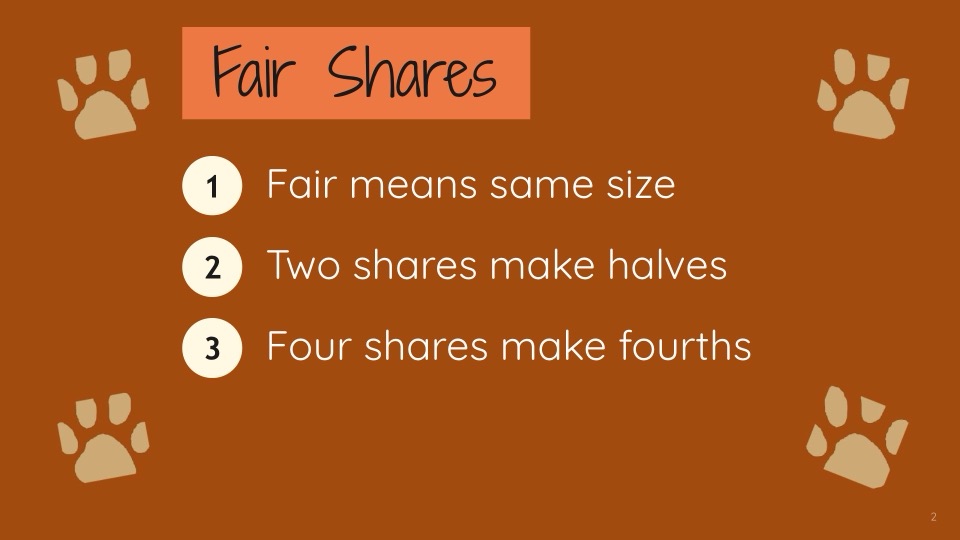
| 8 min | Starter | Hook students and review that fair shares must be the same size. Say the hook with energy: No computers, no screens — just our hands and paper. Who can make perfect fair shares? Show Slide 1: Halves and Fourths [title]: Two and four fair shares and Slide 2: Fair means same size. Hold up a circle cut into 2 unequal pieces and a circle folded into 2 same-size pieces for Fair or not fair? Show Slide 4 question: Fair or not fair? Why? and take 3-4 answers. |
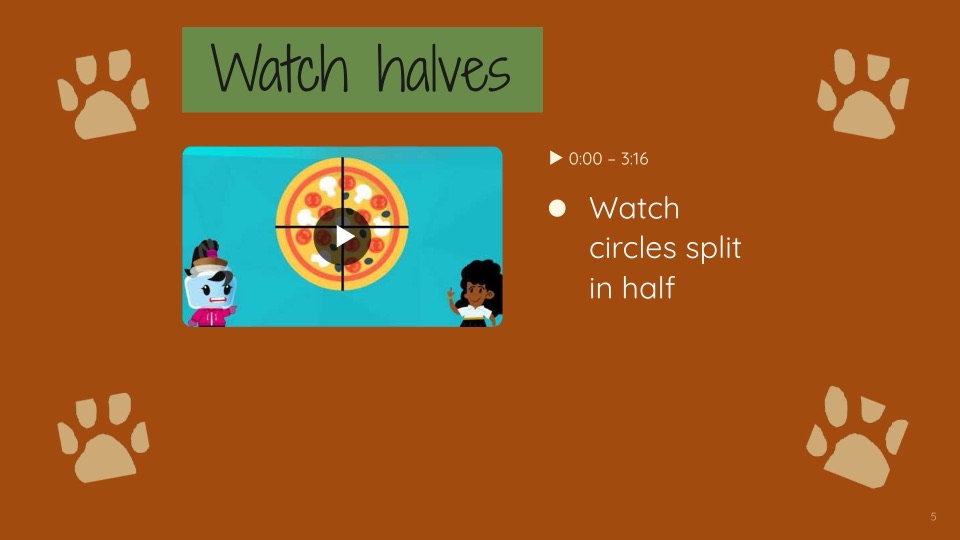
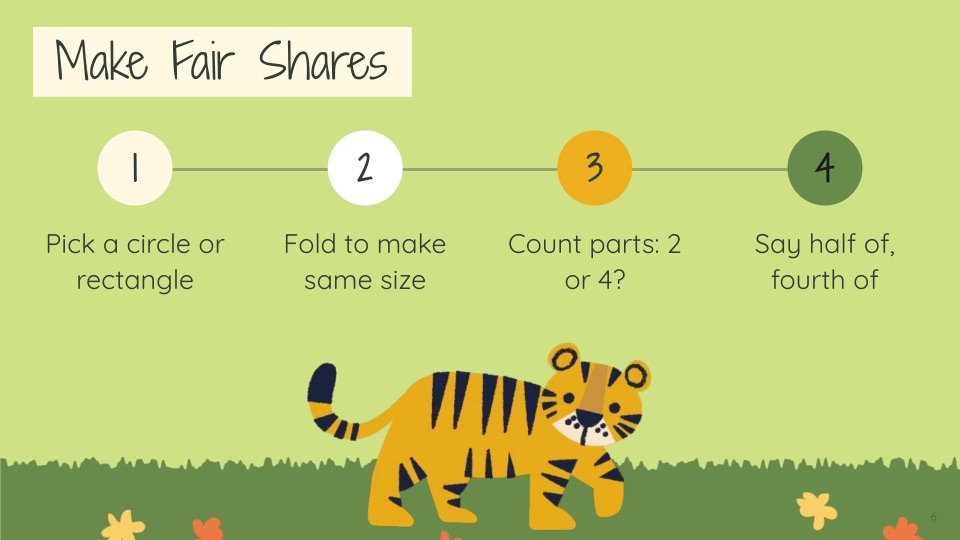
| 12 min | Teaching | Model how to fold and name two equal halves of circles and rectangles. Play Video clip 1 (0:00-3:16) on Slide 5: Watch circles split in half. Show Slide 6 steps: Pick a circle or rectangle, Fold to make same size, Count parts: 2 or 4? Model with a paper plate: fold edge to edge, press, open, trace fold, point and count 2 same-size parts. Model saying: This is half of the circle. The whole is two of the halves, since 2 halves make one whole. |
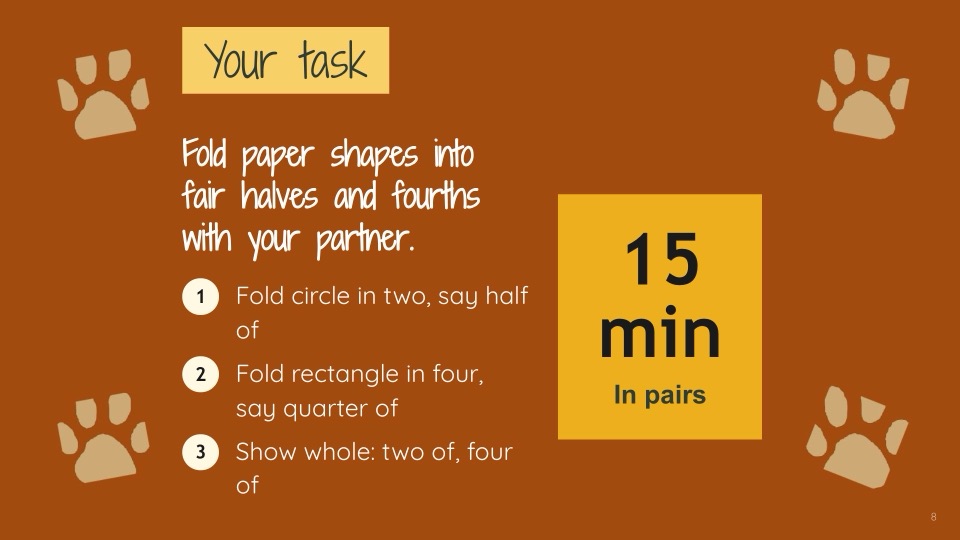
| 22 min | Main activity | Partition paper circles and rectangles into halves and fourths and name the shares. Show Slide 8 task and give out one paper plate, two index cards, and crayons. Model each fold slowly at the front and have students copy one fold at a time. Guide first fold into 2, then fold again to make 4 equal shares, since four equal shares are called fourths, also called quarters. Guide labeling and counting: half of on 2-part shapes and fourth of, quarter of on 4-part shapes, then count 2 halves make the whole, 4 fourths make the whole. |
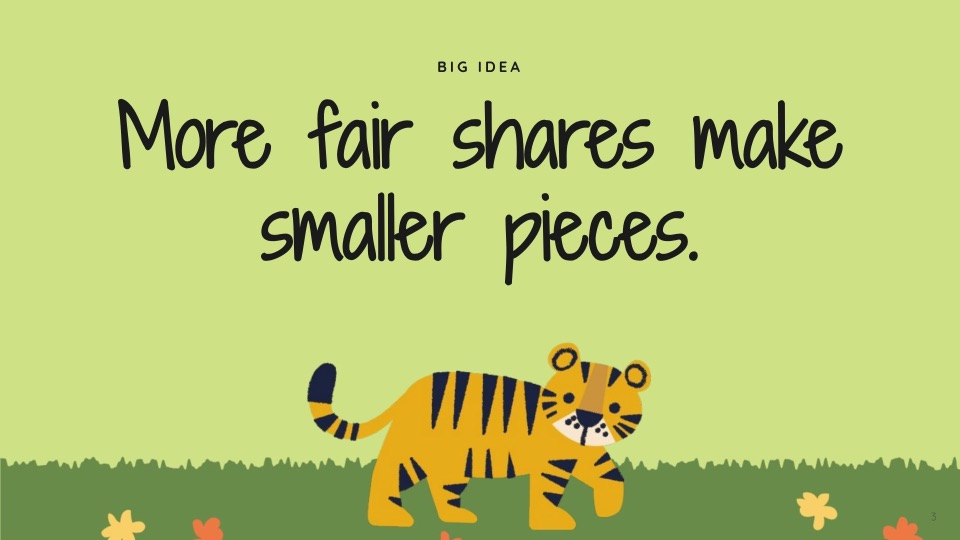
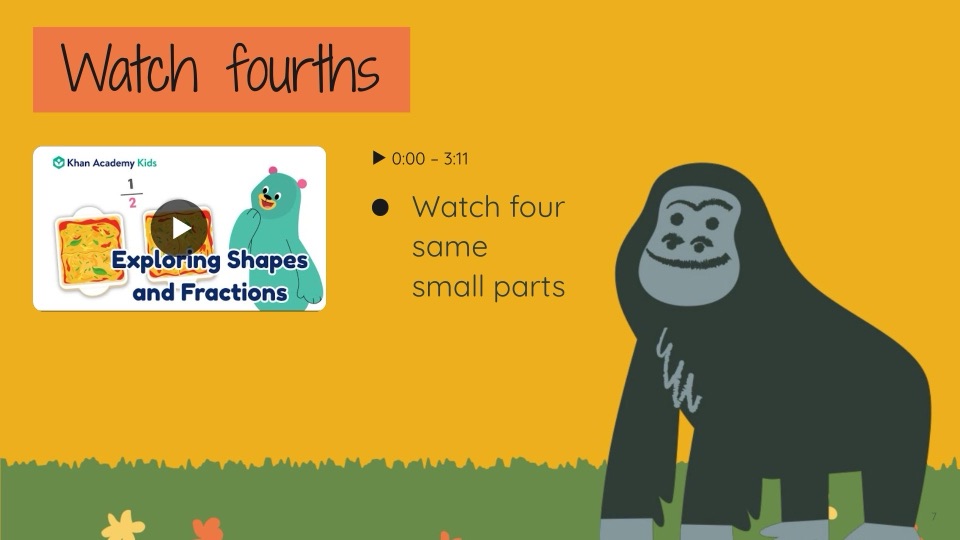
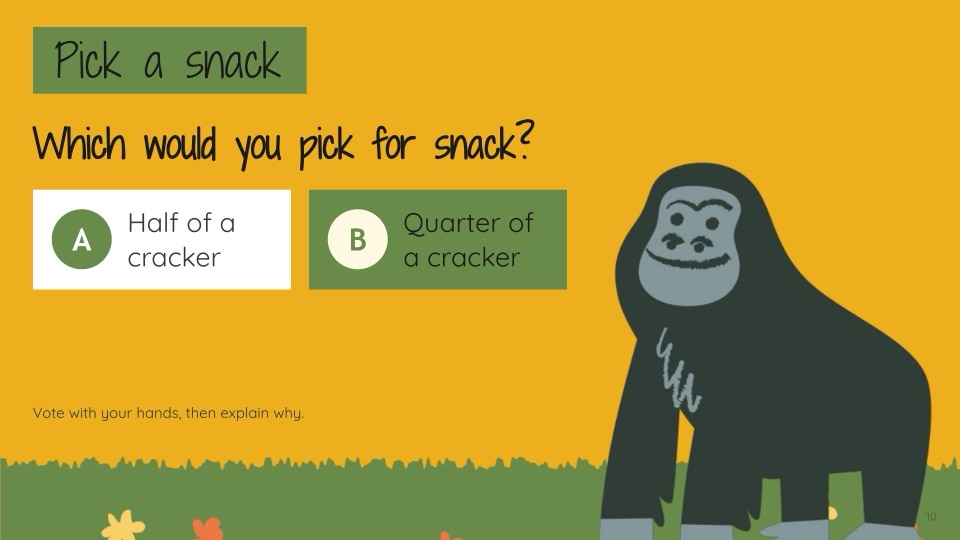
| 10 min | Compare | Show that more equal shares of the same whole makes smaller shares. Place two same-size paper circles side by side, one cut into 2 halves and one cut into 4 fourths. Play Video clip 2 (0:00-3:11) on Slide 7: Watch four same small parts, then show Slide 3: More fair shares make smaller pieces. Lay out pieces to show a fourth is smaller than a half, since the more equal shares you make, the smaller each share becomes. Show Slide 10 vote: Which would you pick for snack? Half of a cracker or Quarter of a cracker and take votes. |
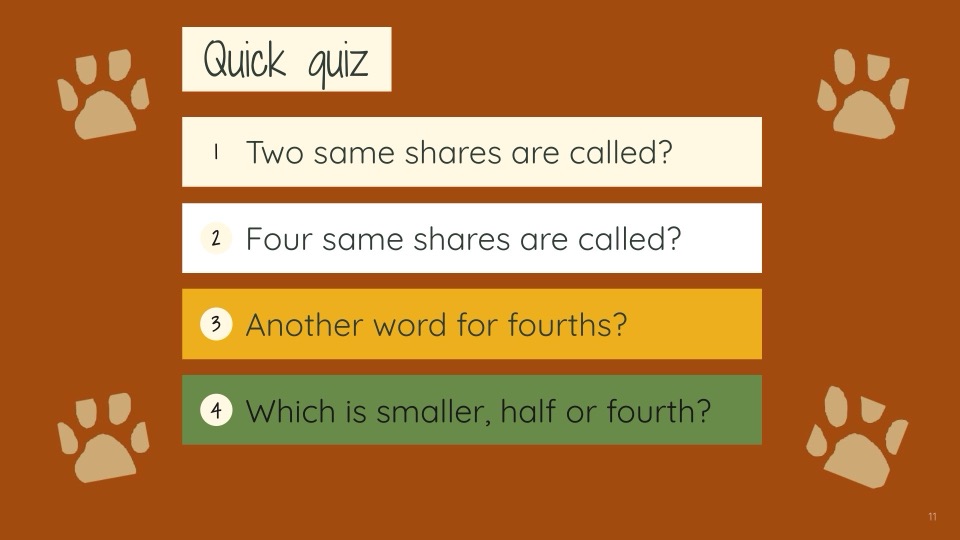
| 8 min | Plenary | Review key words and check halves, fourths, and whole. Show Slide 9 words: halves, fourths, quarters, whole and have class read and point to folded shapes. Show Slide 11 quiz and ask: Two same shares are called? Four same shares are called? Another word for fourths? Have students hold up circle and say: This is half of the whole. The whole is two of the halves. Have students hold up rectangle and say: This is a quarter of the whole. Four quarters make the whole. |
Common mistakes
- Calls unequal parts halves or fourths
How to spot it: Student names 2 or 4 pieces halves or fourths when pieces do not match
Overlay pieces and ask if every part is the same size, since equal shares must be the same size to be fair. Refold to match edges. - Thinks a fourth is bigger than a half of the same whole
How to spot it: Student picks quarter of a cracker as bigger than half
Place half and fourth from same-size wholes side by side and show the more equal shares you make, the smaller each share becomes. - Says the whole is one share instead of all shares
How to spot it: Student points to one half or one fourth and calls it the whole
Push 2 halves together and 4 fourths together to rebuild, counting 2 halves make the whole and 4 fourths make the whole.
Support
- Give shapes with lightly drawn fold lines and number parts 1-4 to color in order
- Model one fold at a time and let students check same size by stacking pieces
Stretch
- Fold same shape different ways to make halves and compare, and show half is bigger than fourth
- Explain how to fix not-fair shares and what more shares would do to size
Check questions
- A circle is split into 2 same-size shares. What is each share called?
Answer: A half; two halves make the whole. - A rectangle is split into 4 same-size shares. What is each share called? Give the other name.
Answer: A fourth; also called a quarter. Four fourths make the whole. - Which is smaller, half of a cracker or quarter of the same cracker? Why?
Answer: A quarter is smaller because more equal shares make smaller shares.
Curriculum
Partition circles and rectangles into two and four equal shares, describe the shares using the words halves, fourths, and quarters, and use the phrases half of, fourth of, and quarter of. Describe the whole as two of, or four of the shares. Understand for these examples that decomposing into more equal shares creates smaller shares.
Video clips
Clips on YouTube, from the start and end times we chose. Check each one before you show it.
-
1st grade halves and fourths from 0:00 to 3:16
Boddle Learning: Understanding Halves and Fourths - 1st Grade Math (1.GA.3)
Made exactly for 1st grade ages 6-7 and teaches partitioning circles and rectangles into halves and fourths with correct vocabulary.
-
shapes halves and fourths from 0:00 to 3:11
Khan Academy Kids: Fractions for Kids (Halves & Fourths) with Shapes | Khan Academy Kids
Khan Academy Kids uses slow friendly explanation and big shapes that fit ages 6-7 learning halves and fourths.
Worksheet
Sources
- Grade2 Math Equal Shares Halves Thirds Fourths utah effortlessmath.com
- Generation Z Wikipedia
- Nicolas Bourbaki Wikipedia
- Alan Garner Wikipedia
Picture credits
Made with Lesson Dino's AI on 17 October 2026. AI can make mistakes, so check facts against the sources before you teach.